
Data Room Checklist for a Seed Round
A seed data room needs about seven folders, and most of it can be ready before your first meeting. Here is the checklist, the folder order, and what to hold back.
 GraphicsGround teamInvestor decks, built with you, backed for the raise.
A data room is a shared folder of documents that lets an investor check what your pitch deck claims. For a seed round it needs about seven folders: the overview, financials, company and legal documents, cap table, team, customers and traction, and product and intellectual property. Build it before investors ask. A founder who sends a tidy data room the same day it is requested looks organized, and a founder who takes two weeks loses momentum.
This checklist covers what goes in each folder, what to share at each stage, and how to keep the data room and the deck telling the same story.
Key takeaways
- Prepare the data room before your first investor meeting, not after a term sheet.
- Share it in two stages: a light version early, the full version when an investor is serious.
- Every number in the deck must match the number in the data room.
- Number your folders so anyone can find a document in seconds.
What a seed investor is checking
At seed, diligence is lighter than at later rounds, but the questions are the same.
- Is the story true? Do the revenue, users and growth in the deck match the records?
- Who owns the company? Is the cap table clean, and are there promises of equity nobody mentioned?
- Does the company own what it sells? Did everyone who wrote code or designed the product assign their work to the company?
- Are there surprises? Debts, disputes, unusual contract terms.
The data room exists to answer those four questions quickly. Anything that does not help answer them can stay out.
The seven folders
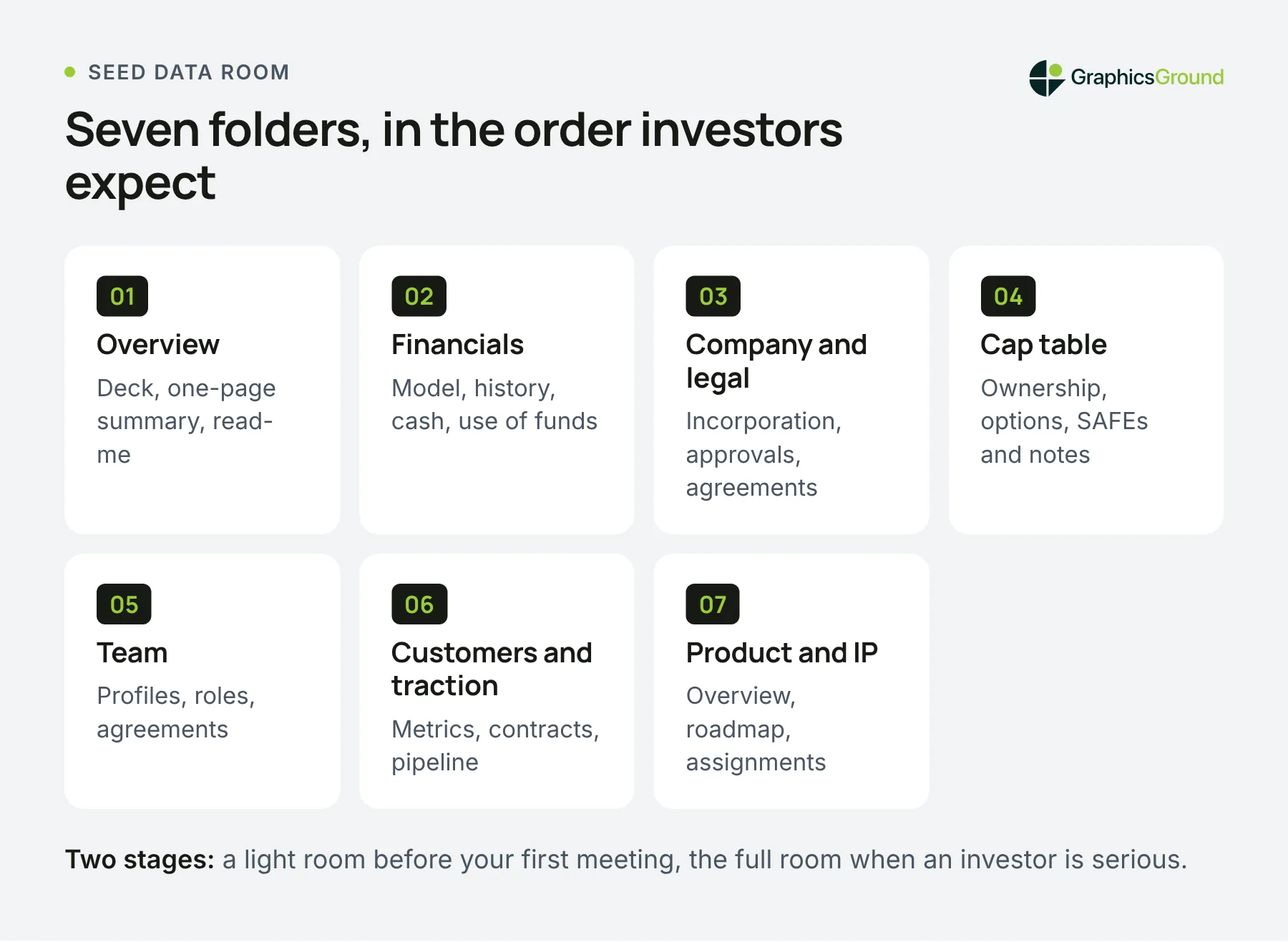
| Folder | What goes in it | Share when |
|---|---|---|
| 01 Overview | Pitch deck, one-page summary, a short note on what is in the room | From the start |
| 02 Financials | Financial model, historical profit and loss, current cash and monthly burn, use of funds | Summary early, model on request |
| 03 Company and legal | Incorporation documents, governing documents, board and shareholder approvals, any existing investment agreements | When an investor is serious |
| 04 Cap table | Current cap table, option pool, all SAFEs or convertible notes with their terms | Summary early, detail when serious |
| 05 Team | Founder profiles, team list with roles, employment and contractor agreements, key hires planned | Profiles early, agreements when serious |
| 06 Customers and traction | Metrics dashboard or export, customer list, key contracts, pipeline, references | Metrics early, contracts when serious |
| 07 Product and IP | Product overview or demo, roadmap, intellectual property assignments, patents or trademarks if any | Overview early, assignments when serious |
For a detailed legal view of what sits inside each folder, the law firm Lewis Silkin publishes a data room toolkit for startups. It is written for UK companies, but the structure applies widely.
Share it in two stages
You do not hand everything to everyone. A data room has two versions.
Stage one: the light room
Ready before your first meeting, shared with any investor who asks after a good conversation.
- The deck, in the version built to be read alone
- A one-page investment summary
- A summary financial model and use of funds
- A cap table summary: who owns roughly what, and what is outstanding
- Founder profiles
- A one-page metrics summary
Stage two: the full room
Opened when an investor signals real intent, usually around a term sheet.
- The full model with assumptions
- Legal documents and approvals
- The detailed cap table and every convertible instrument
- Employment, contractor and IP assignment agreements
- Customer contracts and detailed metrics
Check before you share contracts and personal data. Customer agreements often contain confidentiality clauses, and employee details are personal data. Anonymize what you can, and ask your lawyer what you are allowed to disclose and when.
Make the data room match the deck
This is the part we care most about, because it is where a good pitch is quietly lost. An investor reads “$46K monthly revenue” on your traction slide, opens the model, and finds $41K. Nothing dishonest happened. The deck was updated in October and the model in September. The investor does not know that, and now doubts every other number.
The fix is a short source list kept beside the deck: each number on a slide, where it comes from, and the date. Before you share the data room, check the list against the files.
- Every figure in the deck appears in the data room with the same value and the same date.
- The use of funds on the ask slide matches the model.
- The team slide matches the team list.
- Customer names and logos in the deck are ones you are permitted to show.
- The one-page summary uses the same sentence as the first slide.
If the deck changes during the raise, the data room changes the same day. We cover how and when to change a deck in pitch deck redesign: fix it or rebuild it.
How to organize and share it
- Use a tool you already have. A shared drive folder is enough for a seed round. Dedicated data room software helps when you want to see who opened what.
- Number folders and name files clearly. “02 Financials / 2026-10 Financial model.xlsx” is better than “model final v3”.
- Add a read-me. One page listing what is in the room and the date it was last updated.
- Share view-only. Give access per investor, so you can remove it later.
- Use PDFs for documents and a spreadsheet for the model. Investors will want to change assumptions.
- Keep one owner. One person on your team updates the room. Two people updating it creates two versions.
Six mistakes that slow a close
- Building it after the request. Missing documents take longest to find when you are busiest.
- Missing IP assignments. A contractor who built part of the product and never signed over the work is a common problem, and a fixable one if you find it early.
- An unclear cap table. Verbal promises of equity, or notes nobody has modeled.
- Old numbers. A model that stops three months ago.
- A dumping ground. Two hundred files with no structure is as bad as none.
- Different stories. The deck says one thing and the files say another.
The checklist
Seed data room checklist
- Pitch deck, reading version, dated
- One-page investment summary
- Financial model and use of funds
- Historical financials, current cash and burn
- Incorporation and governing documents
- Board and shareholder approvals
- Cap table, option pool, SAFEs and notes
- Founder profiles and team list
- Employment, contractor and IP assignment agreements
- Metrics summary and customer list
- Key customer contracts
- Product overview, demo link and roadmap
- Read-me with contents and last-updated date
Frequently asked questions
When do investors ask for a data room?
Usually after one or two good meetings, when they want to check the claims in the deck. Some ask earlier. Have the light version ready before you start outreach.
Do I need a data room for a pre-seed round?
A small one. The deck, a one-page summary, a simple model, the cap table and founder profiles are usually enough at pre-seed.
Should the pitch deck be in the data room?
Yes, in the first folder, in the version built to be read without you presenting. Investors forward data room links to partners who never saw the pitch.
What is the difference between a data room and a pitch deck?
The deck makes the argument. The data room is the evidence. The deck should be readable in a few minutes, and the data room is where someone goes to check it.
Is a shared drive secure enough?
For most seed rounds, yes, if you share view-only with named people and remove access when the round closes. Ask your lawyer if you hold sensitive data.
A data room checklist and a one-page investment summary are both included in Investor Deck + 90 Days of Raise Support. If you are earlier in the process, the free 30-Day Fundraising Checklist shows when to prepare each piece. We are designers, not lawyers, so have counsel review your legal documents before you share them.
What to prepare, send, and track in your first 30 days of raising. Free.
Investor Feedback on Your Pitch Deck: When to Change It
One investor’s comment is an opinion. The same comment from three is a pattern. Here is how to log investor feedback, read it, and decide what to change.
Read the article
Investor Ready Checklist: 30 Days Before You Raise
Being investor ready means you can answer “send me more” within the hour. Use this four-week checklist to prepare, target, send and track before you raise.
Read the article