
Pitch Deck Redesign: Fix It or Rebuild It?
A pitch deck redesign only works when the story underneath is sound. Here is how to tell whether your deck needs new slides, a new order, or a new story.
 GraphicsGround teamInvestor decks, built with you, backed for the raise.
A pitch deck redesign is the right fix when investors understand your business but the slides are slow or tiring to read. It is the wrong fix when they do not understand the business at all. In that case new design makes a confusing deck look polished, and a polished confusing deck still gets no reply.
So before you pay for a redesign, find out which problem you have. Every deck has three layers: the story, the structure and the surface. This guide shows how to test each one, and what to do with the answer.
Key takeaways
- Redesign fixes how a deck reads. It cannot fix what the deck says.
- Test three layers in order: story, structure, surface.
- If a stranger cannot explain your company after three minutes with the deck, rebuild the story first.
- Change the deck when feedback repeats, not after one opinion.
The three layers of a pitch deck
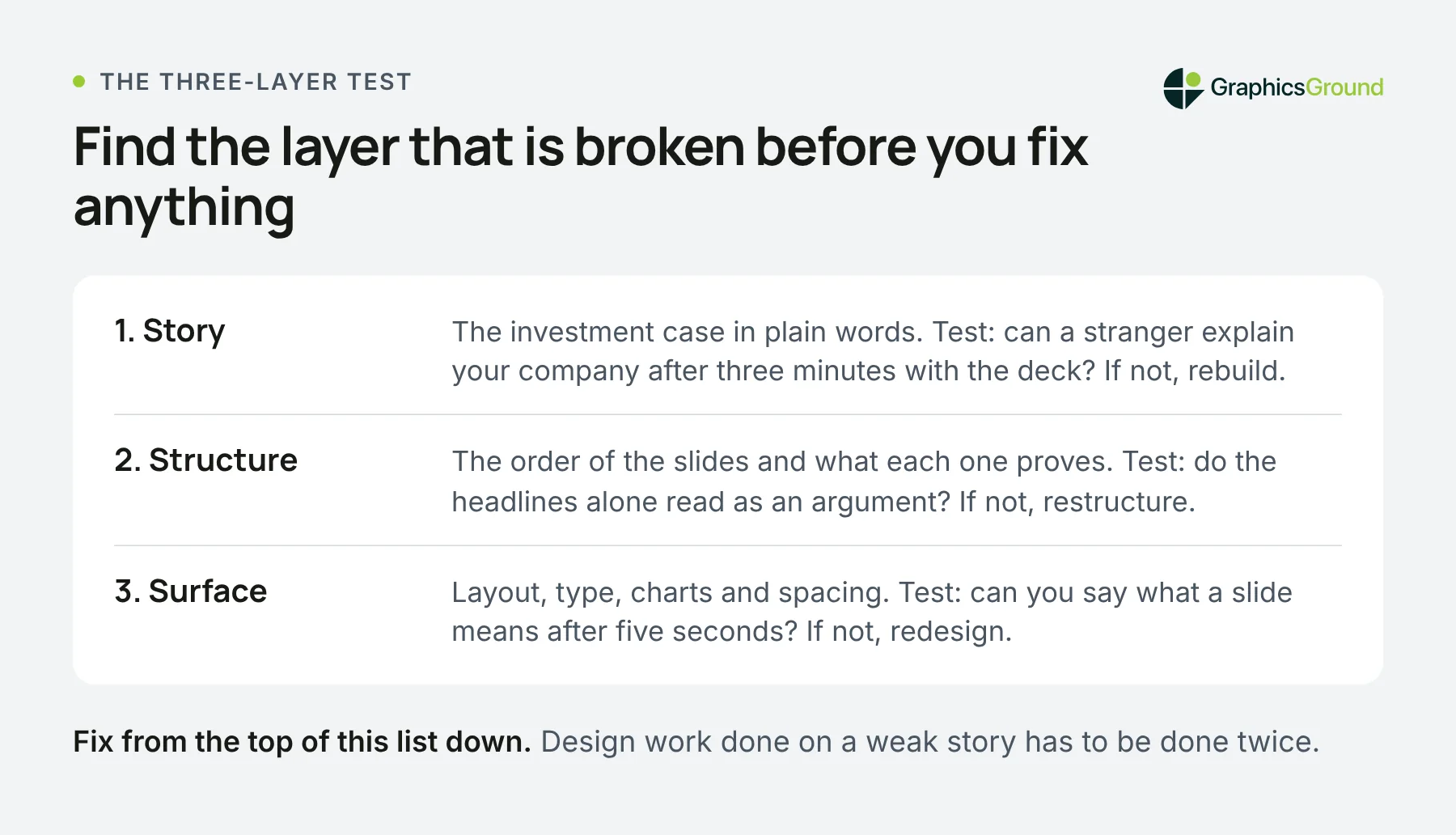
- Story. The investment case in plain words. What you do, who has the problem, why now, why you, what the money achieves.
- Structure. The order of the slides and what each one has to prove.
- Surface. Layout, type, charts, color, spacing. What most people mean when they say “design”.
A redesign works on the surface. A restructure moves and rewrites slides. A rebuild starts again from the story. The cost of getting this wrong is real: we often see founders pay for a visual redesign, send the new deck to the same kind of investors, and get the same silence.
Step 1: Test the story with a cold read
We run this test on every deck before we touch a slide. It takes ten minutes.
- Send the deck to someone smart who does not know your company. Not a co-founder, not an advisor.
- Give them three minutes with it. No call, no explanation.
- Ask them to tell you, from memory: what the company does, who it is for, what proof they saw, and what you are asking for.
Three minutes is not an arbitrary number. A DocSend study of real fundraising decks, reported by TechCrunch, found investors spent an average of 3 minutes 44 seconds on a deck. Your reader has about that long, alone, with no one to answer questions.
If they get all four right: the story holds. Go to step 2.
If they get the company wrong or cannot name the ask: stop. No redesign will help yet. You need to rebuild the story.
Step 2: Test the structure with the headlines
Copy every slide headline into a blank document, in order. Read only that list.
A deck with sound structure reads like a short argument. Something like this:
- Restaurant managers lose six hours a week covering no-show shifts.
- We fill those shifts in under two hours.
- 120 restaurants pay us every month, and 9 in 10 renew.
A deck with weak structure reads like a table of contents: Problem. Solution. Traction. Market. Team. Those are labels. They tell the reader what kind of slide this is, not what it proves.
If the list reads as an argument: the structure is fine. Go to step 3.
If it reads as labels, or the order jumps around: you need a restructure. Reorder the slides and rewrite each headline as the point of the slide. The 10 slides every seed deck needs is a good order to start from.
Step 3: Test the surface with a five-second look
Open each slide for five seconds, then look away. Can you say what the slide was telling you?
If not, look for the usual causes:
- Too much on one slide. Three ideas competing for attention.
- The key number is small. Your best figure sits in a chart legend or a footnote.
- Charts that need study. Five colors, tiny labels, no stated takeaway.
- No hierarchy. Everything is the same size, so nothing is first.
- Inconsistent slides. Different fonts, margins and colors from page to page, which reads as a rushed company.
If the story and structure passed and the slides fail here, a redesign is exactly what you need.
Redesign, restructure or rebuild: which one do you need?
| What you are seeing | Layer | What to do |
|---|---|---|
| Investors reply “what exactly do you do?” | Story | Rebuild |
| Meetings go well, but the deck sent alone gets no reply | Story or structure | Rebuild or restructure |
| You have to explain several slides on every call | Structure | Restructure |
| The same question comes up from different investors | Structure | Add or fix the slide that should answer it |
| People understand it but say it feels dense or dated | Surface | Redesign |
| The business changed: new model, new market, new round | Story | Rebuild |
| Slides were added by several people over a year | Surface and structure | Restructure, then redesign |
What a redesign looks like when the story is right
Here is one slide from a fund deck we worked on for 196 Ventures. The information was correct in the original. The reader had to work to find the point.


On that project we did not start with the slides. We rebuilt the narrative first, around the market opportunity, the fund’s strategy, the evidence and the ask. Then we redesigned every slide. Narrative and design took 10 days, and 196 Ventures went on to reach its $50M fund target. The full case is in our 196 Ventures case study.
That order is how we work on every deck. In our process the founder approves the story before a single slide is designed, because a change to the story after design means redoing the design.
When not to change your deck at all
Founders often redesign for the wrong reason: one investor said something sharp, and the deck gets torn up that night.
Our rule is simple. One investor’s opinion should not change your deck. Repeated feedback should. If three investors stumble at the same slide, that slide has a problem. If one investor dislikes your market slide and five others move straight past it, the deck is fine and that investor was not a fit.
Keep a short log during your raise: who you sent the deck to, what they asked, where they stopped. After ten conversations the pattern is usually obvious. We cover how to read that pattern in what investor feedback really means.
Frequently asked questions
How long does a pitch deck redesign take?
A surface redesign of a sound deck takes a few working days. When the story has to be rebuilt first, plan for about 10 days: three for the story, the rest for design. That is the schedule we work to.
How much does a pitch deck redesign cost?
It depends on who does it and which layers they touch. A freelancer who restyles slides costs less than a studio that rebuilds the story. Our own price is fixed at $1,450 for the story, the hand-designed deck and 90 days of raise support. See what a pitch deck costs in 2026 for the full range.
Can I redesign my deck with a template or an AI tool?
For the surface, partly. A good template gives you consistent type and spacing. Neither a template nor a tool knows which of your numbers matters most or what an investor will doubt. Those are story decisions, and they are where decks win or lose.
Should I redesign in the middle of a raise?
Yes, if the feedback is repeating. Fix the slide that keeps causing the question and keep sending. Do not pause the raise for a full redesign unless the cold read test fails.
Not sure which layer is the problem? Send us your deck. We will read it cold and tell you what an investor will question first. If we work together, the story, the deck and 90 days of support are one fixed price.
What to prepare, send, and track in your first 30 days of raising. Free.

Series A Pitch Deck: What Changes From Your Seed Deck
A Series A pitch deck proves a business is working, where a seed deck proved it could. Here are the six slides that change, the metrics to show, and the order.
Read the article
Pre-Seed Pitch Deck: What Investors Look For
A pre-seed pitch deck has to earn belief before there is revenue. Here are the 12 sections, where investors spend their time, and what counts as proof this early.
Read the article