
Investor Feedback on Your Pitch Deck: When to Change It
One investor’s comment is an opinion. The same comment from three is a pattern. Here is how to log investor feedback, read it, and decide what to change.
 GraphicsGround teamInvestor decks, built with you, backed for the raise.
Change your pitch deck when the same investor feedback comes up three times, and leave it alone when it comes up once. One investor’s comment is an opinion, shaped by their fund, their last deal and their mood that day. The same comment from three investors is a pattern, and a pattern points to a slide that is not doing its job. The work is telling the two apart, which means writing feedback down instead of reacting to it.
Founders usually get this wrong in one of two directions. Some rewrite the deck after every meeting and end up with a version no clearer than the first. Others defend the deck against everything and hear the same objection for three months. This guide gives you a method that avoids both.
Key takeaways
- Log every question and objection the same day, in the investor’s own words.
- Group feedback by theme and count it. Change the deck for patterns of three.
- What investors say is often a polite cover for what they mean. Learn the translations.
- Before you change a slide, check whether the problem is the deck at all.
Step 1: Write it down the same day
Memory edits feedback. By the weekend you will remember the harshest comment and forget the quiet question that three people asked. So log it within hours of each conversation.
For each investor, record:
- What they asked, in their words, not your summary
- Where they slowed down or went back in the deck
- What they pushed back on
- What they said at the end, including the reason for a pass if they gave one
- Which version of the deck they saw
If an investor passes without a reason, ask for one line. Many will give it, and that line is the most useful data you collect in a raise.
Step 2: Group it by theme and count
After eight or ten conversations, sort every comment into one of five themes.
| Theme | Sounds like | Slide it points to |
|---|---|---|
| Market | “How big can this get?” | Market size, or the one-line description |
| Traction | “It feels early.” “What does retention look like?” | Traction |
| Team | “Who is doing sales?” “Have you done this before?” | Team |
| Business model | “How do you make money?” “What are the margins?” | Business model, pricing |
| Terms | “What is the valuation?” “Who else is in?” | The ask, or nothing in the deck |
Then count how often each theme appears. The count is the point. A theme with one mark is noise. A theme with five is telling you something.
Step 3: Apply the rule of three
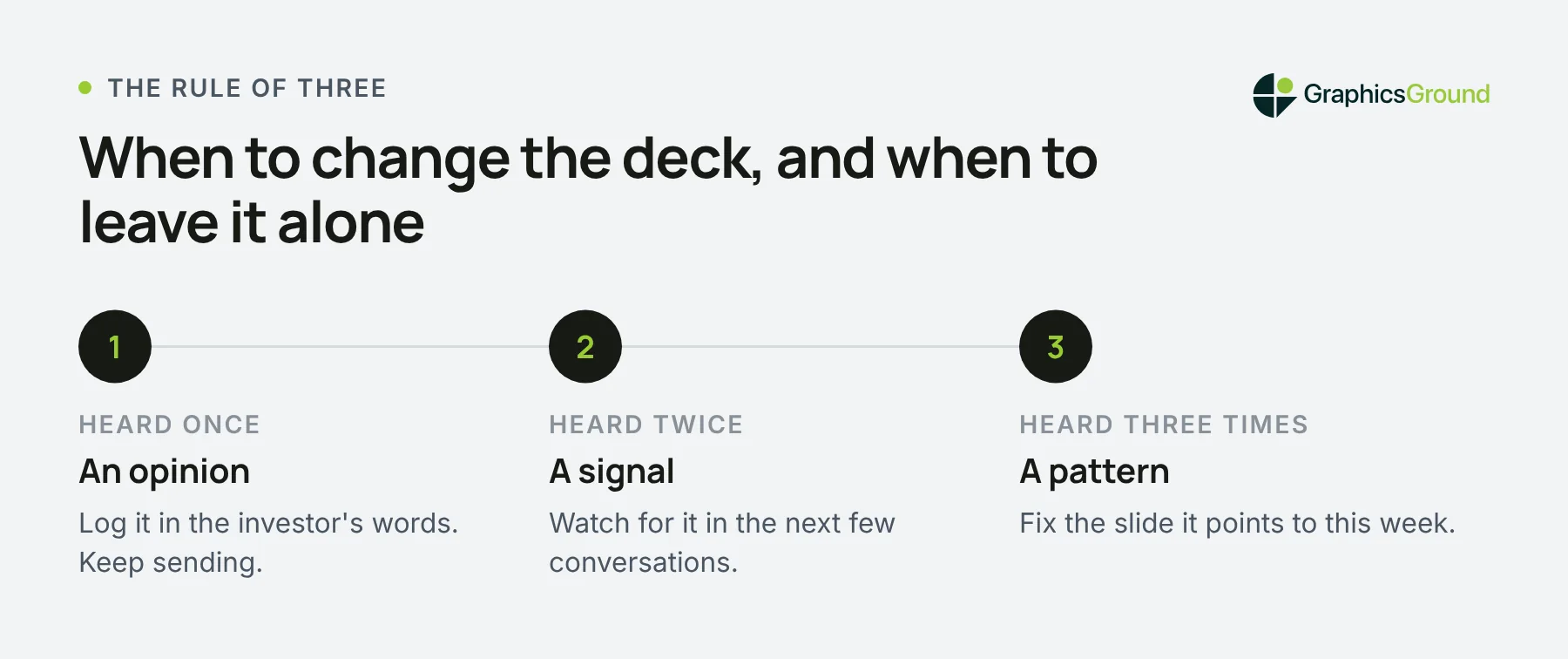
- Once: an opinion. Log it and keep sending.
- Twice: a signal. Watch for it in the next few conversations.
- Three times: a pattern. Fix the slide it points to this week.
This is the rule we use in the weekly calls of our raise support, and it is the reason the offer includes three revision rounds after delivery instead of unlimited edits before it. A deck improves fastest when it changes in response to real investors, a few times, for clear reasons.
Buffer’s founders described the rule in action in their account of their seed round. Investors liked the traction, and conversations kept stalling on competition. That repeated objection was the pattern, so they reworked the competition slide.
What investors say, and what it usually means
Investors are polite, and a direct no is rare. In a TechCrunch report on why VCs go quiet, investors admitted that writing a rejection often gets pushed down the list. So you have to read the soft versions.
| What they say | What it usually means | What to do |
|---|---|---|
| “It is too early for us.” | The proof is not strong enough yet, or not visible enough | Ask what milestone would change that. Check your traction slide. |
| “The market feels small.” | They cannot see the path from your first customers to a large company | Rebuild the market slide from customers and price |
| “I do not quite get it.” | The first slides did not explain what you do | Rewrite the one-line description and run a cold read |
| “How is this different from X?” | The competition slide is not answering the question | Show the difference in one glance |
| “Keep me posted.” | Not now | Add them to your monthly update |
| “Interesting.” | Nothing yet | Follow up with news, then move on |
| “Who else is investing?” | Interest, looking for a signal | Answer honestly, including when nobody has committed |
Step 4: Check whether the deck is the problem at all
Feedback about the deck is not always caused by the deck. Before changing slides, look at where the raise is actually getting stuck.
| What you see | What it usually means | What to do |
|---|---|---|
| Few replies | The problem comes before the deck: the list or the message | Check your list’s fit and rewrite your first two lines |
| Replies, but few meetings after they see the deck | The deck is not making the case on its own | Run the cold read test and fix where the reader gets lost |
| First meetings, but few second meetings | The story works on paper and loses people in the room | Look at the questions you logged. The most common one needs an answer in the deck. |
| The same objection three times | A pattern | Fix that slide this week |
| A different objection every time | No pattern yet | Leave the deck alone. Keep sending and logging. |
| Interest, but no decision | Nothing is making them move | Share real progress and set a real closing date |
If the first row describes you, see how to build an investor list and how to write a cold email to investors. If it is the second, see why investors are not responding to your pitch deck.
Step 5: Make the change, and track the version
When a pattern is clear, fix the slide it points to and only that slide.
- Name the question the slide failed to answer. “How is this different from X?”
- Rewrite the headline so it answers that question. The headline carries the point.
- Add the one piece of proof that supports it. A number, a comparison, a customer.
- Remove what distracted from it.
- Give the deck a new version number and note in your tracker which version each investor has seen.
If several patterns point at different slides, the problem may be the structure and not the individual slides. See pitch deck redesign: fix it or rebuild it.
Do not send the new version to investors who already passed. Use what you learned on the investors you have not contacted yet. That is why your best-fit names go out after the pitch has had practice.
Feedback you should not act on
- Style preferences. One investor likes more slides, another likes fewer. Neither is a pattern.
- Advice to become a different company. “Have you thought about going enterprise?” is a conversation, not a deck edit.
- Feedback from the wrong investors. A late-stage investor telling a pre-seed founder to show more revenue is describing their own fund.
- A request to remove a risk. In the same TechCrunch report, investors named founders who claim no competitors or no risks as a red flag. Keep the honest slide.
Frequently asked questions
Should I change my pitch deck after every investor meeting?
No. Log what you heard and keep sending. Change the deck when the same point has come up three times.
How do I ask an investor for feedback after a pass?
Keep it to one line: “Thank you for telling me directly. Could you share the main reason, in a sentence? It would help us.” Do not argue with the answer.
What if investors give me contradictory feedback?
That is normal, and it means there is no pattern yet. Contradictory feedback is a reason to leave the deck alone and collect more data.
How many conversations do I need before I can see a pattern?
Usually eight to ten. Fewer than that and one strong personality can look like a trend.
Is “too early” feedback about the deck or the company?
It can be either. If your traction is real and investors still say it, the deck is hiding it. If the traction is thin, no slide will fix that. Ask which milestone would change their mind.
Feedback pointing in ten directions? Weekly reviews and deck revisions are what our 90 days of raise support are for. Or start with the free 30-Day Fundraising Checklist.
What to prepare, send, and track in your first 30 days of raising. Free.
Investor Ready Checklist: 30 Days Before You Raise
Being investor ready means you can answer “send me more” within the hour. Use this four-week checklist to prepare, target, send and track before you raise.
Read the article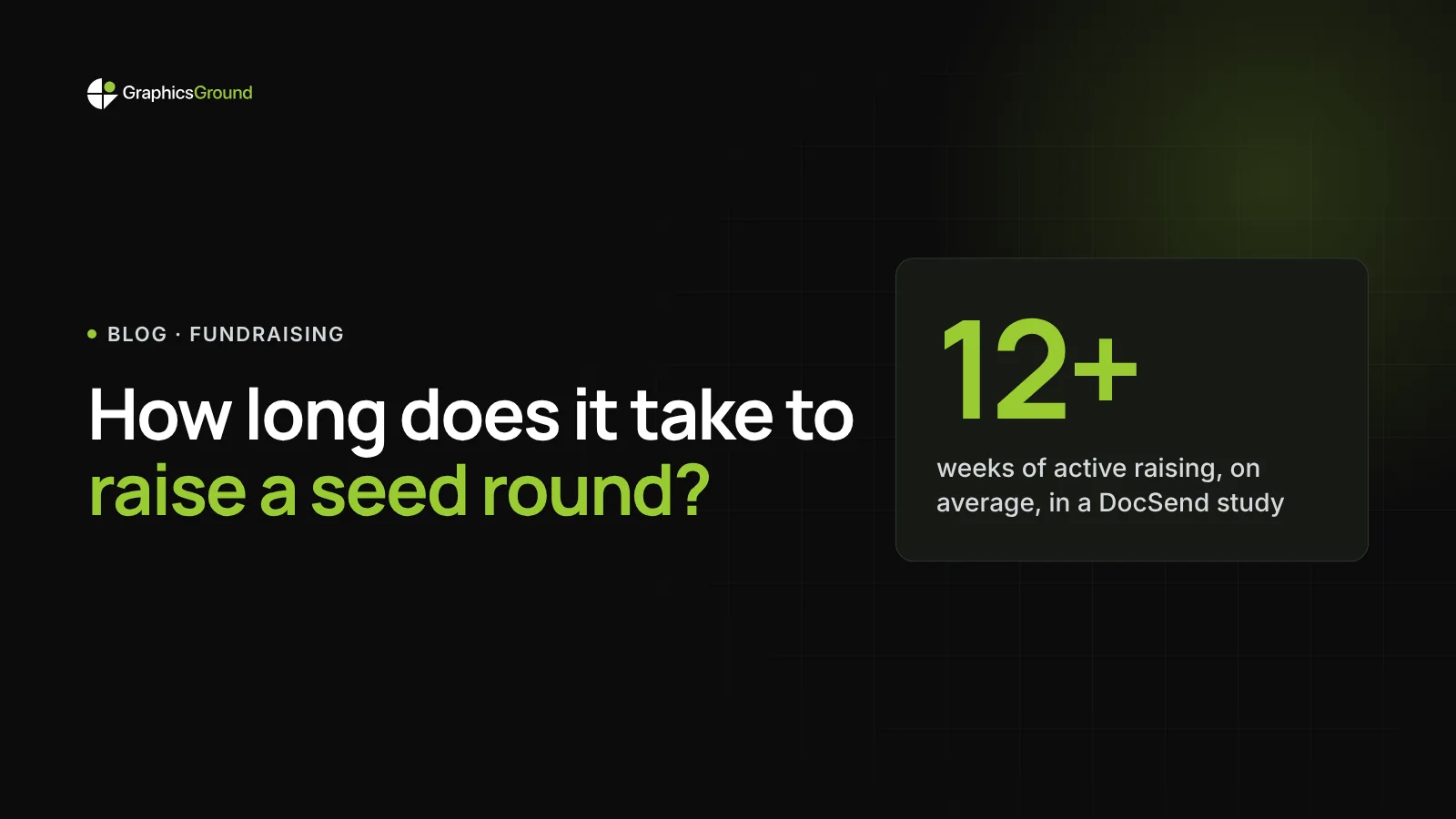
How Long Does It Take to Raise a Seed Round?
Plan for about three months of active fundraising for a seed round, plus preparation before and legal work after. Here is the timeline, week by week.
Read the article