
LP Pitch Deck: What a First-Time Fund Manager Must Show
An LP pitch deck sells your judgment, not a product. Here is the slide order LPs expect from a first fund, and how to show a track record without one.
 GraphicsGround teamInvestor decks, built with you, backed for the raise.
An LP pitch deck is the deck a fund manager uses to raise money from limited partners. For a first fund, it has to answer one question above all others: why should anyone trust your judgment with their capital for the next ten years? LPs expect about 10 to 12 slides covering the thesis, the team, the track record, how the portfolio will be built, and the terms.
A founder sells a company. A fund manager sells a strategy and the people running it. That one difference changes what goes on almost every slide. This guide shows the structure, then the part first-time managers find hardest: the track record slide when there is no previous fund.
Key takeaways
- An LP deck sells judgment and process. Lead with the thesis and the team.
- No prior fund does not mean no track record. Show the deals and decisions you can prove.
- Portfolio construction is the slide that separates serious managers from hopeful ones.
- Every claim needs a name, a number or a date behind it.
How an LP deck differs from a startup pitch deck
If you have built or reviewed startup decks, most of your instincts need adjusting.
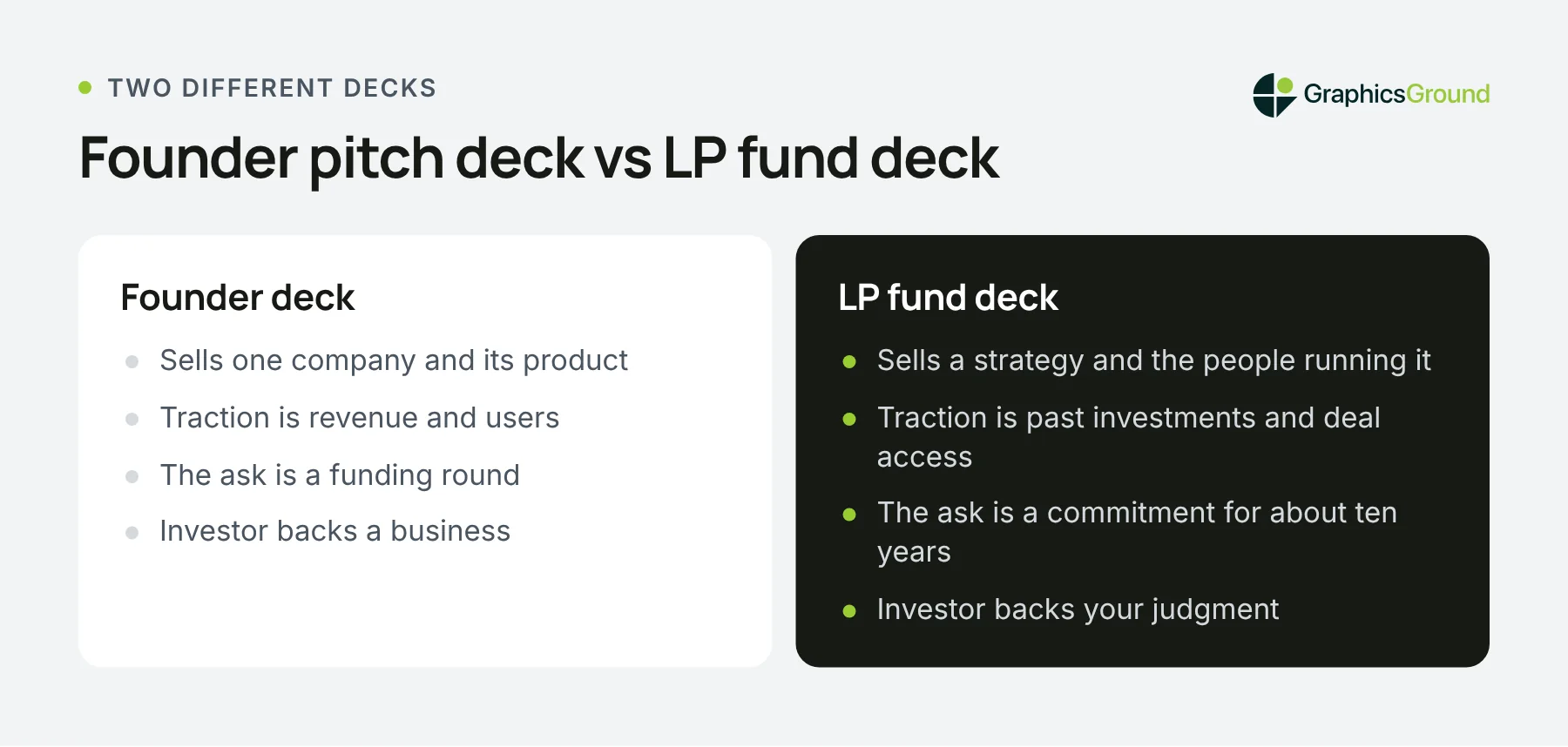
- What you sell. A founder sells one product. You sell a repeatable way of finding and choosing investments.
- What counts as traction. Revenue for a startup. For you, past investments, access to deals, and the quality of people who will vouch for you.
- The time frame. A venture fund usually runs about ten years. LPs read the deck as the start of a long relationship, so tone matters as much as numbers.
- The diligence. LPs check references and read the legal documents. Anything in the deck you cannot back up will surface later.
The 10 slides LPs expect in a first fund deck
This is the order we use. It follows the questions an LP asks, in the order they ask them.
| Slide | The LP’s question | What to show |
|---|---|---|
| 1. Fund overview | What is this? | Fund name, target size, stage, sector, geography, check size, number of investments |
| 2. Thesis | Why does this strategy make money? | The gap you invest in and why it exists now, in two sentences |
| 3. Team | Why you? | Each partner’s specific experience and what they bring to deals |
| 4. Track record | Have you done this before? | Named investments with dates, check sizes and current value |
| 5. Sourcing edge | How do you see deals others miss? | Where your deals come from, with real examples |
| 6. Process | How do you decide? | How you evaluate, who decides, how you support companies after |
| 7. Portfolio construction | Does the math work? | Number of companies, initial checks, reserves, target ownership |
| 8. Pipeline | Is this real today? | Companies you are talking to now, or have already backed |
| 9. Terms | What am I signing up for? | Fees, carry, GP commitment, fund life, minimum, closing dates |
| 10. Next steps | What happens now? | Timeline to first close and what you will send next |
Keep the main deck to these 10 to 12 slides. Detailed case studies, the full investment list and biographies go in an appendix or the data room.
If you are still setting up the fund itself, Carta’s playbook on raising and forming a fund covers the structure and the closing process.
How to show a track record when this is your first fund
This is where most first-time managers go vague, and where LPs look hardest. You do not have a fund track record. You do have evidence of judgment. Put it in a table, with names.
- Angel investments. Company, date, check size, the round you joined, where it stands today.
- Deals from a previous firm. State your exact role. “Sourced and led” and “sat on the deal team” are not the same claim, and LPs will call to check.
- Operating experience. A company you built, scaled or sold, if it relates to what you will invest in.
- Founders and co-investors who will vouch for you. Name them, with permission.
- Deal flow. The companies you saw over the last 12 months and how they reached you.
Two rules keep this slide credible. First, show the misses as well as the wins. A table with only winners looks edited. Second, separate realized results from paper value, and label both.
Avoid unsupported volume claims. “We have reviewed hundreds of deals” means nothing without a list. One named investment with a date and a result is worth more than any adjective.
Portfolio construction: the slide that shows you have done the math
A thesis says what you believe. Portfolio construction says how the money is actually used. LPs use this slide to judge whether you understand fund economics.
Lay it out as simple arithmetic the reader can follow:
- Total fund size, minus fees and expenses over the fund’s life, equals the capital you can invest.
- How much of that goes into first checks, and how much is reserved for follow-on rounds.
- Number of companies and the average first check.
- The ownership you target at entry.
- What has to happen for the fund to return the multiple you are targeting.
When we design this slide, we draw it as one flow from left to right, fund size to outcome, with a single number at each step. A reader should be able to check your arithmetic in their head. If it takes a spreadsheet to follow, simplify the slide and keep the spreadsheet for the data room.
What we learned designing a $50M fund deck
We worked with 196 Ventures on their fund deck. They came in with deep market knowledge, a defined investment approach and a large amount of data. The information was right. The investment story was hard to follow in one read.
We did three things:
- Rebuilt the order. Market opportunity, then the fund’s strategy, then the evidence, then the ask.
- Rewrote every headline as a claim. A headline that states the point lets an LP skim the deck and still get the argument.
- Made the data readable at a glance. One message per chart, the key figure set large, supporting detail kept small.
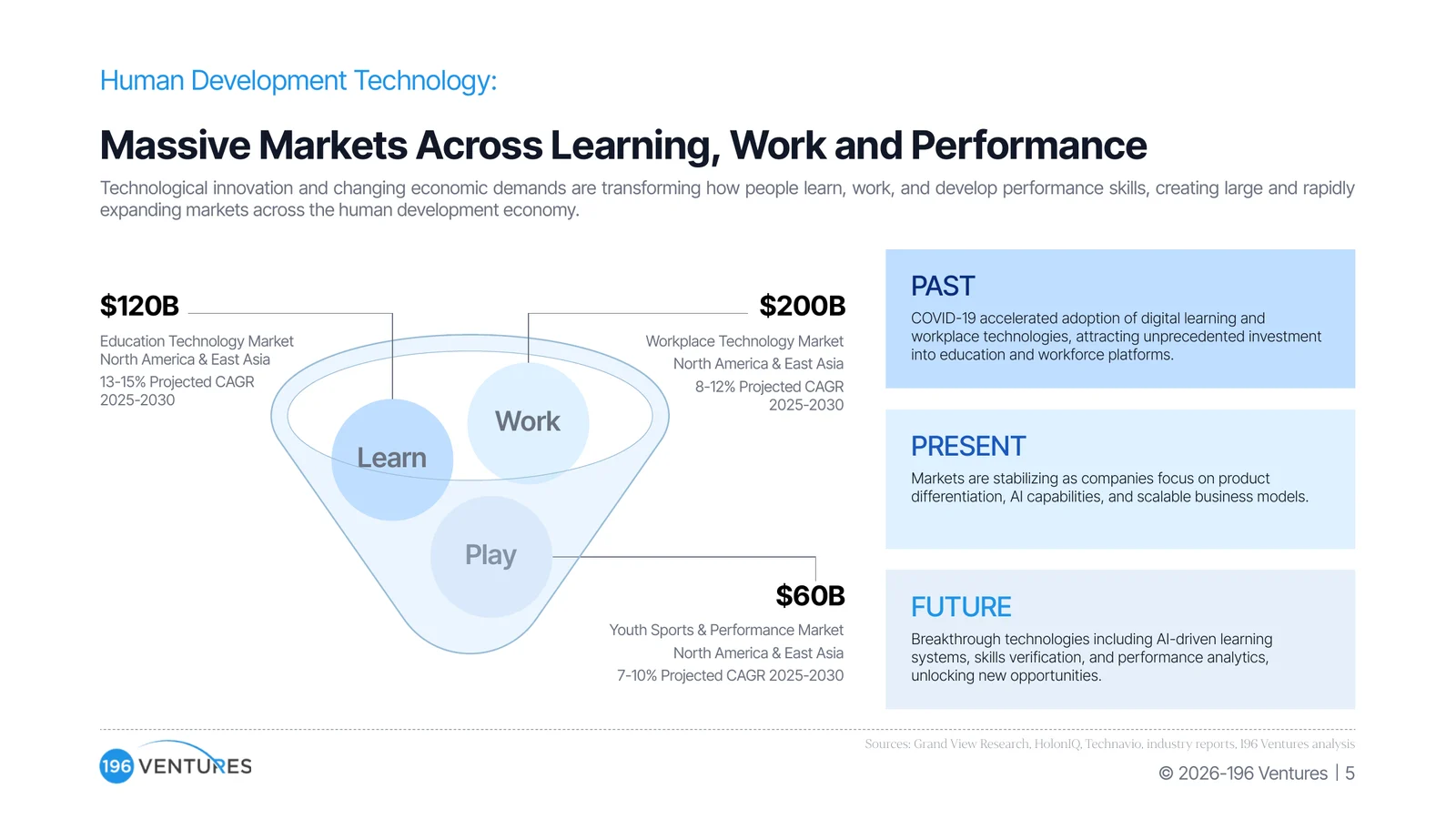
196 Ventures went on to reach its $50M fund target.
“They organized extensive data, refined the narrative, and brought it together.”
Liam Pisano, Managing Partner, 196 Ventures
The lesson for a first-time manager is that most LP decks do not fail on content. They fail because the reader has to work to find the argument. You can see more of the deck in the 196 Ventures case study.
Six mistakes that weaken a first fund deck
- A thesis anyone could claim. “We back exceptional founders early” describes every fund. Name the sector, the stage and the reason you see it first.
- Team slide as a list of logos. Logos say where you worked. LPs want to know what you did there.
- Target returns with no path. A 3x net target needs the portfolio math that gets there.
- Terms left out. If fees, carry and your own commitment are missing, the LP assumes there is something to hide.
- One deck for every LP. A family office and an institution ask different questions. Keep one master deck and adjust the emphasis.
- Design that looks like a startup deck. Bright, loud slides suit a consumer app. A fund deck should feel calm, exact and easy to check.
Check the rules before you send it
Fund interests are securities, and how you may share a deck depends on the exemption you raise under. In the United States, the SEC notes that offerings under Rule 506(b) cannot use general solicitation or advertising. That affects whether you can post the deck publicly or send it to people you do not already know.
We design decks. We do not give legal advice. Ask your fund counsel to review the deck, the disclaimers and how you plan to distribute it.
Frequently asked questions
How long should an LP pitch deck be?
Ten to twelve slides for the main deck, plus an appendix. LPs who are interested will ask for the data room, so the deck only has to earn the next conversation.
Do I need a deck if I already know the LPs?
Yes. People who know you still have to explain the fund to a spouse, a partner or an investment committee. The deck is what they forward.
What is the difference between an LP deck and a private placement memorandum?
The deck is a short marketing document that explains the strategy. The memorandum and fund agreement are legal documents prepared by counsel that set out the terms and risks in full. You need both.
Is a real estate fund deck built the same way?
The logic is the same, the slides differ. See what investors expect in a real estate fund pitch deck.
Building the deck for your first fund? Our Investor Deck + Raise Support offer covers the story, the design and 90 days of support, and it is open to first-time fund managers. Or send us your current deck and we will tell you what an LP will question first.
What to prepare, send, and track in your first 30 days of raising. Free.
Series A Pitch Deck: What Changes From Your Seed Deck
A Series A pitch deck proves a business is working, where a seed deck proved it could. Here are the six slides that change, the metrics to show, and the order.
Read the article
Pre-Seed Pitch Deck: What Investors Look For
A pre-seed pitch deck has to earn belief before there is revenue. Here are the 12 sections, where investors spend their time, and what counts as proof this early.
Read the article