
Real Estate Fund Pitch Deck: What Investors Expect
A real estate fund pitch deck sells the sponsor before the property. Here are the slides investors expect, the numbers to show, and the mistakes to cut.
 GraphicsGround teamInvestor decks, built with you, backed for the raise.
A real estate fund pitch deck has one job: convince an investor to trust you with capital before they know which properties you will buy. That is why it leads with the sponsor, the track record and the strategy, and only then shows example deals. A single-property deck works the other way round. It leads with the asset.
Most of the weak fund decks we see are deal decks with the word “fund” on the cover. This guide covers the slides investors expect, the numbers to put on them, and what we change when we design one.
Key takeaways
- A fund deck sells the sponsor and the strategy. A deal deck sells one asset.
- Investors look for track record, strategy, returns and terms, in that order.
- Plan for 15 to 20 slides, with one clear number on each returns slide.
- The deck starts the conversation. The offering documents close it.
Fund deck or deal deck: which one are you building?
Before any design work, we ask one question: is the investor backing a property or backing you? The answer changes the order of every slide.
| Single-deal deck | Fund deck | |
|---|---|---|
| Opens with | The property and the business plan | The sponsor, track record and strategy |
| Investor is asking | “Is this deal good?” | “Can this team repeat good deals?” |
| Proof | Comps, rent roll, underwriting | Past deals with realized returns |
| Deals shown | One, in full | Two or three, as examples of the strategy |
| Typical length | 12 to 15 slides | 15 to 20 slides |
If you are raising for one building, use the deal structure. If you are raising a pool of capital to place across several assets, read on.
The 12 slides a real estate fund deck needs
Every slide answers one question an investor is already asking. This is the order we use.
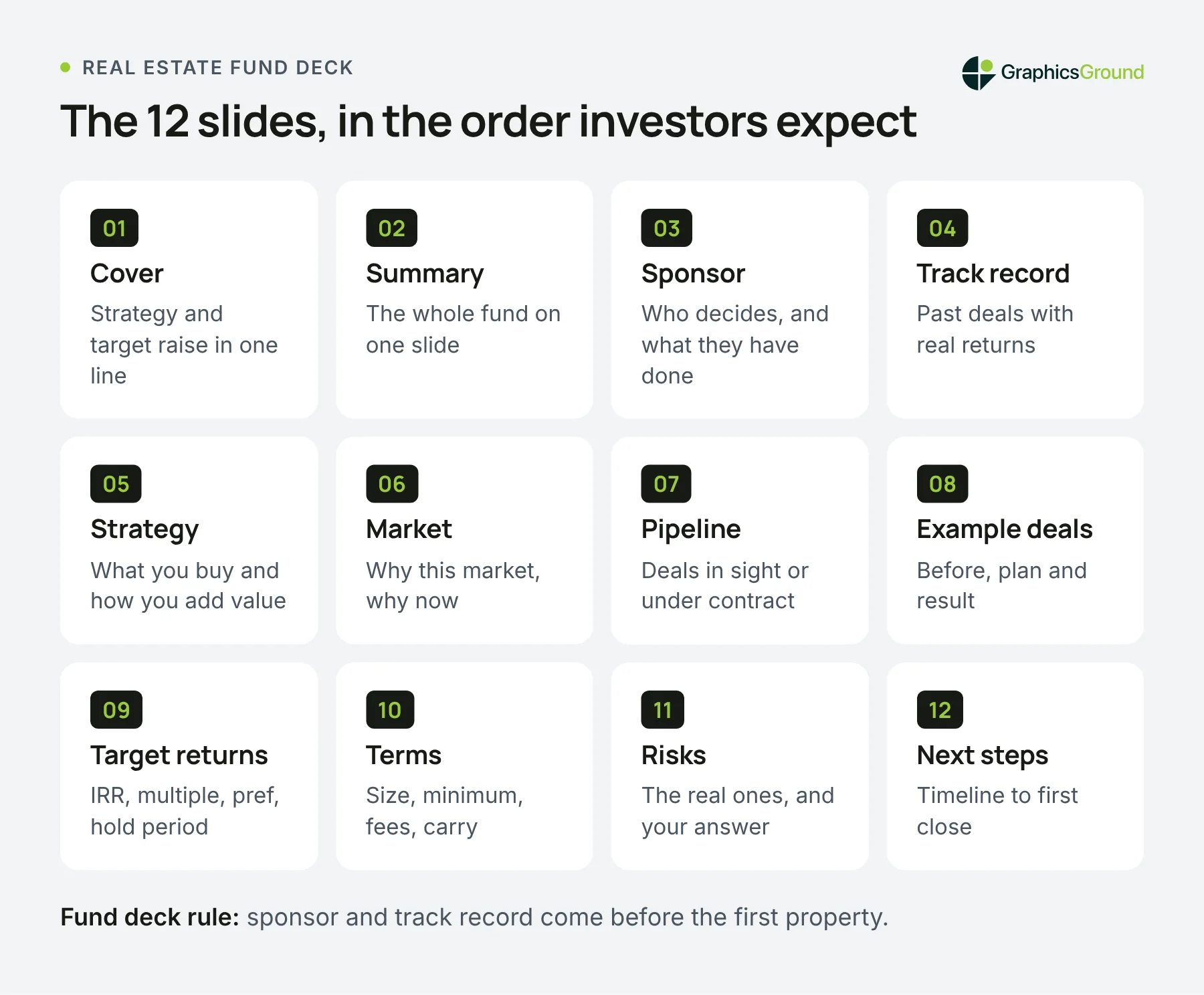
- Cover. Fund name, strategy in one line, target raise. “A $40M value-add multifamily fund in the Sun Belt” tells the reader more than a skyline photo.
- Summary. The whole fund on one slide: strategy, target size, target returns, hold period, minimum investment. Many investors decide whether to keep reading here.
- Sponsor and team. Who makes the decisions, and what each person has done. Show years, units, square feet or dollars. Leave out job titles that say nothing.
- Track record. Past deals in a table: asset, year bought, equity invested, status, realized or projected return. This is the slide investors spend the longest on.
- Strategy. What you buy, where, at what size, and how you add value. One sentence an investor could repeat to a partner.
- Market. Why this market and this asset type now. Three demand drivers with a source for each beat ten charts.
- Pipeline. Deals you are looking at or have under contract. It proves the strategy is real and that you have deal flow.
- Example deals. Two or three past or pipeline deals shown as before, plan and result. Keep each to one slide.
- Target returns. Net IRR, equity multiple, preferred return, hold period. State the assumptions behind them in plain words.
- Terms. Fund size, minimum investment, fees, carried interest, the sponsor’s own commitment, and how distributions flow.
- Risks. The three to five real risks and what you do about each. A deck with no risk slide reads as either naive or evasive.
- Next steps. Timeline to first close, what the investor receives next, and who to contact.
The numbers investors look for first
Real estate investors read decks number-first. If they have to hunt for a figure, they assume it is weak. These are the ones to make easy to find:
- Net IRR and equity multiple for the fund target, and for each past deal.
- Preferred return and the split above it.
- Hold period and the exit assumption.
- Fees: management fee, acquisition fee, any others. Hidden fees found later end conversations.
- Sponsor commitment: how much of your own money is in the fund.
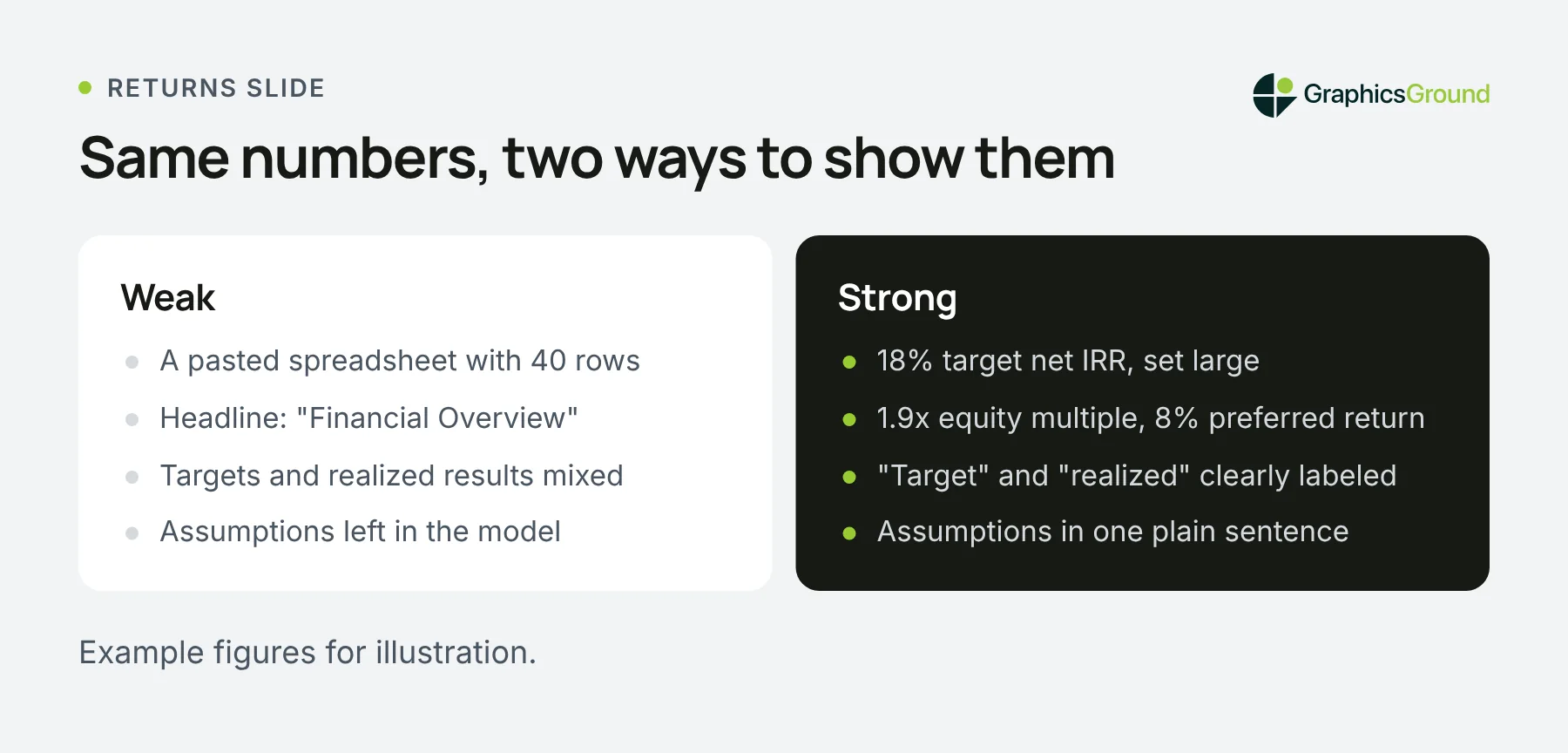
In our workflow, each of these gets one slide or one clear block, with the number set large and the assumption written under it in a full sentence. A returns slide that says “18% net IRR, based on a 5-year hold and a 5.5% exit cap rate” is stronger than a dense model screenshot, because the reader can see what the figure depends on.
Label every projection. Mark target returns as targets and realized returns as realized. Never mix the two in one table without labels. Investors notice, and so do regulators.
What to show if this is your first fund
A first-time fund manager has no fund track record. You almost always have a deal track record, and that is what goes on the slide.
- Deals you sponsored yourself. Even three or four, shown honestly, carry weight.
- Deals you worked on at a previous firm. Say exactly what your role was. “Led acquisitions on” and “was part of the team on” are different claims.
- Deals in progress. Show them as unrealized, with the current status.
Put the full deal table in the deck, including the deal that underperformed. A sponsor who shows one weak result and explains what changed afterwards is easier to trust than one with a perfect record nobody can check.
We cover the first-fund case in more depth in the LP pitch deck guide for first-time fund managers.
Five mistakes we remove when we redesign a real estate deck
We have designed decks for a value-add real estate fund, a student housing project, a hotel conversion and a residential developer. The same five problems come up in almost every first draft.
- Photos doing the work of facts. Renderings are fine. A slide that is only a rendering answers no question.
- Headlines that name the topic. “Market Overview” tells the reader nothing. “Jobs grew four times faster than new apartments in our target market” makes the point.
- The model pasted as a screenshot. Nobody reads 40 rows at slide size. Pull out the five numbers that matter and put the rest in the data room.
- The track record buried at the back. In a fund deck it belongs in the first five slides.
- No stated ask. If the reader cannot find the fund size, the minimum and the timeline in 10 seconds, the deck has not asked for anything.
You can see how these fixes look on real slides in our Lone Star value-add fund deck.
Test the deck before it goes to an investor
We run one test on every deck before it is sent. Give it to someone who has never heard of your fund. Give them three minutes and no explanation. Then ask them four things:
- What does this fund buy?
- Why should I trust this team?
- What return is it targeting, and over how long?
- How much is it raising, and what is the minimum?
If they miss one, the fix is on the slide, not in your voiceover. Decks get forwarded to partners and opened with nobody there to explain them.
Where the deck stops and the offering documents start
A pitch deck is a marketing document. It gets you the meeting. It does not replace the private placement memorandum, the fund agreement or the subscription documents your attorney prepares.
In the United States, how you are allowed to share the deck depends on the exemption you raise under. The SEC explains that an offering under Rule 506(b) cannot use general solicitation or advertising, which affects whether you can post the deck publicly or send it to people you have no relationship with. The SEC’s overview of exempt offerings lists the other routes.
We are designers, not lawyers. Have your securities attorney review the deck, the disclaimers and your distribution plan before anything goes out.
Frequently asked questions
How many slides should a real estate fund pitch deck have?
Plan for 15 to 20. The 12 core slides above, plus one slide per example deal and an appendix for detailed underwriting. A single-deal deck is shorter, usually 12 to 15.
Who can design fundraising materials for a new real estate investment fund?
You need someone who can do two things: organize the investment case, and design it so the numbers are easy to read. A presentation designer alone will make it look good. A studio that works on investor decks will also question the order, the headlines and the proof. That is the work we do in our 10-day story and deck process.
Should the deck include full financial projections?
Include the summary: target returns, key assumptions and a sensitivity line or two. Keep the full model in the data room and offer it after the first conversation.
Can I use the same deck for every investor?
Keep one master deck. Adjust the summary and the example deals for the investor in front of you. A family office that owns multifamily wants different examples from a first-time individual investor.
Raising for a fund and not sure the deck makes the case? Send us your deck and we will tell you what an investor will question first. If you would rather start with a plan, the 30-Day Fundraising Checklist is free.
What to prepare, send, and track in your first 30 days of raising. Free.
Series A Pitch Deck: What Changes From Your Seed Deck
A Series A pitch deck proves a business is working, where a seed deck proved it could. Here are the six slides that change, the metrics to show, and the order.
Read the article
Pre-Seed Pitch Deck: What Investors Look For
A pre-seed pitch deck has to earn belief before there is revenue. Here are the 12 sections, where investors spend their time, and what counts as proof this early.
Read the article