
Series A Pitch Deck: What Changes From Your Seed Deck
A Series A pitch deck proves a business is working, where a seed deck proved it could. Here are the six slides that change, the metrics to show, and the order.
 GraphicsGround teamInvestor decks, built with you, backed for the raise.

A Series A pitch deck answers a different question from a seed deck. At seed, investors ask “could this work?” and back a team and an early signal. At Series A they ask “is this working, and will more money make it work faster?” So the deck shifts from promise to proof. It opens with results, gives traction several slides instead of one, shows unit economics from real operating data, and explains exactly how the new capital turns into growth.
If you send a seed-style deck to a Series A investor, the usual reply is “come back when you have more traction”, even when the traction is there and simply is not shown. This guide covers what changes, slide by slide.
Key takeaways
- Open with your strongest result, not the problem.
- Traction becomes a section: revenue, growth, retention and unit economics.
- Go-to-market must show what already works and what it costs.
- The ask has to prove that capital is the thing limiting growth.
Seed deck vs Series A deck at a glance
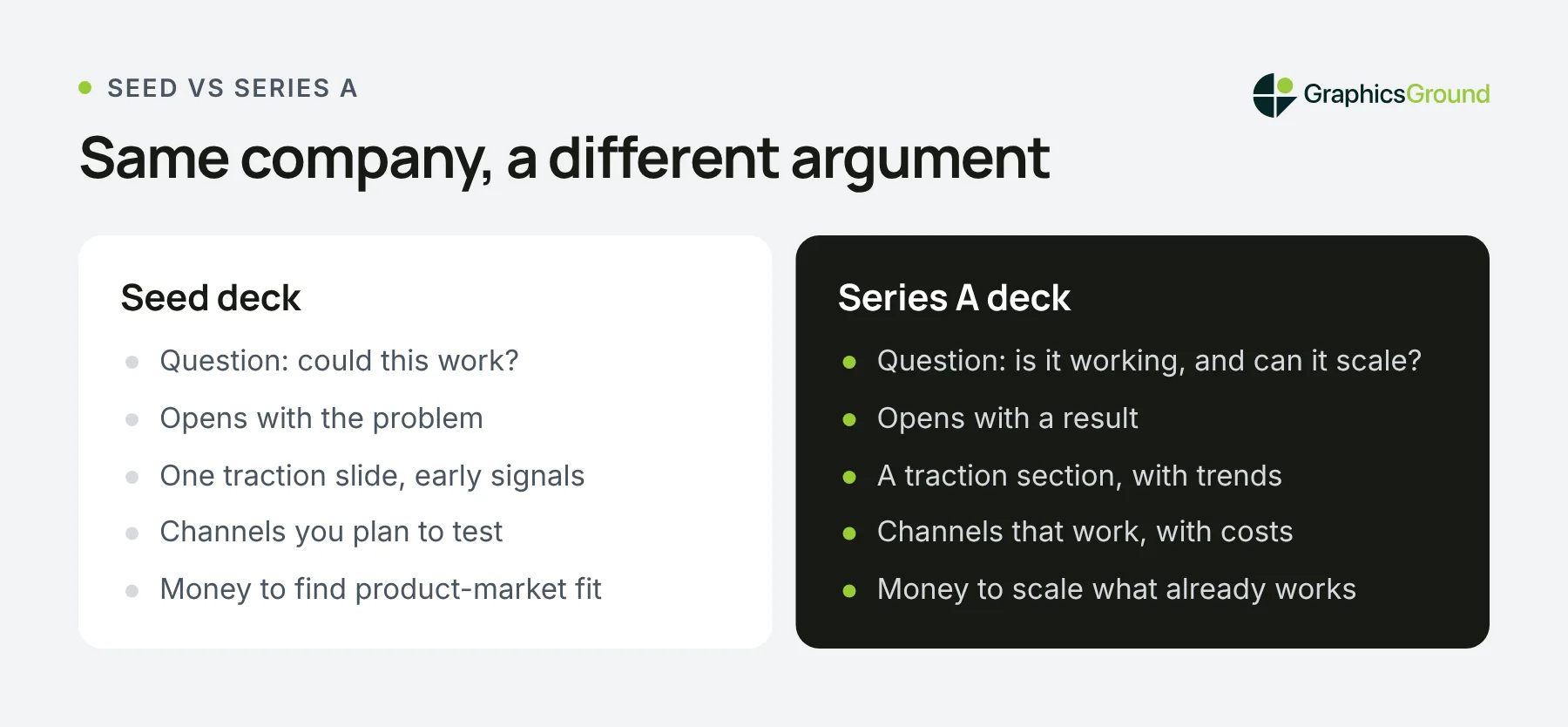
| Seed deck | Series A deck | |
|---|---|---|
| Investor’s question | Could this work? | Is it working, and can it scale? |
| Opens with | The problem | A proof point: revenue, growth or customers |
| Traction | One slide, early signals | Several slides, with trends over time |
| Go-to-market | Channels you plan to test | Channels that work, with costs |
| Team | Why these founders | Proof you can hire and run a company |
| The ask | Money to find product-market fit | Money to scale what is already working |
| Length | 10 to 15 slides | 15 to 20 slides, plus an appendix |
The structure of this comparison follows the venture firm CRV’s guide to what changes in a Series A pitch deck, which is worth reading for the investor’s side.
The six slides that change
1. The opening
A seed deck earns attention with a painful problem. A Series A deck earns it with a result. Put your strongest number on the first or second slide, then bring the problem back as context.
Seed opening: “Restaurant managers lose six hours a week covering no-show shifts.”
Series A opening: “1,400 restaurants use Shiftwise to fill shifts in under two hours. Revenue tripled in 12 months.”
The company is invented for illustration. The pattern is real: lead with what has already happened.
2. Traction
One slide becomes a section. A Series A investor expects to see:
- Revenue and growth over time, usually monthly for at least a year
- Retention, shown by cohort
- Gross margin
- Unit economics: what it costs to win a customer and what that customer is worth
- For companies selling to businesses, sales cycle length and average contract value
3. Go-to-market
At seed, a list of channels to test is fine. At Series A the slide has to show which channels already bring customers, what each one costs, and what it would take in people and budget to scale them. A theoretical go-to-market slide is one of the most common reasons a Series A deck is passed over.
4. Team
The founders’ background mattered most at seed. Now investors want to know whether you can build a company around yourselves: the key hires made, the gaps still open, and evidence that good people want to join.
5. Competition
You now have real competitors and real win and loss data. Show where you win, where you lose and why. Claiming there is no competition is a red flag at any stage.
6. Use of funds
This slide has the hardest job. It must show that money is the constraint. “We spend $1 on this channel and get $3 back, and we are limited by budget” is the argument. Tie the funds to specific channels and specific roles, not to broad categories like “sales and marketing, 40%”.
The metrics a Series A deck needs
| Metric | What it shows | How to present it |
|---|---|---|
| Annual recurring revenue and growth | Size and speed | A monthly chart for 12 to 24 months |
| Net revenue retention | Whether customers stay and expand | One figure, with cohorts in the appendix |
| Gross margin | Whether growth is profitable at the unit level | One figure and its trend |
| Customer acquisition cost and payback | How efficient growth is | By channel if you can |
| Burn multiple | How much you spend to add revenue | One figure, honestly calculated |
Two benchmarks from the CRV guide are useful. Net revenue retention above 100% tells investors that existing customers are spending more over time. And spending $3 million to add $1 million in recurring revenue is treated as a warning sign. The guide also stresses that these figures should come from actual operating data, not projections.
Use real numbers, calculated the standard way. Series A investors will rebuild your metrics from the data room. A flattering definition of retention or acquisition cost that does not survive that check costs more trust than a weaker honest number.
A Series A slide order that works
- Company and headline result
- Traction: revenue and growth
- The problem, briefly
- The product and why customers choose it
- Retention and customer proof
- Unit economics
- Market size and how you expand within it
- Go-to-market: what works, what it costs
- Competition and why you win
- Business model and pricing
- Team and key hires
- Financial plan
- The ask and use of funds
- Milestones the round will reach
That is fourteen. With two or three traction slides split out, most Series A decks land between 15 and 20. Detailed cohorts, the full model and technical architecture go in the appendix. See how many slides a pitch deck should have.
What changes in the design
A Series A deck carries far more data than a seed deck, and that changes the design job. When we build one, most of the effort goes into charts.
- One message per chart. The headline states the conclusion. The chart proves it.
- One chart style throughout. Same colors, same axes, same labeling, so the reader learns to read your charts once.
- The key figure pulled out and set large. Nobody should have to read a value off an axis.
- Real product, real logos. Wireframes and placeholder customers make a company look earlier than it is.
- An appendix with a divider. So the main argument ends cleanly at the ask.
Seven mistakes that make a Series A deck look like a seed deck
- Leading with vision. Three slides on the future before any result.
- One traction slide. A single chart where a section should be.
- Product metrics instead of business metrics. Sign-ups and sessions where revenue and retention should be.
- Missing unit economics. Or unit economics based on forecasts.
- A go-to-market plan with no costs.
- Too much technical detail in the main deck.
- Old screenshots and beta visuals.
Are you ready for a Series A deck?
Sometimes the honest answer is that the deck is not the issue. If you cannot fill the traction section with a year of real numbers, a bridge or seed extension may be the right raise, and a seed-style deck with updated proof is the right tool. See what the best seed decks have in common.
If the numbers are there and investors still say “too early”, the deck is probably hiding them. That is a structure problem, and it is fixable. See when to fix a deck and when to rebuild it.
Frequently asked questions
How long should a Series A pitch deck be?
About 15 to 20 slides in the main deck, with an appendix for detailed metrics and the financial model.
Can I update my seed deck for Series A?
You can reuse the brand and some slides. The order and the argument need rebuilding, because the question being answered has changed.
What revenue do I need for a Series A?
It varies by sector and market conditions, and investors judge growth and efficiency alongside the absolute number. Ask investors in your space what they are seeing this year instead of relying on a fixed threshold.
Should the financial model be in the deck?
A summary of the plan belongs in the deck. The model itself goes in the data room. See our data room checklist.
Do Series A investors still care about the story?
Yes. The numbers get you considered. The story explains why the numbers will continue. A deck that is only charts leaves the investor to write your narrative for you.
Preparing a Series A? Investor Deck + 90 Days of Raise Support covers founders from pre-seed to Series A at one fixed price, with no slide limit. Or send us your current deck and we will tell you whether it reads as seed or Series A.
What to prepare, send, and track in your first 30 days of raising. Free.
Pre-Seed Pitch Deck: What Investors Look For
A pre-seed pitch deck has to earn belief before there is revenue. Here are the 12 sections, where investors spend their time, and what counts as proof this early.
Read the article
How Many Slides Should a Pitch Deck Have?
A pitch deck should have 10 to 15 slides. Here is what the data says, how the number changes by stage, and how to cut a long deck without losing the argument.
Read the article