
Pre-Seed Pitch Deck: What Investors Look For
A pre-seed pitch deck has to earn belief before there is revenue. Here are the 12 sections, where investors spend their time, and what counts as proof this early.
 GraphicsGround teamInvestor decks, built with you, backed for the raise.
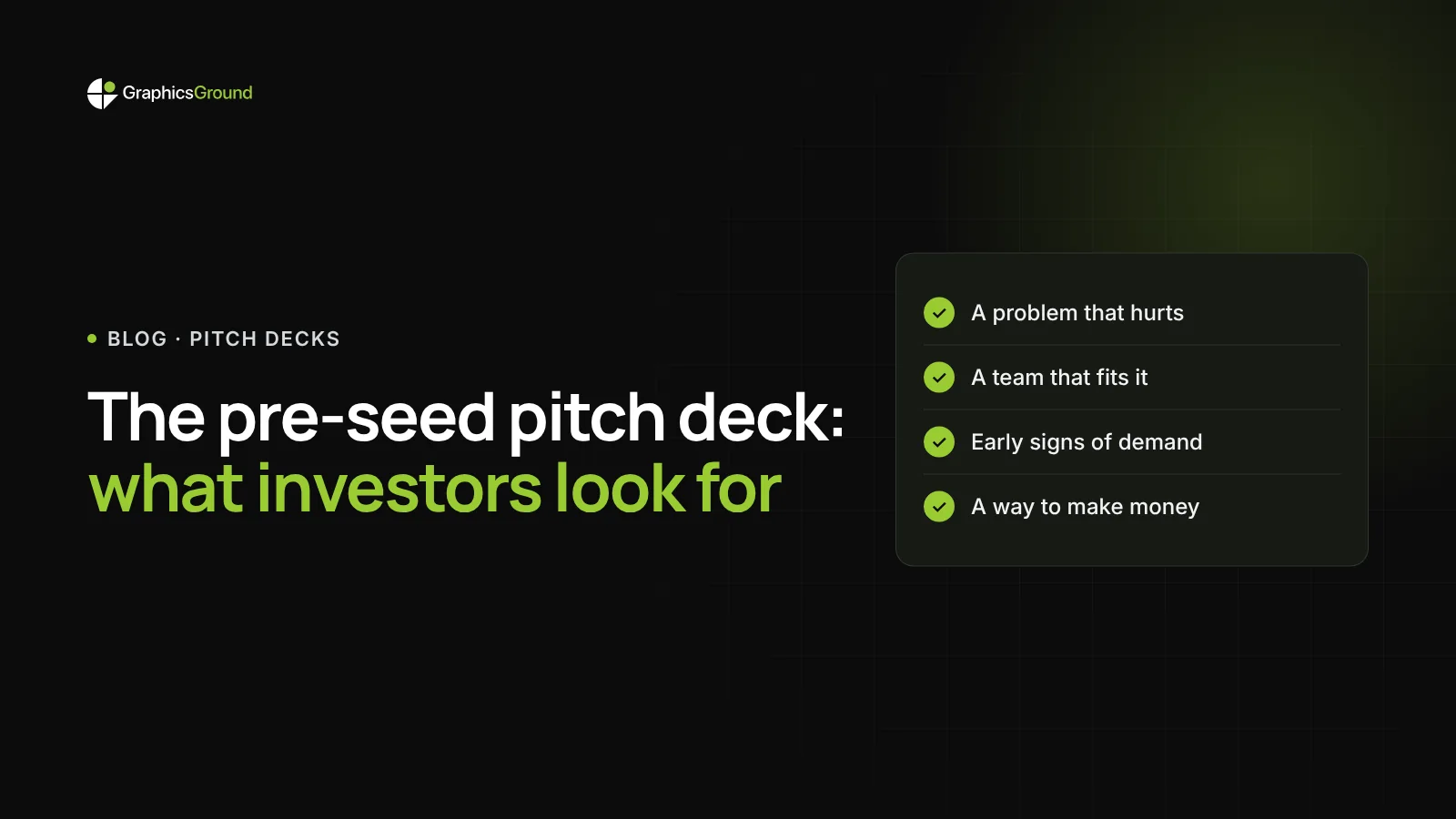
A pre-seed pitch deck has to answer a harder question than any later deck: why should someone invest before there is revenue to point to? Investors at this stage look for four things. A problem that clearly hurts a specific customer, a team with a reason to be the ones solving it, early evidence that people want the product, and a believable way the company makes money. The deck covers the same sections as a seed deck. The proof inside them is different.
This guide gives you the section order, shows where pre-seed investors actually spend their reading time, and explains what to use as traction when the numbers are still small.
Key takeaways
- Pre-seed investors are buying the team, the insight and early signals of demand.
- They spend the most time on the business model and the product, even this early.
- “No revenue” does not mean “no traction”. Use the strongest evidence you have and date it.
- Be exact about what is proven and what is planned. Investors forgive early. They do not forgive vague.
What pre-seed investors are deciding
At seed and later, an investor can study growth and retention. At pre-seed there is often little to study, so the decision rests on judgment about three things.
- Is the problem real and painful? For a specific person, often enough, at a cost they notice.
- Why this team? What you know or have done that makes you more likely to win than the next founder with the same idea.
- Is there any sign of pull? Anything that shows customers moving toward the product without being pushed.
The odds are steep, and it helps to know them. DocSend’s research lead writes in their guide to pre-seed decks that investors receive more than 100 decks a week and that only 1 to 2 percent lead to a meeting. Your deck is competing for attention before it competes on merit.
Where pre-seed investors spend their time
The same DocSend analysis measured how long investors spent on each section of pre-seed decks. The average total was 4 minutes 10 seconds. The split is not what most founders expect.
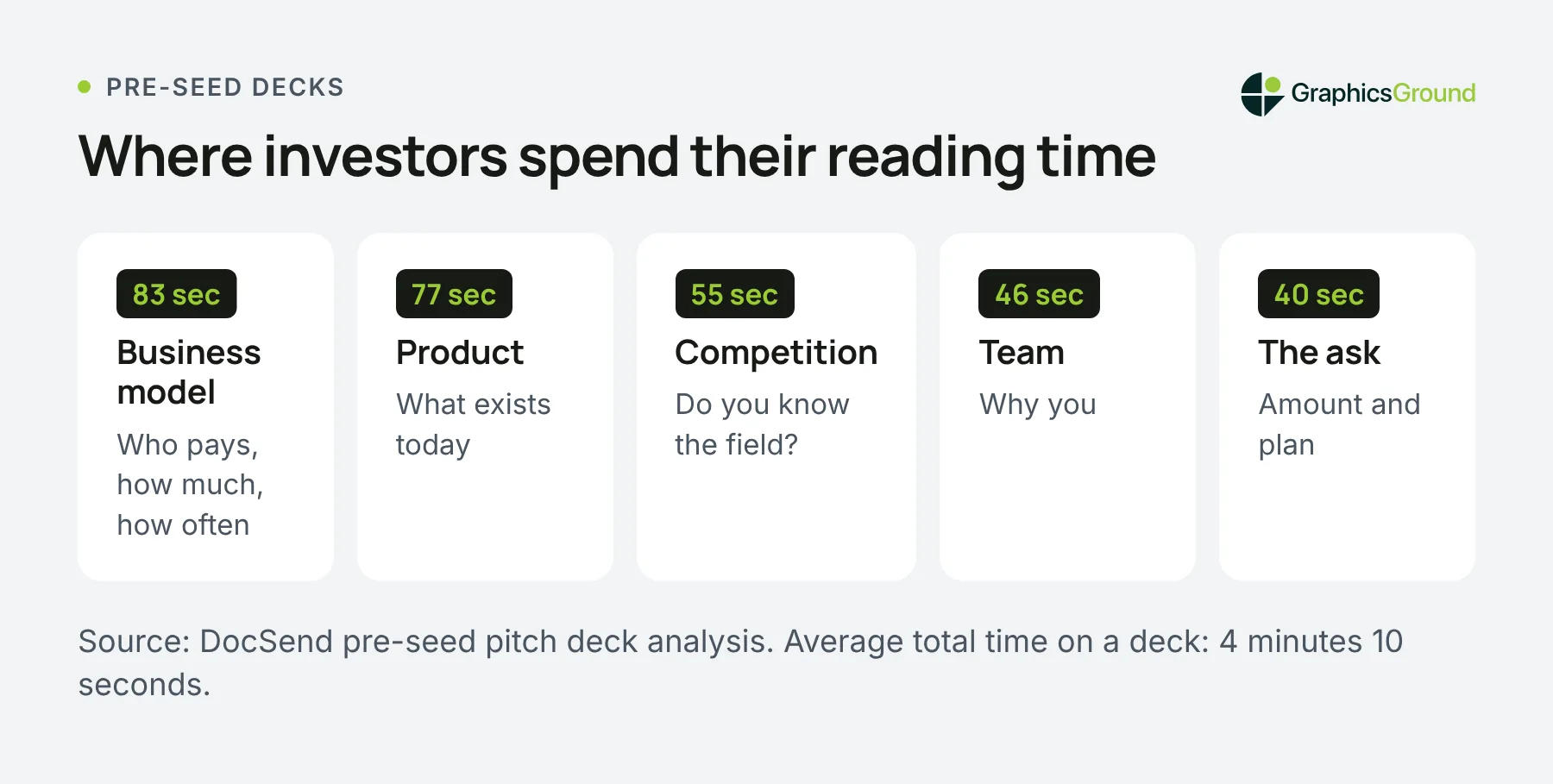
| Section | Average time | What that tells you |
|---|---|---|
| Business model | 83 seconds | Even pre-revenue, investors want to see how money will be made |
| Product | 77 seconds | They want to see that something real exists |
| Competition | 55 seconds | They are checking whether you know the field |
| Team | 46 seconds | Short, but decisive |
| Fundraising ask | 40 seconds | They look for the amount and the plan |
The lesson we take from this when we build a pre-seed deck: do not treat the business model as a formality because revenue is in the future. It is the section being read most closely. One clear slide on who pays, how much, and how often does more than three slides of vision.
The 12 sections of a pre-seed deck
This order follows the questions an investor asks, and matches the structure DocSend recommends.
- Company purpose. What you do, in one sentence a stranger could repeat.
- Problem. Who has it, how often, and what it costs them today.
- Solution. What you built and what changes for the customer.
- Why now. What shifted in technology, regulation or behavior that makes this possible today. Optional, but strong when true.
- Product. Real screens or a demo. Show what exists, and label what is planned.
- Market size. Built from customers and price, so the reader can check it.
- Team. The specific experience that fits this problem.
- Business model. Who pays, how much, how often.
- Traction. The strongest evidence you have. See the next section.
- Financials. Optional at this stage. A simple view of costs and runway is enough.
- Competition. The alternatives, including doing nothing, and why you win.
- The ask. The amount, what it gets you to, and by when.
DocSend suggests around 18 pages for a pre-seed deck, with product and business model taking more than one page each. We aim shorter where we can, usually 12 to 15, and move extra product screens to an appendix. Either way the rule holds: one idea per page. More on length in how many slides a pitch deck should have.
What counts as traction before revenue
This is where pre-seed decks are won. “We have no traction yet” is almost never true. You have evidence. The work is choosing the strongest piece and stating it precisely.
| Evidence | Strength | How to state it |
|---|---|---|
| Paying customers, even a few | Strongest | “6 restaurants pay $400 a month. First signed in August.” |
| Signed pilots or letters of intent | Strong | “3 signed pilots, converting to paid in January.” |
| Active usage of a free product | Strong | “140 weekly active users, 60% return each week.” |
| A waitlist that converts | Medium | “900 sign-ups, 1 in 5 completed onboarding.” |
| Customer interviews | Medium | “40 interviews. 31 named this as a top-three problem.” |
| A waitlist number alone | Weak | Add what those people did next |
| “Lots of interest” | None | Replace with any of the above |
The examples are invented to show the wording. Notice the pattern: a number, a unit and a date. “Strong early interest” tells an investor nothing. “Three signed pilots since September” tells them something happened.
Separate what is real from what is planned. Label mockups as mockups, pilots as pilots and projections as projections. A pre-seed investor expects gaps. Finding out later that a “customer” was a free trial ends the conversation.
The team slide carries more weight at pre-seed
Investors spent 46 seconds on it in the DocSend data, which sounds short. It is long enough to decide. At this stage the team slide is doing the job the traction slide does later.
- Lead with the fit, not the title. “Ran operations for a 40-location restaurant group” beats “CEO and Co-Founder”.
- Show what each founder has built or sold that relates to this company.
- Name the gap. If you have no technical co-founder or no sales lead, say how you are covering it.
- Skip the advisor wall. Three advisors who actually help are worth more than twelve logos.
Six mistakes we see in pre-seed decks
- A vision instead of a description. The first slide says where the world is going and never says what the product does.
- A top-down market number. “A $400B industry” with no path from that to your first customers.
- Mockups presented as product. Investors can usually tell.
- No business model slide. “We will figure out monetization later” on the most-read section.
- Claiming no competitors. In a TechCrunch piece on why investors pass, one investor named this as a red flag. There is always an alternative, even if it is a spreadsheet.
- An ask with no milestone. “Raising $750K” without what it buys.
How a pre-seed deck differs from a seed deck
| Pre-seed | Seed | |
|---|---|---|
| Main proof | Team, insight, early signals | Customers, revenue, retention |
| Product | Prototype or early version | Live product with users |
| Traction slide | Pilots, usage, interviews | Growth over time |
| The ask | Money to reach first proof | Money to scale what works |
| Investor’s question | “Could this work?” | “Is this working?” |
For the next stage up, see the 10 slides every seed deck needs and what the best seed decks have in common.
Frequently asked questions
How many slides should a pre-seed pitch deck have?
Between 12 and 18. Cover the 12 sections above, give product and business model the room they need, and move extra detail to an appendix.
Do I need financial projections at pre-seed?
A detailed model is not expected. Show what the money will be spent on, how long it lasts, and the milestone it gets you to.
Can I raise pre-seed with only an idea?
It happens, mostly for founders with a strong track record in the same field. For everyone else, some evidence of demand makes the raise far easier: interviews, a waitlist that converts, or a pilot.
How much should I ask for at pre-seed?
Enough to reach the milestone that makes a seed round possible, with a margin. Work backwards from that milestone instead of from a round number.
Should a pre-seed deck be designed professionally?
It should be clear and consistent. That matters more than polish. A plain deck with a sharp story beats a beautiful one that hides what the company does. If the story is not landing, start there. See pitch deck redesign: fix it or rebuild it.
Raising a pre-seed round? Our Investor Deck + 90 Days of Raise Support is built for founders from pre-seed to Series A, at one fixed price. Or start with the free 30-Day Fundraising Checklist.
What to prepare, send, and track in your first 30 days of raising. Free.
Series A Pitch Deck: What Changes From Your Seed Deck
A Series A pitch deck proves a business is working, where a seed deck proved it could. Here are the six slides that change, the metrics to show, and the order.
Read the article
How Many Slides Should a Pitch Deck Have?
A pitch deck should have 10 to 15 slides. Here is what the data says, how the number changes by stage, and how to cut a long deck without losing the argument.
Read the article