
Pitch Deck Consultant, Designer or Advisor: Who to Hire
A pitch deck designer fixes how the deck looks. A pitch deck consultant fixes what it says. A fundraising advisor helps run the raise. Here is how to pick.
 GraphicsGround teamInvestor decks, built with you, backed for the raise.
Hire a pitch deck designer when your story is clear and the slides are hard to read. Hire a pitch deck consultant when investors do not understand the business from the deck. Hire a fundraising advisor when the deck is working and you need help running the raise itself: who to approach, in what order, and what to do with their replies.
Most founders hire the wrong one first, because all three describe themselves in similar words. This guide separates the roles by what each one actually changes, what each costs, and the warning signs to look for.
Key takeaways
- A designer changes the surface. A consultant changes the story. An advisor changes the process.
- Find your real problem before you hire. A three-minute test will tell you.
- Be careful with anyone who guarantees funding or asks for a percentage of the round.
- Many early-stage founders need parts of all three, in a small dose.
What each one actually changes
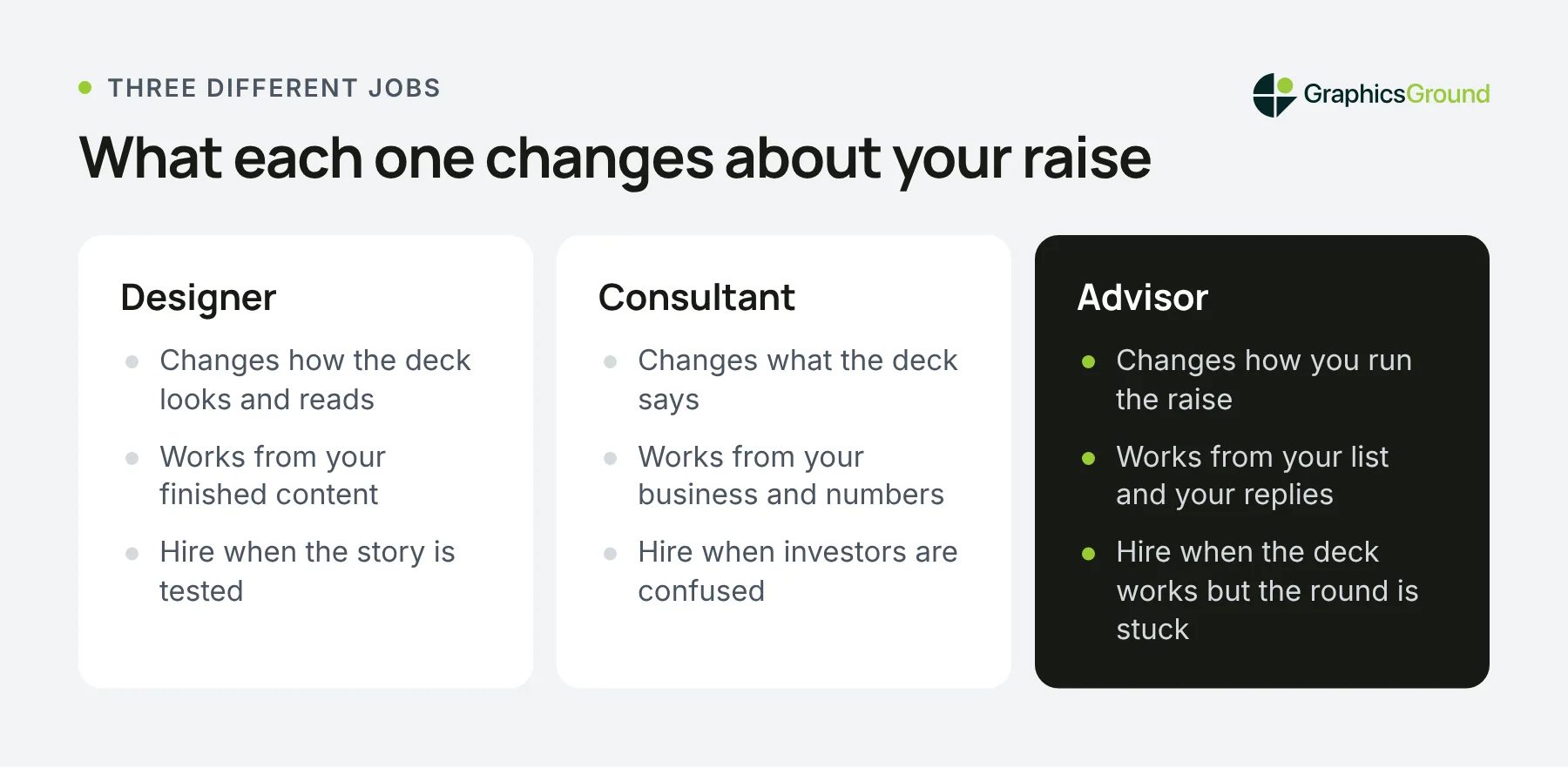
| Designer | Pitch deck consultant | Fundraising advisor | |
|---|---|---|---|
| Changes | How the deck looks and reads | What the deck says and in what order | How you run the raise |
| Works from | Your finished content | Your business, numbers and goals | Your deck, your target list, your replies |
| Delivers | Designed slides | A rebuilt narrative, usually with design | Investor strategy, outreach, meeting prep, feedback |
| Typical pricing | Per deck, per slide or hourly | Per project | Monthly retainer, sometimes plus a success fee |
| Hire when | The story is tested | Investors are confused or silent | The deck works and the process is the bottleneck |
The pitch deck designer
A designer takes the content you give them and makes it clear and consistent: layout, type, charts, spacing. A good one will tidy your wording and suggest splitting a crowded slide. Most will not tell you that your market slide is unconvincing, because that is not what you hired them for.
Designers are the right hire when you have already tested the story on real investors and it holds.
The pitch deck consultant
A consultant starts with the business, not the slides. They ask what you are raising, from whom, and what those investors need to believe. Then they rebuild the argument: which slide comes first, what each one claims, what proof supports it. Some consultants design the result. Others hand you an outline and send you to a designer.
This is the right hire when smart people read your deck and still cannot explain what you do.
The fundraising advisor
An advisor works on everything around the deck. Which investors fit your stage and sector. How to reach them. What to send first. What a reply really means. When to follow up and when to stop. A good advisor has seen many raises and can tell you whether a slow month is normal.
This is the right hire when the deck gets meetings but the meetings are not turning into a round.
How to tell which one you need
Do not guess. Run this test, which takes about ten minutes.
- Send your deck to someone who does not know the company.
- Let them read it alone for three minutes.
- Ask them to describe the business, the proof and the ask.
Then match what happened to the list below.
- They got it, but found it dense or dated. You need a designer.
- They got parts wrong or missed the ask. You need a consultant.
- They got it, investors get it, and the round is still stuck. You need an advisor.
- You have not sent it to any investors yet. You probably need a consultant first and an advisor soon after.
We explain the test in more depth in pitch deck redesign: fix it or rebuild it.
What each one costs
Prices vary a lot, so treat these as orientation.
- Designers. Freelancers typically charge about $500 to $5,000 per deck. Studios charge more for structure and custom visuals.
- Consultants. Specialist studios that work on the story usually sit between $2,500 and $15,000. Full consultancies that add a financial model and investor strategy run from $10,000 to $50,000 or more.
- Advisors. Commonly a monthly retainer. Some add a success fee, a percentage of the money raised.
We go through the numbers in what a pitch deck costs in 2026.
Five warning signs before you sign
- A funding guarantee. Nobody controls an investor’s decision. Anyone who promises money is selling something else.
- A percentage of the round for making introductions. In the United States, being paid a commission on a securities sale can require registration as a broker-dealer. The SEC’s guide to broker-dealer registration explains who has to register. Ask how the person is registered, and ask your lawyer.
- “We have a list of 5,000 investors.” A large list is not a fit. Thirty investors who back your stage and sector are worth more than thousands who do not.
- No before and after. Finished work shows taste. A before and after shows thinking. Ask for both.
- They never ask about your numbers. If the first conversation is only about fonts and colors, you are talking to a designer, whatever the title says.
Keep the relationships. Whoever you hire, the investor conversations should happen from your own email address and in your own name. Investors back founders, and they notice when a third party is running the inbox.
Why early-stage founders often need a little of all three
At pre-seed and seed, the three problems are usually tangled together. The story is not quite sharp, so the slides feel crowded, so replies are slow, so the founder is unsure who to approach next. Hiring three specialists for that is slow and expensive.
That is the reason we built our own service the way we did. Investor Deck + 90 Days of Raise Support covers a small, defined amount of each role:
- The consultant’s work. Three days rebuilding the story with you. You approve it before design starts.
- The designer’s work. Every slide designed by hand, no slide limit, delivered in an editable format.
- Part of the advisor’s work. For 90 days: weekly calls with our founder, 30 to 50 investors researched by name for your round, outreach templates, and three revision rounds when investor feedback repeats.
What we do not do matters as much. We do not make introductions for a fee, we do not take equity or a commission, and we do not send messages as you. You run your raise, and we help you run it well. The price is $1,450, once. Details are in our pricing section.
If you only need one role, hire only that. Our guide to pitch deck design services shows how to compare providers.
Frequently asked questions
What does a pitch deck consultant do?
They work out what your deck needs to argue for the investors you are approaching, then restructure and rewrite it so that argument is easy to follow. Many also design the final slides.
Is a pitch deck consultant worth it?
It is worth it when investors are not understanding the business from the deck and the round matters. It is not worth it if the story is already tested and you only need cleaner slides.
Can I outsource my pitch deck completely?
You can outsource the writing and the design. You cannot outsource the knowledge. Whoever you hire will need your numbers, your customers and your reasoning, so plan for a few hours of your time in the first week.
Do I need a fundraising advisor for a pre-seed round?
Not always. Many pre-seed rounds are raised from angels the founder already knows. An advisor helps most when you are approaching investors cold and need a plan for who, when and how.
Should the same person do the story and the design?
It helps. When the two are split, the designer often has to guess which point on a slide matters most. When one team does both, the design can serve the argument directly.
Not sure which of the three you need? Send us your deck. We will read it cold and tell you where the problem sits, including when the answer is “you only need a designer”.
What to prepare, send, and track in your first 30 days of raising. Free.
Investor Feedback on Your Pitch Deck: When to Change It
One investor’s comment is an opinion. The same comment from three is a pattern. Here is how to log investor feedback, read it, and decide what to change.
Read the article
Investor Ready Checklist: 30 Days Before You Raise
Being investor ready means you can answer “send me more” within the hour. Use this four-week checklist to prepare, target, send and track before you raise.
Read the article