
Investor Follow-Up Email: What to Send After a Pitch
Send your investor follow-up email within 24 hours, then follow up with news, not reminders. Here is the schedule, four templates, and when to stop.
 GraphicsGround teamInvestor decks, built with you, backed for the raise.
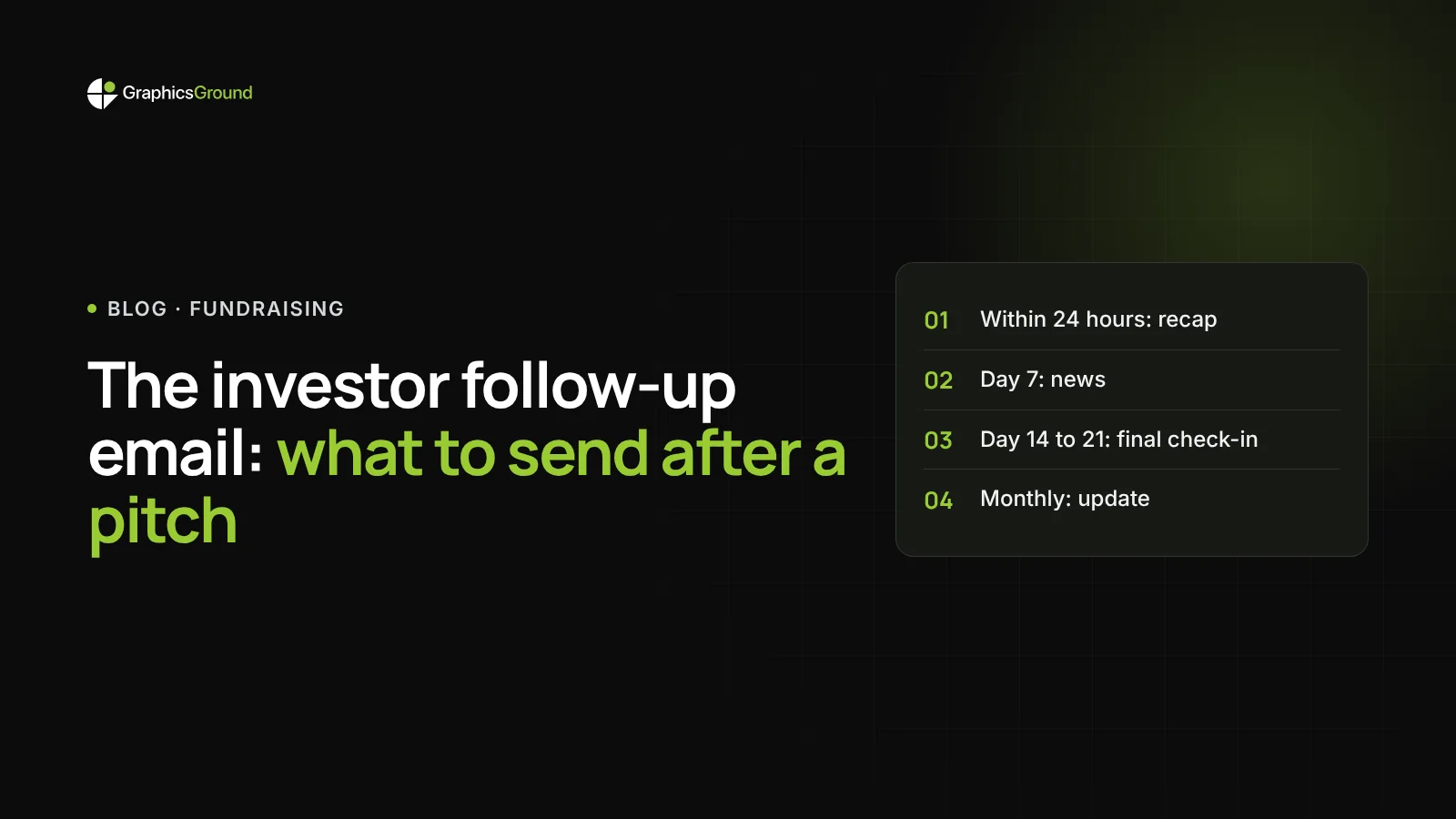
Send your investor follow-up email within 24 hours of the pitch. Keep it short: thank them, answer the questions they asked, link the deck, and state one clear next step. If you hear nothing, follow up again after about a week with something new to say, and once more a week or two after that. After three attempts, move them to your monthly update list and put your energy elsewhere.
That is the whole method. The rest of this guide is the detail: the schedule, four templates you can copy, how to read what investors say back, and the mistakes that end conversations.
Key takeaways
- The first follow-up goes out the same day or the next morning.
- Every later follow-up needs a reason to exist: a new number, a new customer, a new commitment.
- Silence usually means busy, not no. Three attempts is enough to find out.
- A question you hear from several investors is a slide to fix, not only an email to answer.
Why investors go quiet after a good meeting
Founders tend to read silence as rejection. Often it is workload. In a TechCrunch piece on why VCs ghost founders, investors described the cause plainly: a pass takes effort to write and often gets pushed down the list, follow-ups slip during busy periods, and the volume is high. One investor in the article said he receives about 30 pitches a day.
Two things follow from that. First, a polite, useful follow-up is not an intrusion. It is how you stay on a crowded list. Second, the follow-up has to be easy to act on, because the person reading it has very little time.
The follow-up schedule
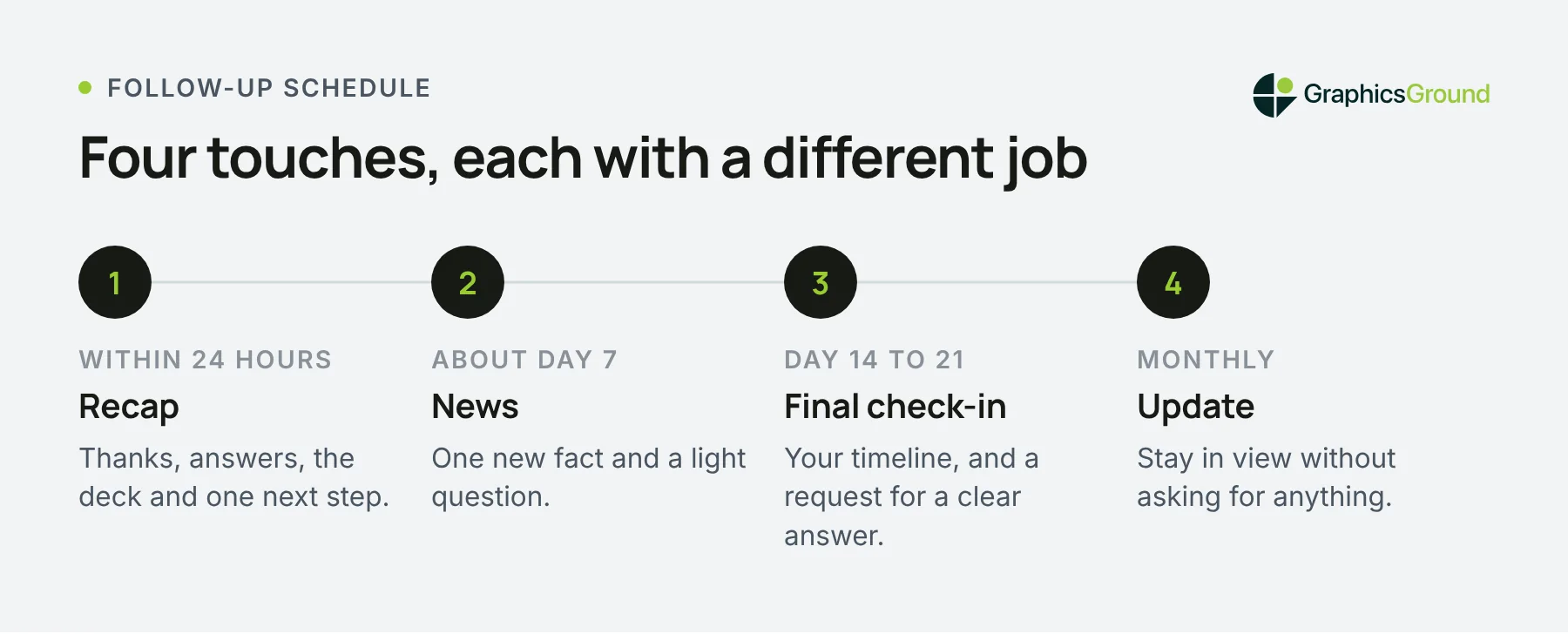
| When | What to send | Its job |
|---|---|---|
| Within 24 hours | Recap, answers to their questions, the deck, one next step | Make it easy to share you with a partner |
| About day 7 | One piece of news and a light question | Give them a reason to reopen the thread |
| About day 14 to 21 | A short final check-in with your timeline | Get a yes, a no, or a “not now” |
| Monthly after that | Your investor update | Stay in view without asking for anything |
If the investor gave you a date, such as “we discuss on Monday”, follow their timeline and ignore this one.
What goes in the first follow-up
The first email does one thing: it lets the person you met explain your company to someone who was not in the room. Investors rarely decide alone, so write it for the partner who will read it second-hand.
- One line of thanks. Specific, not gushing.
- The company in one sentence. The same sentence as your first slide.
- Answers to what they asked. If they wanted churn by cohort, give it or say when it is coming.
- The deck, as a link. The version built to be read alone, not the one you presented from.
- One next step. A call with a co-founder, a customer reference, a date.
Keep it under 150 words. Anything longer belongs behind a link.
Four templates you can copy
Change the details and keep the length. These follow the same structure we give founders in our outreach templates.
1. Within 24 hours of the pitch
Subject: [Company] follow-up and the numbers you asked for
Hi [Name],
Thank you for the time today. Your question about [topic] was the right one to push on.
In one line: [what the company does, for whom, and the result].
You asked about [question]. The answer is [short answer, one number]. The detail is on slide [X] of the deck, linked below.
Would it help to speak with [co-founder or customer] next week? I can set that up for Tuesday or Thursday.
[Your name]
2. About a week later, with news
Subject: [Company]: [the news in five words]
Hi [Name],
A short update since we spoke: [one concrete thing that happened, with a number].
It bears on your question about [their concern], because [one sentence].
Is there anything else you need from us to take this further?
[Your name]
3. The final check-in
Subject: [Company] round timing
Hi [Name],
We are planning to close the round by [date], and [amount or share] is committed so far.
I would like to know where you stand, including if the answer is no. A clear no helps us as much as a yes.
[Your name]
4. After a “not right now”
Subject: Re: [Company]
Hi [Name],
Understood, and thank you for telling me directly. May I ask what you would need to see to look again?
I will add you to our monthly update so you can follow the progress without any effort on your side.
[Your name]
Only state what is true. Do not say the round is closing soon or oversubscribed if it is not. Investors talk to each other, and a false deadline costs you more than a slow reply.
How to read what investors say back
| What they say | What it usually means | What to do |
|---|---|---|
| “Send me the deck.” | Mild interest, or a polite way to end the call | Send it the same day with a one-line summary |
| “Keep me posted.” | Not now, but not never | Add them to the monthly update |
| “It is a bit early for us.” | They want more proof | Ask which milestone would change that |
| “Who else is in?” | They are interested and want a signal | Answer honestly, including “you would be first” |
| A specific question about numbers | Real interest | Answer within a day, fully |
| Nothing, after three attempts | Treat as a no for this round | Move to the monthly update and move on |
When repeated questions mean the deck needs fixing
Keep a simple log of every investor conversation: who, when, what they asked, where they stopped. After eight or ten conversations, read it top to bottom.
In our weekly calls with founders, this log is the first thing we look at. If one investor asks about your competition, answer the email. If four ask, the competition slide is not doing its job and no follow-up email will fix that. The rule we work by: one investor’s opinion should not change your deck, and repeated feedback should.
Buffer’s founders described the same pattern in their account of their seed round. Conversations kept stalling on the competition question, so they reworked that slide. They also contacted around 200 investors to close with 18, which is a useful reminder that follow-up is most of the work.
If you see a pattern and are not sure whether to restyle or restructure, read pitch deck redesign: fix it or rebuild it.
Five follow-up mistakes that end conversations
- “Just checking in.” It asks the investor to do work and gives them nothing. Always bring news or a question.
- Following up every two days. It reads as pressure. A week between touches is a safe gap.
- A different deck each time. Send an updated deck only when something material changed, and say what.
- Long emails. If it needs scrolling on a phone, cut it.
- Taking a no badly. Investors who pass on this round often look again at the next. A gracious reply keeps that door open.
Frequently asked questions
How soon should I follow up after an investor pitch?
Within 24 hours. The meeting is fresh, and the investor may be writing up notes for partners that same day.
How many times should I follow up with an investor?
Three times over about three weeks, each with something new. After that, add them to your monthly update and stop asking.
What if an investor opened my deck but did not reply?
An open is not interest. Send your day-seven follow-up as planned, with news. Do not mention that you saw them open it.
Should I follow up by email or LinkedIn?
Use the channel the conversation started on. Email is the default. Do not chase the same person on three channels in one week.
What should a monthly investor update include?
A few key numbers, what went well, what did not, and one specific ask. We cover the format in our investor update template.
Following up is one part of a 30-day plan. The 30-Day Fundraising Checklist lays out the rest, week by week, and it is free. If you would like someone to go through your replies with you every week, that is part of our 90 days of raise support.
What to prepare, send, and track in your first 30 days of raising. Free.
Investor Feedback on Your Pitch Deck: When to Change It
One investor’s comment is an opinion. The same comment from three is a pattern. Here is how to log investor feedback, read it, and decide what to change.
Read the article
Investor Ready Checklist: 30 Days Before You Raise
Being investor ready means you can answer “send me more” within the hour. Use this four-week checklist to prepare, target, send and track before you raise.
Read the article