
Investor Update Email: A Template for While You Raise
A monthly investor update email keeps interested investors warm between meetings. Here is a five-part template, what to include at seed, and what to leave out.
 GraphicsGround teamInvestor decks, built with you, backed for the raise.
An investor update email is a short monthly message that tells investors what changed in your company. While you are raising, send it to everyone who said “keep me posted” as well as the investors you already have. Keep it under about 250 words, in five parts: your asks, one headline number, what went well, what did not, and where the round stands.
Most founders only start sending updates after they close a round. Starting during the raise is more useful, because it turns a single meeting into a record of progress an investor can watch. This guide gives you the template, a filled-in example, and the rules that keep people reading.
Key takeaways
- Send it monthly, on the same day, even when the month was quiet.
- Put your asks first. Many readers never get past the opening lines.
- Include the bad news. An update with only wins stops being believed.
- During a raise, the update does the follow-up for you.
Why an update is worth sending during a raise
An investor who meets you once sees one data point. They have no way to tell whether your numbers were a peak or a trend. An investor who then receives three monthly updates has seen you set goals and hit them, or miss them and explain why. That is far more persuasive than any second pitch.
It also solves a practical problem. After the third unanswered follow-up, you have no polite reason to email an investor again. The monthly update is that reason. It asks nothing of them, and it keeps your name in their inbox with fresh proof beside it. We explain where this fits in our investor follow-up schedule.
The five-part template
The structure below is adapted from the short format investor Elad Gil recommends for seed companies in his post on investor update emails: asks, highlights, lowlights and milestones. We add one line on the round, because you are raising.
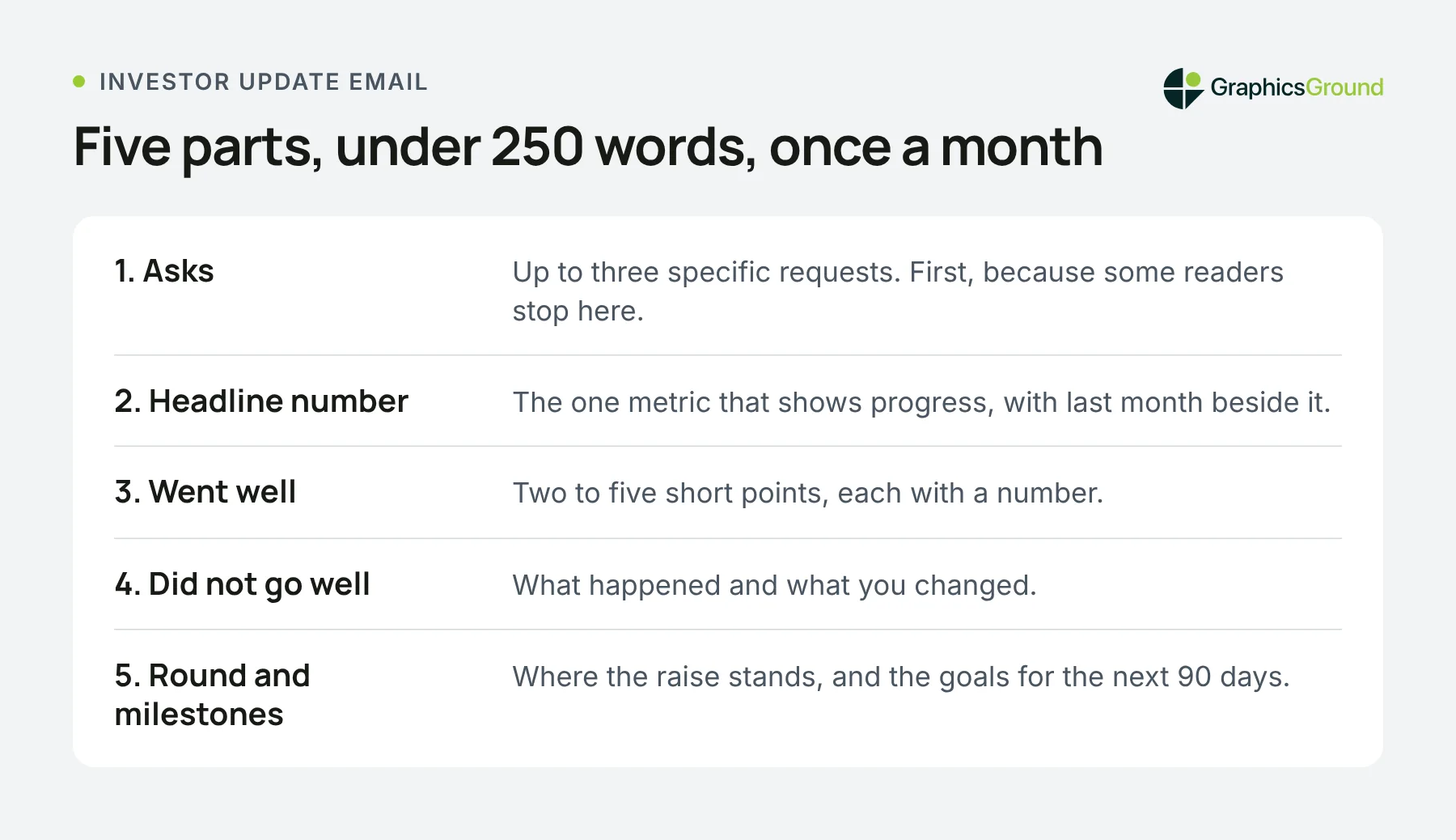
- Asks. Up to three specific requests. An introduction to a named person, a hire you need, a customer type you are looking for.
- Headline number. The one metric that best shows progress, with last month beside it.
- Highlights. Two to five short points on what went well.
- Lowlights. Two to five short points on what went badly, and what you are doing about it.
- Round and milestones. Where the raise stands, and the goals for the next few months.
A template you can copy
Subject: [Company] update: [Month], [headline number]
Hi all,
Asks
1. An introduction to [named person or type of investor].
2. A [role] hire. Job description linked below.
Headline
[Metric]: [this month], up from [last month].
Went well
- [Result, with a number]
- [Result, with a number]
Did not go well
- [What happened, and what you changed]
The round
Raising [amount]. [Amount] committed. Planning to close by [date].
Next 90 days
- [Milestone and date]
- [Milestone and date]
[Your name]
A filled-in example
The company and numbers here are invented to show the format.
Subject: Shiftwise update: October, $46K MRR
Hi all,
Asks
1. An introduction to anyone who runs operations at a restaurant group with 20 or more locations.
2. We are hiring a second account manager in Chicago.
Headline
Monthly recurring revenue: $46K, up from $40K in September.
Went well
- Signed three restaurant groups, 41 locations in total.
- Average time to fill a shift fell from 2.4 hours to 1.8.
Did not go well
- Two small customers left, both citing price. We are testing a lower plan for single-location restaurants.
The round
Raising $2M. $650K committed. Planning to close by mid-December.
Next 90 days
- Reach $60K MRR by January.
- Launch in a second city in February.
Maya
That is about 130 words. It can be read in under a minute on a phone, and every line is a fact.
Who should receive it
| Group | Include? | Note |
|---|---|---|
| Existing investors and angels | Yes | They are your first source of introductions |
| Advisors | Yes | Asks are often easiest for them to act on |
| Investors who said “keep me posted” | Yes, with permission | Ask once: “May I add you to our monthly update?” |
| Investors who passed for stage or timing | Yes, with permission | Many look again at the next round |
| Investors who never replied | No | Do not add people who have not agreed |
If the prospective investors on your list should not see cash or runway figures, keep two versions: a full one for existing investors and a lighter one for prospects. Send group updates with the recipients hidden, or use a simple mailing tool.
Which number to lead with
- Pre-revenue. Active users, waitlist sign-ups that convert, pilots signed, or usage per customer.
- Early revenue. Monthly recurring revenue or monthly revenue, with the month before.
- Marketplaces. Transactions or volume, and repeat rate.
- Deep tech or long sales cycles. A technical milestone reached, or signed letters of intent.
Choose one and keep it the same every month. Changing the headline metric whenever the old one dips is the first thing investors notice.
Six rules that keep investors reading
- Same day every month. Put a recurring slot in your calendar. Consistency is part of the message.
- Short. Under about 250 words. Link to detail, do not paste it.
- Numbers over adjectives. “Grew 15%” instead of “great momentum”.
- Bad news included. Say what went wrong and what you changed. It builds more trust than another win.
- Specific asks. “Introductions welcome” gets nothing. “An introduction to the COO of [company]” gets replies.
- Plain email. No designed newsletter, no heavy attachment. It should look like a note from a founder.
Be accurate about the round. Only report money as committed when it is. Prospective investors will compare your update with what they hear elsewhere.
How we use updates in raise support
An investor update template is one of the materials founders get in our 90 days of raise support, and it connects to the weekly call. Each week we look at what happened: who replied, what they asked, what moved. At the end of the month, the update is mostly written already, because the facts were logged as they happened.
The update also feeds the deck. If the headline number has improved for three months, the traction slide should say so. We use the revision rounds for exactly that kind of change. See when a deck needs fixing and when it needs rebuilding.
Frequently asked questions
How often should I send an investor update?
Monthly. Quarterly is too slow during a raise, and weekly is too much for people who have not invested yet.
What if I have nothing to report this month?
Send it anyway, shorter. A quiet month reported honestly is better than a gap, which readers fill in with their own guesses.
Should the update include financials?
For existing investors, include cash, burn and runway. For prospects, the headline metric and round status are usually enough.
Can an update replace a follow-up email?
After your first three follow-ups, yes. Before that, write to the investor directly. See what to send after a pitch.
Should I attach the deck to every update?
No. Link to the latest version once, and mention it only when something material has changed.
The monthly update is part of a wider plan for your first weeks of raising. The 30-Day Fundraising Checklist lays it out, free. If you want the template, the investor list and a weekly review of your raise, see Investor Deck + 90 Days of Raise Support.
What to prepare, send, and track in your first 30 days of raising. Free.
Investor Feedback on Your Pitch Deck: When to Change It
One investor’s comment is an opinion. The same comment from three is a pattern. Here is how to log investor feedback, read it, and decide what to change.
Read the article
Investor Ready Checklist: 30 Days Before You Raise
Being investor ready means you can answer “send me more” within the hour. Use this four-week checklist to prepare, target, send and track before you raise.
Read the article