An investor reading your seed deck is not reading slides. They are asking questions. What do you do? Who has this problem? Is anyone paying? Why you?
Every slide in your deck should answer one of those questions, clearly and quickly. When a slide does its job, the investor moves to the next question. When it doesn’t, they either ask you in a meeting or, more often, stop reading.
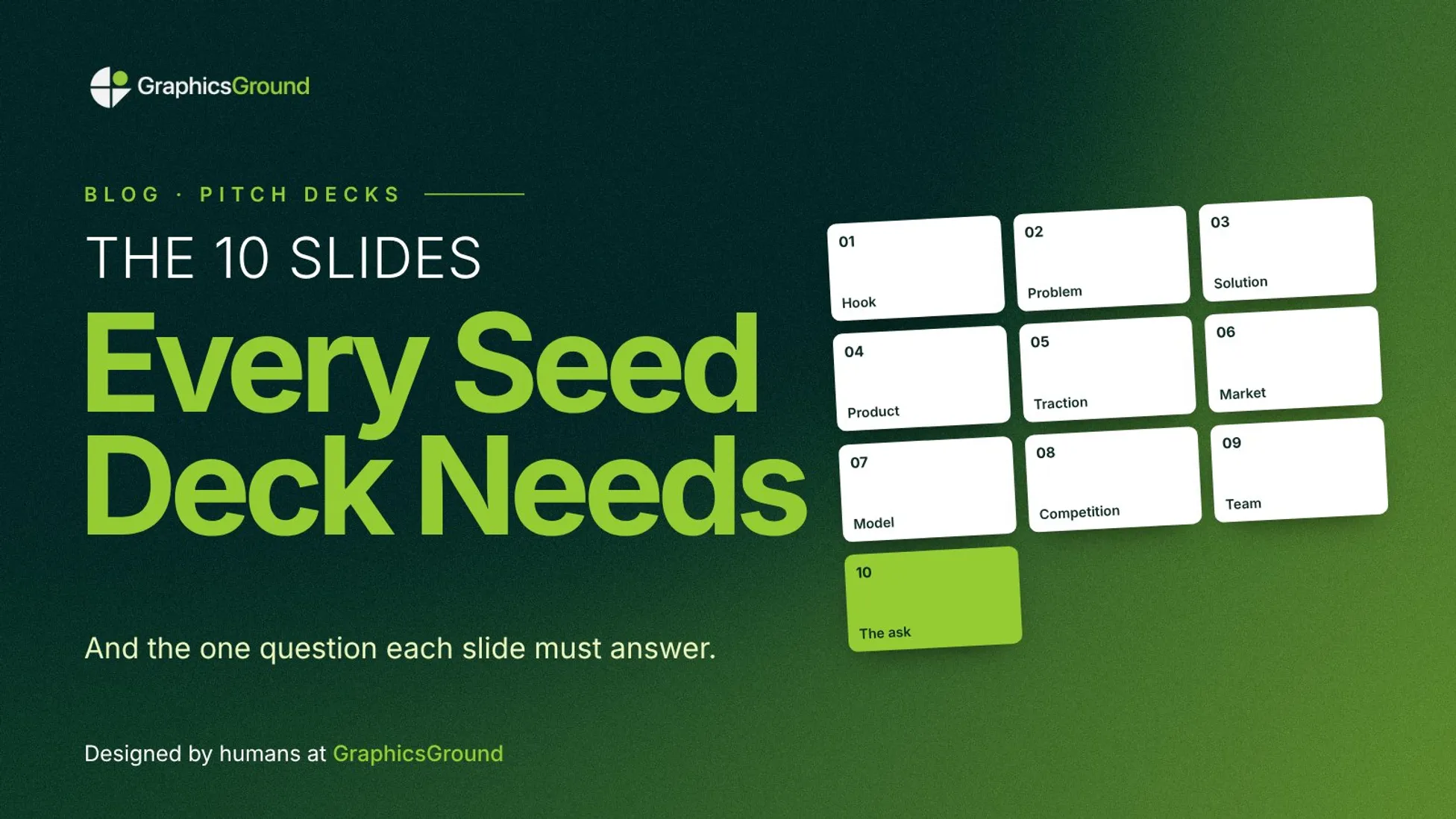
Here are the 10 slides every seed deck needs, in the order investors expect them, and the one question each slide must answer.
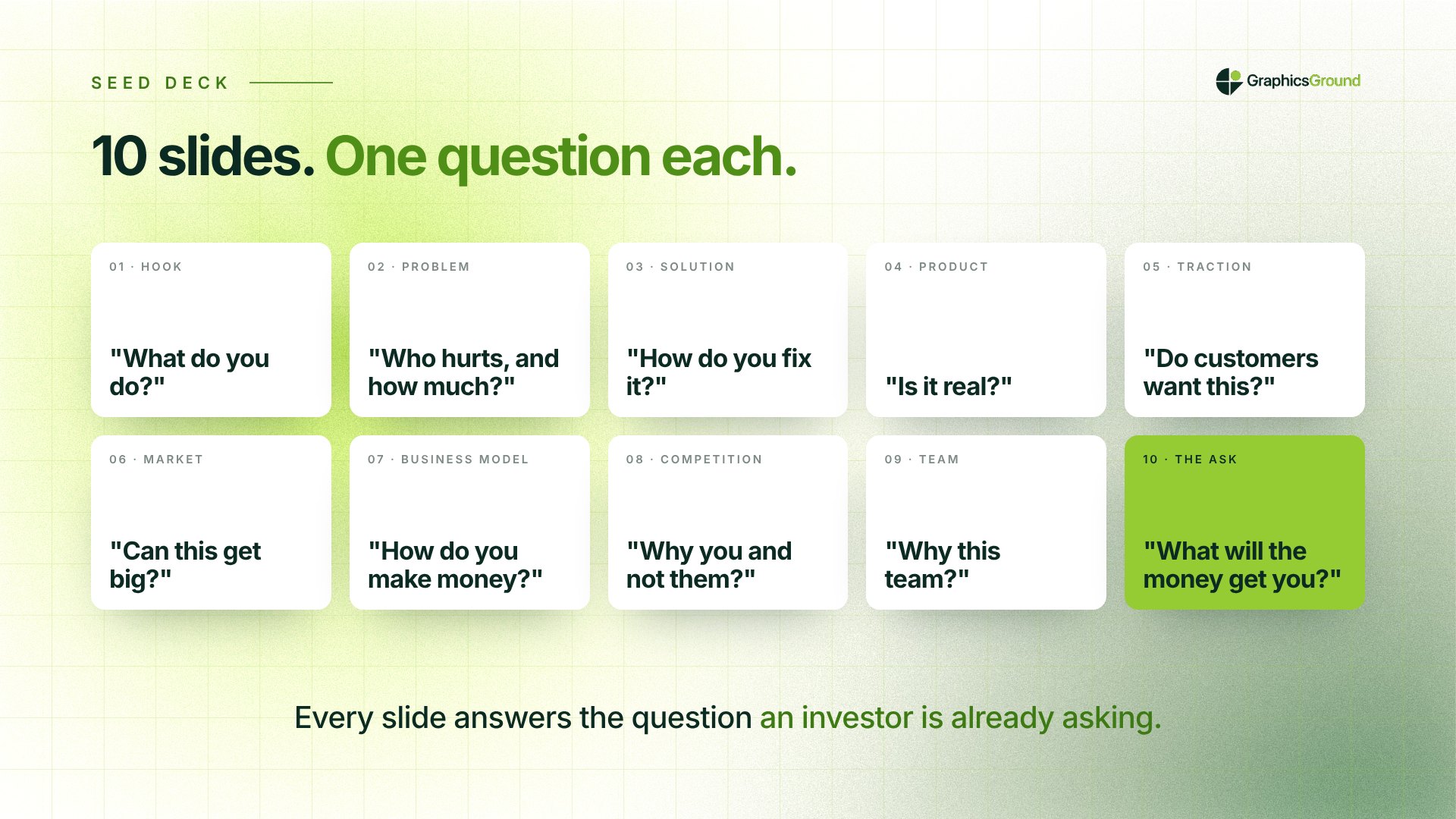
1. The hook: “What do you do?”
Your first slide should tell an investor what your company does in one plain sentence: who it’s for and what changes for them. If they can’t repeat it back after this slide, nothing that follows will stick.
Weak: “Shiftwise: Reimagining the future of hospitality work.”
Strong: “Shiftwise fills last-minute restaurant shifts in under 2 hours.”
The weak version sounds ambitious but says nothing. The strong one gives the customer, the job and a result in one line.
2. The problem: “Who hurts, and how much?”
Investors back specific pain for specific people, because that is where your first customers come from. Name the customer, how often the problem happens, and what it costs them today.
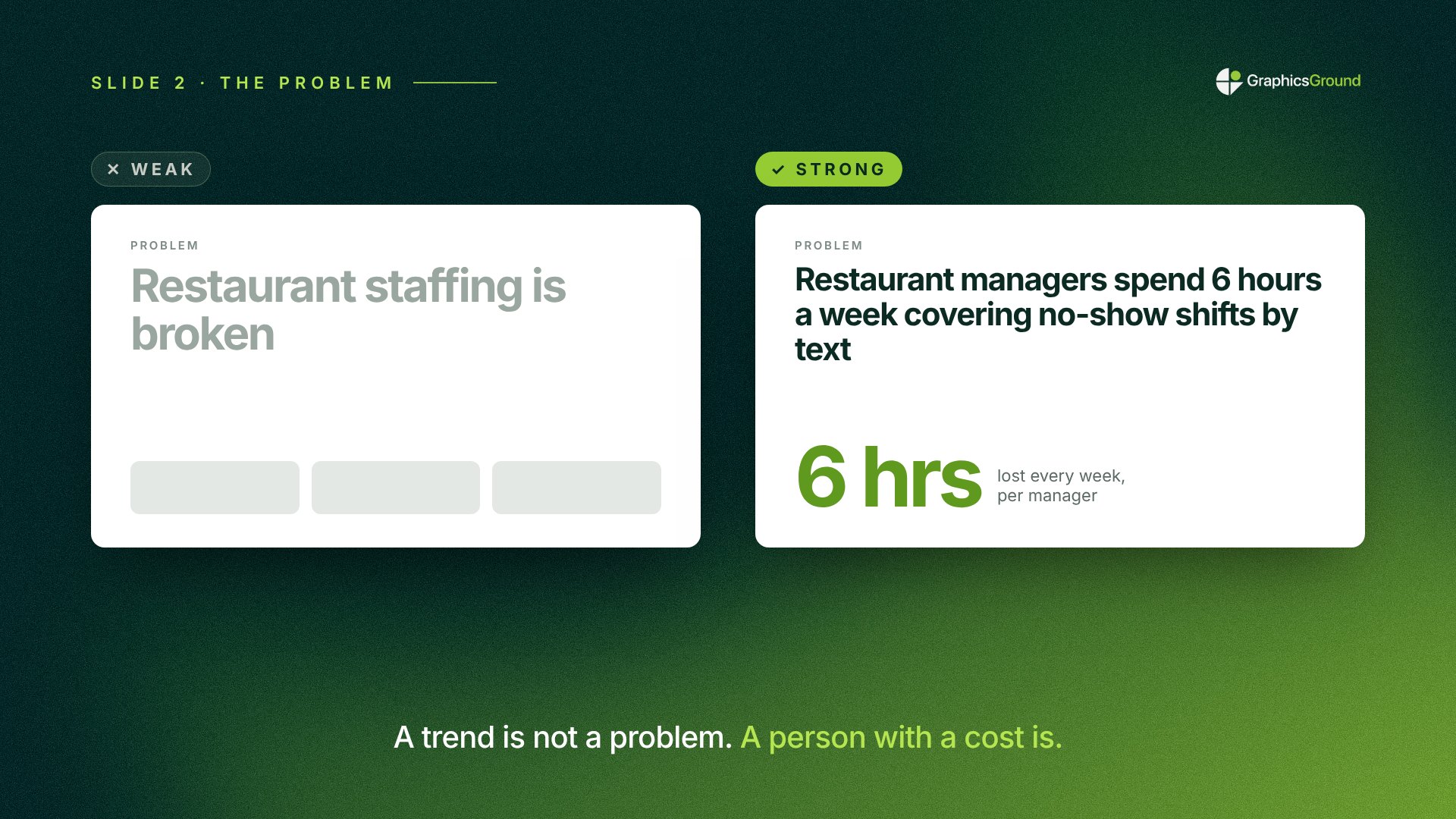
Weak: “Restaurant staffing is broken.”
Strong: “Restaurant managers spend 6 hours a week covering no-show shifts by text.”
3. The solution: “How do you fix it?”
Show how you remove the exact pain from slide 2. Investors want a direct line between the two slides. Lead with the one thing that solves the problem, not your full feature list.
4. The product: “Is it real?”
Make the product easy to picture. One clear screenshot or mockup of the key moment, with two or three callouts, does more than a crowded dashboard nobody can read.
5. Traction: “Do customers actually want this?”
This is the slide investors believe most, because it shows what customers did, not what you say. Show growth over time and whether customers stay. A big number with no time frame raises more questions than it answers.
Weak: “10,000 signups.”
Strong: “Filled shifts grew 5x in 6 months, and 88% of restaurants are still active after 90 days.”
If your traction is your strongest point, move this slide earlier. Order can flex when you have a reason.
6. The market: “Can this get big?”
Investors need to believe the business can grow large enough to return their fund. A bottom up number, your customers multiplied by what each pays, is more convincing than a giant figure from an industry report because they can check the logic.
7. The business model: “How do you make money?”
Who pays, how much and how often. At seed stage, one clear pricing line plus early unit economics is enough. Avoid listing revenue streams you haven’t tested.
8. Competition: “Why you and not them?”
Every investor will ask who else is doing this. Show the real alternatives, including spreadsheets or doing nothing, and the one thing you do that is hard to copy. A table where you have every tick and competitors have none convinces nobody.
9. The team: “Why is this the team to win?”
Job titles and big company logos show where you’ve been. Investors want to know why you are the right people for this specific problem. Give each founder one line of proof that links their past to this market.
10. The ask: “What do you need, and what will it get you?”
State the amount, how you will spend it, and the milestone it reaches. The milestone is what lets an investor judge whether the amount is enough.
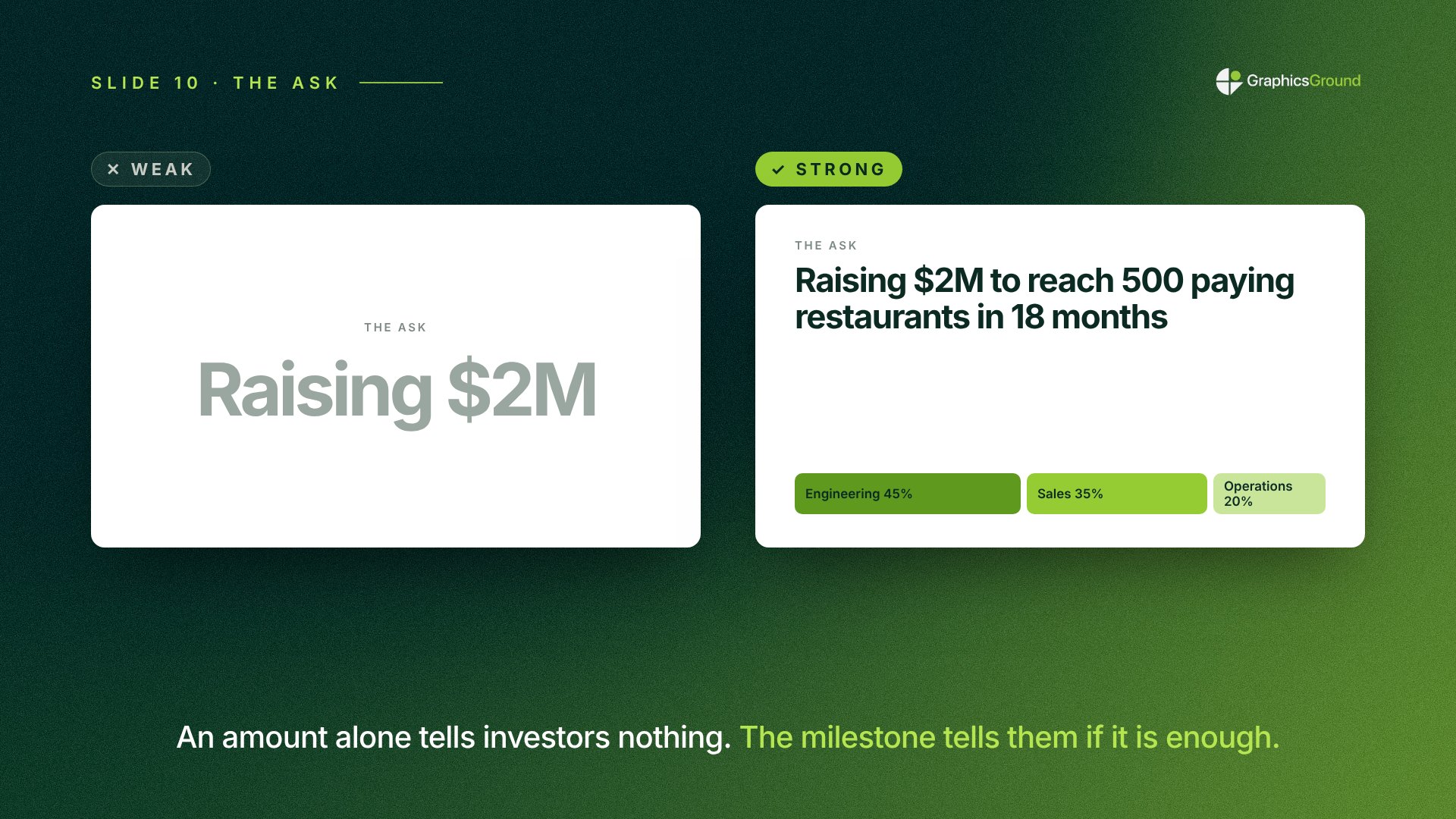
Weak: “Raising $2M.”
Strong: “Raising $2M to reach 500 paying restaurants in 18 months.”
All companies and numbers in these examples are illustrative.
Know what each slide should say, but not how to lay it out? The Seed Deck Slide Blueprint gives you a page for every slide: a headline formula, a simple layout, what investors look for and the most common mistake to avoid.
Why this order works
The order follows the way an investor thinks. First they need to understand what you do (slides 1 to 4). Then they need evidence that it works (slide 5). Then they ask if it can be big and profitable (slides 6 and 7), whether you can defend it (slide 8), and whether you are the people to build it (slide 9). Only then does the ask make sense (slide 10).
You can move a slide when you have a reason, like leading with traction if it’s exceptional. What hurts is jumping back and forth, so the investor loses the thread.
What goes in the appendix
Ten slides keep your story tight. Everything else goes after them: detailed financials, cohort data, extra customer case studies, product screens and the full roadmap. Investors who want the detail will find it, and the main story stays fast.
Build each slide with the blueprint
Knowing the question is the first step. Answering it well on one slide is the hard part. The free blueprint walks you through all 10 slides with a headline formula you can fill in, a simple layout for each, and an example for every slide.
Want these 10 slides designed for you?
Our designers build seed decks for founders preparing for Demo Day and the raise after it. Every slide is designed by people, not templates. Start with a free 30 minute deck review.
Pitching on stage soon? Read: How to Build a Demo Day Pitch Deck (3-Minute Format). Just finished Demo Day? Read: Your Demo Day Deck Is Not Your Investor Deck.