
Cold Email to Investors: How to Write One, With Templates
A cold email to investors works when it is short, specific to that investor, and easy to forward. Here is the five-line structure and three templates to copy.
 GraphicsGround teamInvestor decks, built with you, backed for the raise.
A cold email to investors should be under 120 words and do five things in order: say why you chose this investor, describe the company in one sentence, give your strongest proof, state what you are raising, and ask for one small next step. Send it from your own address, to one named person, with the deck shared as a link.
That structure matters more now than it did a few years ago. Investors are receiving more outreach than ever, much of it written by software, and they filter hard. Below is how to write the kind of email that still gets read, with three templates.
Key takeaways
- The first line must prove you picked this investor on purpose.
- One sentence for the company, one number for proof, one ask.
- Write it so the investor can forward it to a partner without editing.
- A specific email to 40 well-chosen investors beats a generic one to 400.
Why most cold emails to investors are ignored
The volume is the problem. In a TechCrunch report on why VCs go quiet, one investor said he receives about 30 pitches a day. Another warned that AI-written cold emails are drowning out genuine outreach, and that investors may start filtering out senders they do not know.
So the bar is simple and high. Your email has to look, within two lines, like it was written by a founder for one specific person. Everything in this guide serves that.
The five lines every investor cold email needs
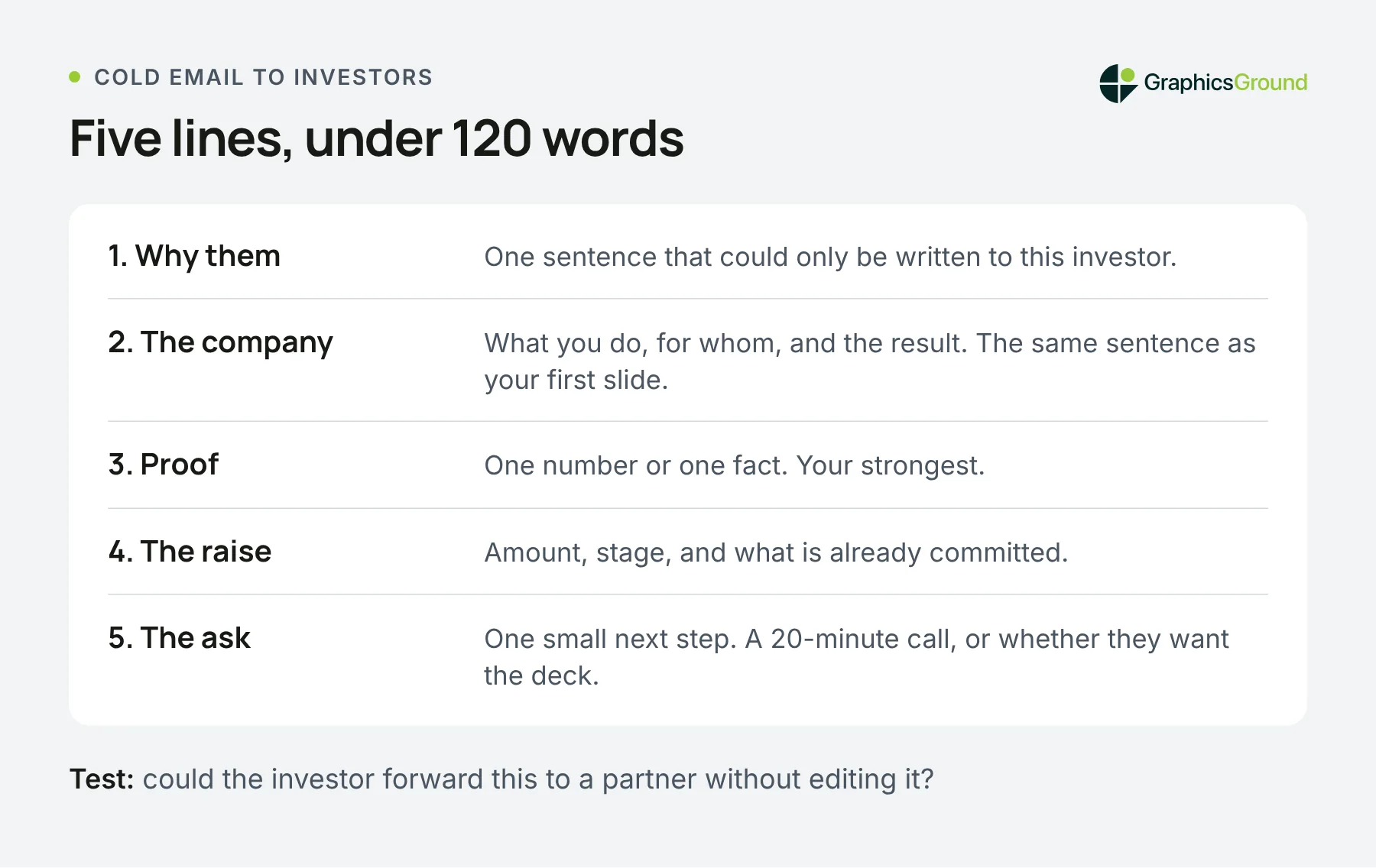
- Why them. One sentence that could only be written to this investor: a portfolio company, something they published, a stated focus. This line comes from the “why them” column of your investor list.
- The company in one sentence. What you do, for whom, and the result. Plain words. The same sentence as your first slide.
- Your strongest proof. One number or one fact: revenue, growth, a named customer, a relevant win. One, not five.
- The raise. The amount, the stage, and what is already committed if anything is.
- One small ask. A 20-minute call, or whether they would like the full deck. Make yes easy.
Notice what is missing: your life story, the market size, the product roadmap, the word “revolutionary”. Those belong in the deck or the meeting.
Subject lines that get opened
The subject line has one job, which is to look like a real email about a real company. Keep it under about 50 characters and put the substance first.
| Weak | Stronger | Why |
|---|---|---|
| Investment opportunity | Shiftwise: seed round, $40K MRR | Names the company and the proof |
| Quick question | Restaurant staffing, after your hospitality post | Shows it was written for them |
| Revolutionary AI platform!! | Intro from [mutual name]: Shiftwise | Leads with the connection |
| Following up | Shiftwise: 3 new restaurant groups signed | Carries news |
The company in these examples is invented for illustration.
Three templates you can copy
Use these as a frame. The first line has to be rewritten for every investor, and that is the point of it.
1. Cold, with a specific reason
Subject: [Company]: [stage] round, [strongest number]
Hi [Name],
I am writing to you because of [their portfolio company or post], which is close to what we are building.
[Company] [does what] for [whom], so that [result].
[Strongest proof: one number or named customer, with a time frame.]
We are raising [amount] to [milestone]. [Amount] is committed.
Would you be open to a 20-minute call next week? The deck is linked below.
[Your name, title, phone]
2. The forwardable email, for a warm introduction
When someone offers to introduce you, do not ask them to write the email. Send them this, so all they have to do is press forward.
Subject: Intro request: [Company] and [Investor name]
Hi [Connector],
Thank you for offering to introduce me to [Investor]. Here is a short note you can forward.
[Company] [does what] for [whom]. [Strongest proof.] We are raising [amount] to [milestone].
I think [Investor] is a fit because [specific reason]. The deck is linked below.
[Your name]
3. Short version, for an angel
Subject: [Company]: [one-line description]
Hi [Name],
You backed [company] early, and we are solving a neighboring problem.
[Company] [does what]. [One proof point.] We are raising [amount], with checks from [minimum].
May I send you the deck?
[Your name]
Every bracket must be true. Do not write “[amount] is committed” unless it is. Do not claim a connection you do not have. Investors compare notes, and one false line undoes the rest.
Should you send the deck in the first email?
Yes, in most cases, and as a link instead of an attachment. The most common reply to a good cold email is “send me the deck”, and including it saves a round trip that many investors never complete. A link has one more advantage: you can update a link, and you cannot take back an attachment.
Three rules make it work for you:
- Send the reading version. A deck built for a live pitch has too little on each slide to be read alone. The one you email needs full-sentence headlines.
- Make the link open for anyone. No sign-in, no request-access screen. Test it in a private browser window before you send.
- Respect stated preferences. If the investor’s site asks for a form or a link, use that.
Before you send it to anyone, test whether the deck works without you. Give it to a stranger for three minutes and ask them to explain the company back. We describe the test in pitch deck redesign: fix it or rebuild it.
How we write outreach with founders
In our raise support, we write the outreach templates around the founder’s company and story, and the founder sends them. That split is deliberate.
- The message matches the deck. The one-sentence description in the email is the first slide of the deck. An investor who reads both hears the same story twice.
- The founder personalizes the first line. We research why each investor fits. The founder turns that into their own words.
- The founder sends, from their own address. Investors are backing a person. The relationship has to start with that person.
We do not send messages as the founder, and we would be cautious of any service that offers to.
Seven mistakes that get you filtered out
- “Dear Sir or Madam” or “Hi there”. Name the person.
- One email to many investors. Never use CC or BCC for a raise.
- Four paragraphs before the point. Lead with why them, then the company.
- Superlatives instead of numbers. “Huge traction” says less than “$40K monthly revenue”.
- Asking for an NDA. Investors do not sign them at this stage, and asking signals inexperience.
- The wrong stage. A Series B fund will not do your pre-seed. Check before you write.
- Text that reads as generated. If the first line could be sent to anyone, it will be treated as sent to everyone.
What to do after you press send
- Log it. Date, investor, version of the deck.
- Follow up once after about a week, with news instead of a reminder. Our investor follow-up guide has the schedule.
- Watch for patterns. If nobody replies to 20 well-targeted emails, look at the first two lines. If people reply and then go quiet after the deck, look at the deck.
For another founder-focused view, Y Combinator’s Michael Seibel has a short talk on how to cold email investors.
Frequently asked questions
Do cold emails to investors work?
They can. A warm introduction is stronger, but many investors read cold email, and a specific, short message from the founder is the version that gets through.
How long should a cold email to an investor be?
Under 120 words. It should fit on a phone screen without scrolling.
How many investors should I email?
Work from a researched list of 30 to 50 and send in small batches, so you can adjust the email as replies come in.
Is it better to email or message on LinkedIn?
Email is the default for a pitch. LinkedIn is fine for a short first contact if the investor is active there. Pick one channel per investor.
When is the best time to send?
There is no reliable magic hour. A weekday morning in the investor’s time zone is a sensible default. What you write matters far more than when you send it.
Outreach is week two of a 30-day plan. The 30-Day Fundraising Checklist covers all four weeks, free. Outreach templates written around your company are part of our Investor Deck + 90 Days of Raise Support.
What to prepare, send, and track in your first 30 days of raising. Free.
Investor Feedback on Your Pitch Deck: When to Change It
One investor’s comment is an opinion. The same comment from three is a pattern. Here is how to log investor feedback, read it, and decide what to change.
Read the article
Investor Ready Checklist: 30 Days Before You Raise
Being investor ready means you can answer “send me more” within the hour. Use this four-week checklist to prepare, target, send and track before you raise.
Read the article