
How to Build an Investor List for Your Seed Round
A seed investor list is 30 to 50 named people who fit your stage, sector, check size and geography. Here is how to find them, score them and sequence them.
 GraphicsGround teamInvestor decks, built with you, backed for the raise.
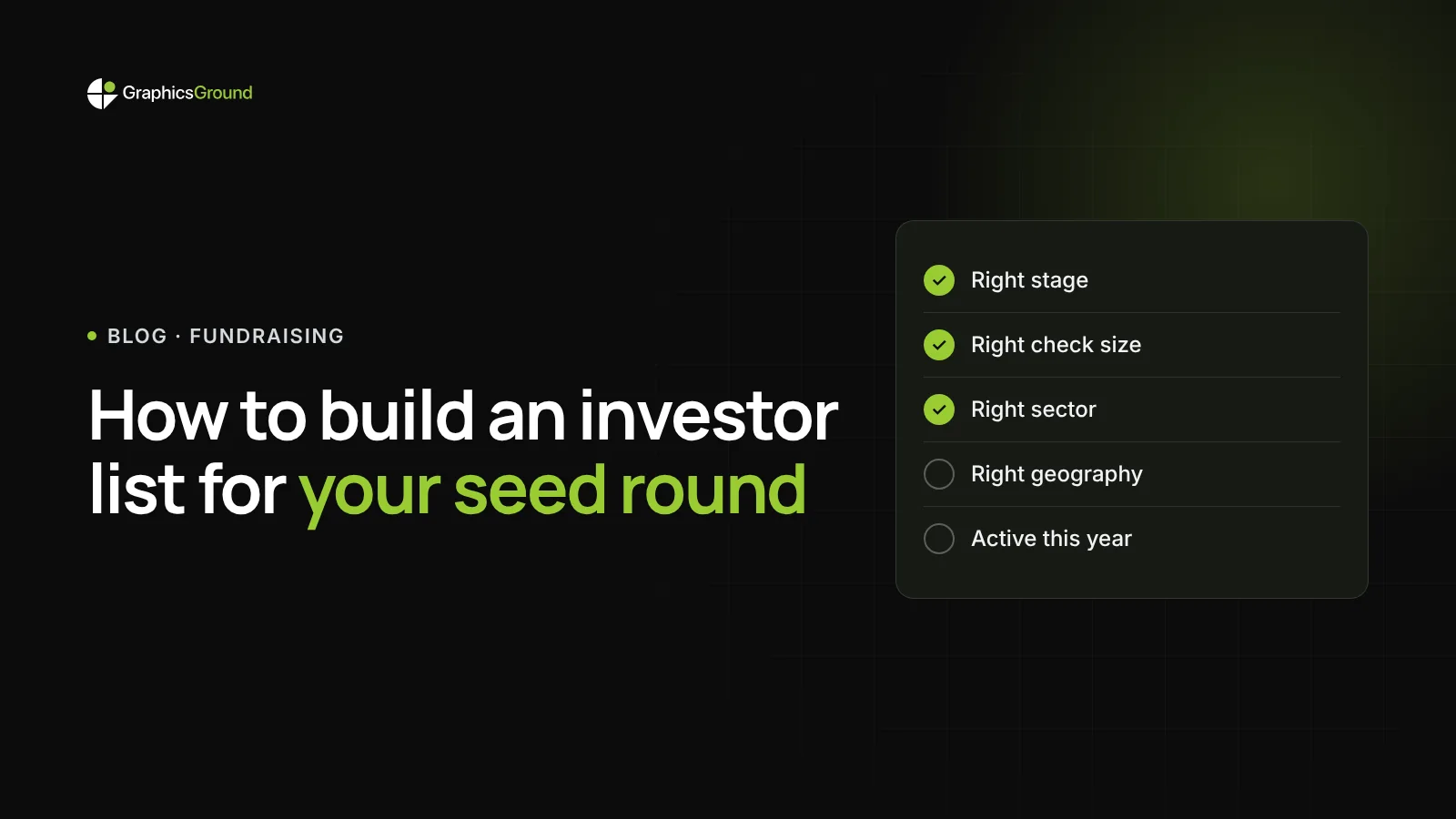
To build an investor list for a seed round, start with a long list of about 75 to 100 names, score each one on fit, and cut to 30 to 50 investors you will actually contact. Fit means five things: they invest at your stage, write your check size, know your sector, invest in your geography, and have made a new investment recently. A list built this way gets more replies than a list of 500, because every message can explain why you chose that person.
This guide walks through the steps we use when we research investors for a founder: the criteria, the sources, the scoring, and the order of outreach.
Key takeaways
- A good list is short and specific. Aim for 30 to 50 named people, not firms.
- Cut hard on stage, check size and sector. A miss on any of those is a no.
- Check for recent activity. An investor who has not done a deal in a year may not be investing.
- Contact your best-fit investors after you have practiced, not first.
Step 1: Write down your round before you look for anyone
You cannot judge fit without knowing what you are fitting to. Put these five lines at the top of your sheet.
- Stage. Pre-seed, seed, or a seed extension.
- Amount. What you are raising and what it gets you to.
- Check size you need. A lead who takes a large share, or several smaller checks.
- Sector. Described the way an investor would describe it, such as “B2B SaaS for restaurants”.
- Geography. Where the company is based and where it sells.
Decide early whether you need a lead. In Mercury’s guide to building a seed target list, a lead typically takes 40 to 60 percent of a seed round, with two to four others filling the rest. That changes who belongs on your list.
Step 2: Collect a long list of 75 to 100 names
Cast wide at first. You will cut most of them.
| Where to look | What it is good for |
|---|---|
| Investors in companies like yours | The strongest signal. Look at who funded startups one or two years ahead of you in the same space. |
| Crunchbase and AngelList | Recent deals, check sizes, who led |
| Fund websites | The stated thesis, stage and portfolio |
| LinkedIn and X | What a partner is writing about this month |
| Your accelerator and your angels | Names plus a possible introduction |
| Other founders | Who was helpful, who was slow, who to avoid |
Write down the person, not only the firm. Funds do not reply to email. Partners do, and each partner has their own interests.
Avoid direct competitors’ investors. An investor who already backs a company doing what you do will usually pass, and may share what you sent. Look for investors in neighboring companies instead.
Step 3: Score every name on fit
Give each investor a simple score so the cutting is based on evidence instead of how famous the fund is.
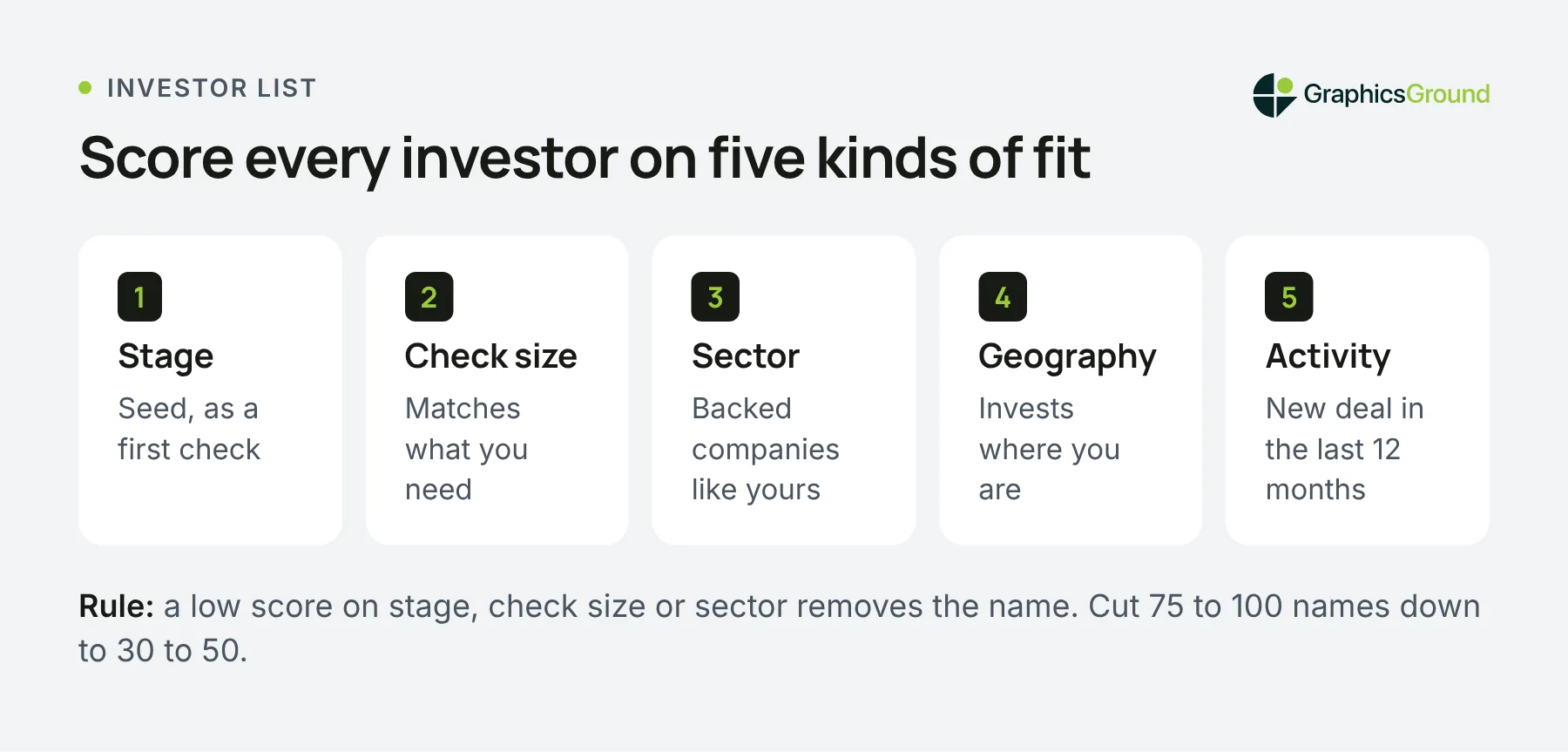
| Criterion | The question | Where to check |
|---|---|---|
| Stage | Do they invest at seed, as a first check? | Their last ten deals |
| Check size | Does their usual check match what you need? | Fund size and recent rounds |
| Sector | Have they backed companies like yours? | Portfolio page |
| Geography | Do they invest where you are? | Portfolio locations |
| Recent activity | Have they made a new seed investment in the last 12 months? | Crunchbase, news, their own posts |
Rate each from 1 to 3 and add them up. Then apply one rule without exceptions: a 1 on stage, check size or sector means cut. A Series B fund that loves your sector is still a Series B fund.
Recent activity is the criterion founders skip. A fund can have the right thesis on its website and no money left to deploy. If there is no new investment in a year or more, score it a 1 and treat the name as a long shot.
Step 4: Cut to 30 to 50 and rank them A, B and C
- A, about 10 names. The best fit. High score on all five.
- B, about 20 names. Good fit with one soft spot.
- C, about 10 to 15 names. Reasonable fit, lower priority.
When we research investors for a founder in our raise support, this is the list we hand over: 30 to 50 people, by name, matched to the stage, sector, geography and size of the round. We keep it that short on purpose. A founder can write 40 good messages. Nobody writes 400.
Step 5: Add the columns that make outreach possible
A list of names is not yet useful. For each investor, add:
- Why them. One sentence: the portfolio company, post or thesis that makes you a fit. This becomes the first line of your email.
- Path in. Who can introduce you, or “cold” if nobody can.
- Contact. Email, or the form they ask founders to use.
- Status. Not contacted, contacted, replied, meeting, passed, committed.
- Last touch and next step. With dates.
- Notes. What they asked, where they hesitated.
The “why them” column is the test of the whole list. If you cannot write that sentence for an investor, they should not be on it.
Step 6: Contact them in the right order
Do not start with your dream investors. Your first few pitches are your worst.
- Start with a batch of mostly B names. Use these conversations to find the questions you did not expect.
- Fix the deck. If the same question comes up three times, change the slide. See when to fix a deck and when to rebuild it.
- Then contact your A names close together. Meetings in the same two weeks create real momentum, and you can truthfully tell each investor that others are looking.
- Follow up on a schedule. Our investor follow-up guide has the timing and templates.
Where you have a warm introduction, use it. Where you do not, a specific cold email still works. We cover that in how to write a cold email to investors.
How many investors do you need to contact?
More than feels comfortable. Buffer’s founders wrote that they contacted around 200 investors, had about 50 meetings, and closed their seed round with 18. Mercury’s guide suggests planning for 30 to 50 real conversations.
The lesson is not to blast 200 people at once. Work your 30 to 50 properly, and refill the list as names drop out. Each new batch goes through the same scoring.
Five mistakes that waste a list
- Buying a database and calling it a list. Thousands of rows with no “why them” is a mailing list, and it performs like one.
- Listing firms instead of partners. The wrong partner at the right firm is a no.
- Ignoring stage. The most common reason for a fast pass is “too early for us”.
- Not tracking. Without status and dates you will follow up twice with one investor and never with another.
- Treating the list as finished. A list is a working document. Update it every week of the raise.
Frequently asked questions
How many investors should be on a seed list?
Start with 75 to 100, then cut to 30 to 50 you will contact. Keep the rest as a reserve to refill from.
Should I include angels or only funds?
Both, in separate tabs. Angels decide faster and write smaller checks. Funds can lead. Most seed rounds use a mix.
Where can I find investor email addresses?
Many investors list an address or a pitch form on their website or profile. Use what they publish. If they ask for a form, use the form.
What tool should I use to track investors?
A spreadsheet is enough for a seed round. One row per person, with the columns in step 5. Move to a CRM only if the sheet becomes hard to manage.
Can someone build the list for me?
Yes, and it saves weeks. Make sure whoever does it scores for fit and gives you the reasoning for each name. A researched list of 30 to 50 investors is part of our 90 days of raise support.
The investor list is week one of a 30-day plan. The 30-Day Fundraising Checklist covers the other three weeks, free. For another view of list building, CRV’s guide on how to build an investor target list is worth reading from an investor’s side.
What to prepare, send, and track in your first 30 days of raising. Free.
Investor Feedback on Your Pitch Deck: When to Change It
One investor’s comment is an opinion. The same comment from three is a pattern. Here is how to log investor feedback, read it, and decide what to change.
Read the article
Investor Ready Checklist: 30 Days Before You Raise
Being investor ready means you can answer “send me more” within the hour. Use this four-week checklist to prepare, target, send and track before you raise.
Read the article