
Investor One-Pager: What It Is and How to Write One
An investor one-pager is your whole raise on a single page. Here are the eight blocks it needs, how to lay them out, and when to send it instead of the deck.
 GraphicsGround teamInvestor decks, built with you, backed for the raise.
An investor one-pager is a single page that summarizes your company and your raise: what you do, the problem, your traction, the market, the team, and what you are asking for. It is also called a one-page investment summary or a teaser. Investors use it to decide in about a minute whether to open the full deck, and to pass your company to a partner without writing anything themselves.
It does not replace the pitch deck. It gets the deck opened. This guide covers the eight blocks a one-pager needs, how to lay them out, and when to send it.
Key takeaways
- One page, one company, one ask. If it runs to two pages, it is a short deck.
- Every number needs a date beside it.
- Write it so an investor can lift the facts straight into their own notes.
- The first sentence must match the first slide of your deck.
One-pager or pitch deck: when to use which
| One-pager | Pitch deck | |
|---|---|---|
| Job | Earn a closer look | Make the full case |
| Reading time | About a minute | Three to five minutes |
| Best for | Cold outreach, forwarded introductions, angel groups, the front of a data room | After interest is shown, and in meetings |
| Detail | Headline facts only | The argument, with proof |
| Format | A one-page PDF | 10 to 15 slides |
A simple rule: send the one-pager when someone has to be persuaded to spend time on you, and the deck once they have decided to.
Why investors like a one-pager
Investors keep their own short record of every company they consider. Hustle Fund’s angel community describes this in its guide to the one-page tear sheet: a snapshot of the company, the thesis, the round terms, a few dated metrics, the team, the main risks and the next step.
That tells you exactly how to write yours. If your one-pager already contains those facts, clearly labeled and dated, the investor can copy them into their notes in a minute. If they have to dig through a 20-slide deck to find your round size, many will not bother.
The eight blocks of an investor one-pager
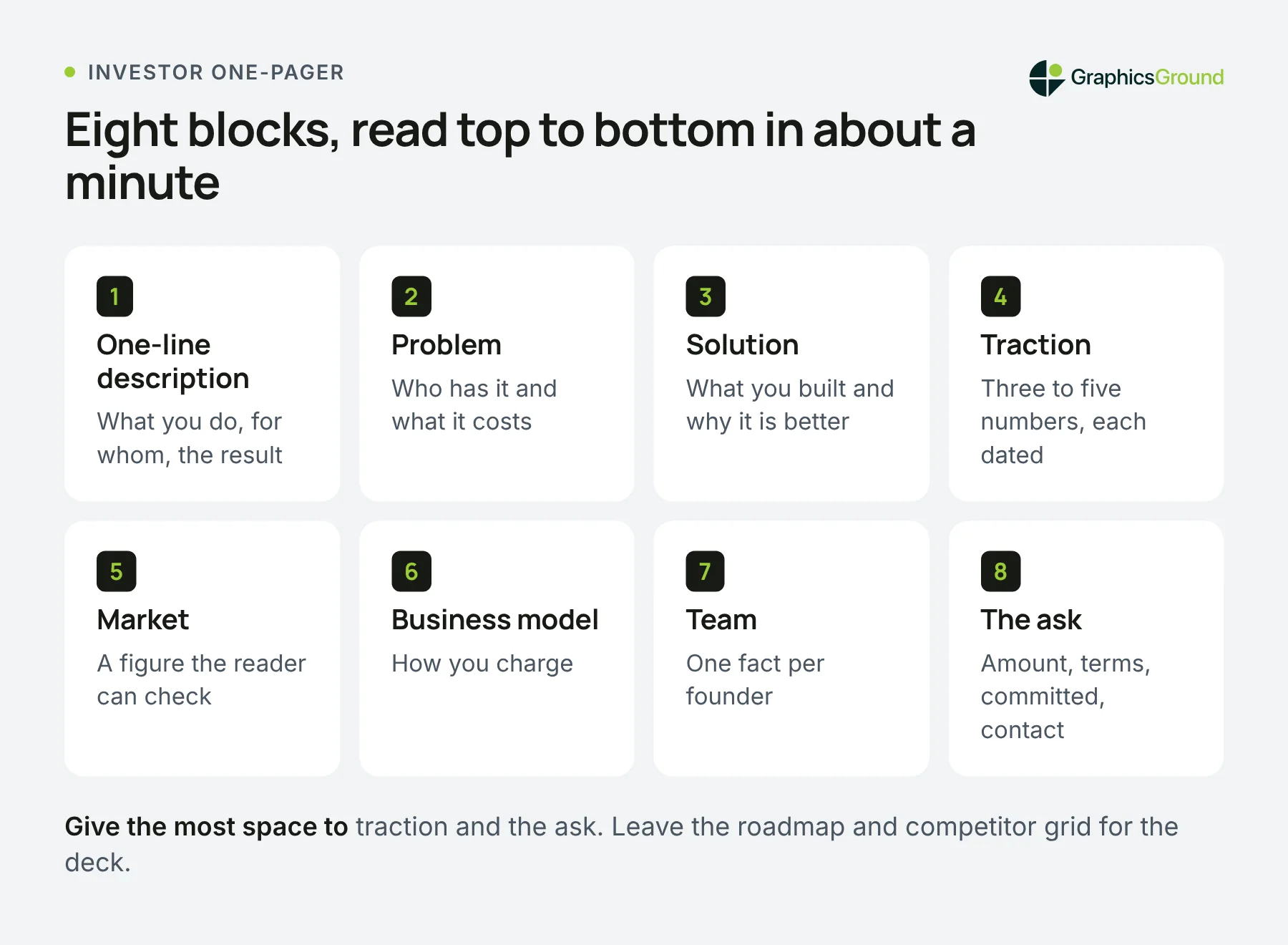
- Header and one-line description. Company name, logo, website, and one sentence: what you do, for whom, and the result.
- Problem. Two lines. Who has it, how often, what it costs them.
- Solution. Two lines. What you built and why it is better than what they do today.
- Traction. Three to five numbers, each with a date. Revenue, growth, customers, retention, pilots. This block gets read first after the header.
- Market. One or two lines with a figure the reader can check.
- Business model. How you charge and roughly what a customer is worth.
- Team. Founders’ names and the one fact about each that explains why this team.
- The ask. Amount, instrument, what is committed, what the money gets you to, and how to reach you.
Leave out the roadmap, the competitor grid and the long vision statement. They belong in the deck.
A one-pager you can adapt
The company below is invented to show the format. Notice that every number has a date.
Shiftwise · shiftwise.example · Chicago
Shiftwise fills last-minute restaurant shifts in under 2 hours.
Problem. Restaurant managers lose about six hours a week covering no-show shifts by text message.
Solution. An app that offers the open shift to vetted local staff and confirms a replacement automatically.
Traction (October 2026). $46K monthly recurring revenue, up 3x in six months. 120 restaurants. 9 in 10 renew.
Market. 24,000 restaurants in our first five cities, at about $400 a month each: roughly $115M a year to start.
Model. Monthly subscription per location, plus a fee per filled shift.
Team. Maya R., CEO, ran operations for a 40-location restaurant group. Dev K., CTO, built scheduling systems for eight years.
Raising. $2M seed on a SAFE. $650K committed. Gets us to 500 restaurants in 18 months. [email protected]
How to lay it out
A one-pager is a design problem as much as a writing one. You are fitting a company onto one page without making it feel crowded. These are the choices we make when we design one alongside a deck.
- Two columns, clear blocks. Narrow columns are faster to read than full-width lines.
- Make the traction numbers the largest thing on the page after the company name.
- One accent color. Use it for numbers and the ask, nothing else.
- Type no smaller than 9 point. If it does not fit, cut words. Do not shrink the text.
- White space is doing work. A page with margins looks confident. A page filled to the edges looks anxious.
- One chart at most. A simple growth line, if it is your strongest proof.
- Same look as the deck. Fonts, colors and logo should match, so the two feel like one set of materials.
Export it as a PDF and check it on a phone. Many first reads happen there.
When to send it
- With a cold email, when you would rather not attach a full deck to a first message. See how to write a cold email to investors.
- With a forwardable introduction. It gives the person introducing you something light to pass on.
- To angel groups and syndicates, which often ask for a one-page summary before anything else.
- As the first file in your data room, beside the deck. See our seed data room checklist.
- After a meeting, so the investor has a summary to circulate.
Six mistakes that make a one-pager useless
- It is two pages. Then it is neither a one-pager nor a deck.
- No ask. A summary with no round size and no contact is a brochure.
- Numbers without dates. “$46K MRR” means little unless the reader knows when.
- A different story from the deck. If the one-line description changes between documents, investors notice.
- Jargon in the first sentence. Write it for the partner who has never heard of your sector.
- A wall of text. If nothing stands out at a glance, nothing will be remembered.
Update it with the deck. Treat the one-pager and the deck as one set. When a number changes in one, change it in the other the same day.
Frequently asked questions
What is the difference between a one-pager and an executive summary?
In fundraising the terms are used for the same thing: a short summary of the company and the raise. An executive summary is sometimes a little longer and more text-based. A one-pager is strictly one page and more visual.
Should I send a one-pager or a deck first?
If the investor asked for a deck, send the deck. If you are reaching out cold or being introduced, the one-pager is a lighter first step, and you can offer the deck in the same message.
How long does it take to write one?
An hour or two if your deck is finished, because the one-pager is the deck’s headline facts. If it takes much longer, the story in the deck probably is not settled yet.
Do I need a designer for a one-pager?
Not necessarily. A clean two-column document with consistent type is enough. Design helps most when you have a lot to fit and need it to stay readable.
Can I use a one-pager for a fund raise?
Yes. Fund managers use a similar summary for limited partners, with strategy, team, track record and terms. See the LP pitch deck for a first fund.
A one-page investment summary comes with every deck we build, designed to match it. See what else is included in Investor Deck + 90 Days of Raise Support, or start with the free 30-Day Fundraising Checklist.
What to prepare, send, and track in your first 30 days of raising. Free.
Investor Feedback on Your Pitch Deck: When to Change It
One investor’s comment is an opinion. The same comment from three is a pattern. Here is how to log investor feedback, read it, and decide what to change.
Read the article
Investor Ready Checklist: 30 Days Before You Raise
Being investor ready means you can answer “send me more” within the hour. Use this four-week checklist to prepare, target, send and track before you raise.
Read the article