
Seed Pitch Deck Examples: What the Best Have in Common
The best seed pitch deck examples share seven traits, and none of them is fancy design. See what Airbnb, Buffer and the YC template do, and how to copy it.
 GraphicsGround teamInvestor decks, built with you, backed for the raise.
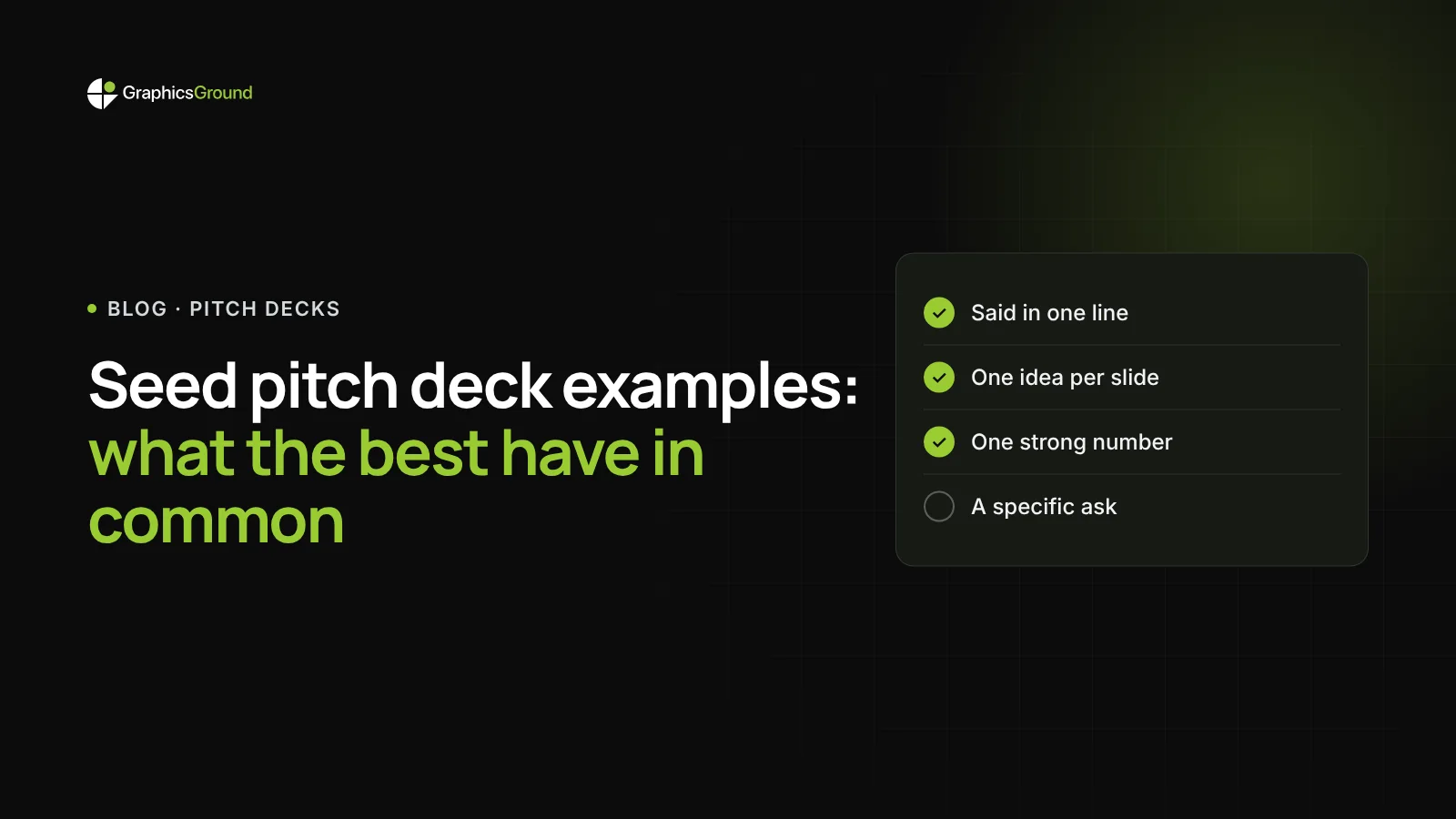
The best seed pitch deck examples have seven things in common: a one-line description on the first slide, one idea per slide, headlines that state the point, one strong number for traction, an honest market size, a specific ask, and a length of roughly 10 to 15 slides. Visual polish is not on that list. Several of the most copied seed decks are plain.
Below are three public examples worth studying, what each one does well, and a checklist you can run on your own deck today.
Key takeaways
- Successful seed decks are clear before they are attractive.
- Every example below can be understood without the founder in the room.
- Traction gets the most attention, and competition causes the most stalls.
- Study the structure of famous decks. Do not copy their content or their era.
The seven traits successful seed pitch decks share
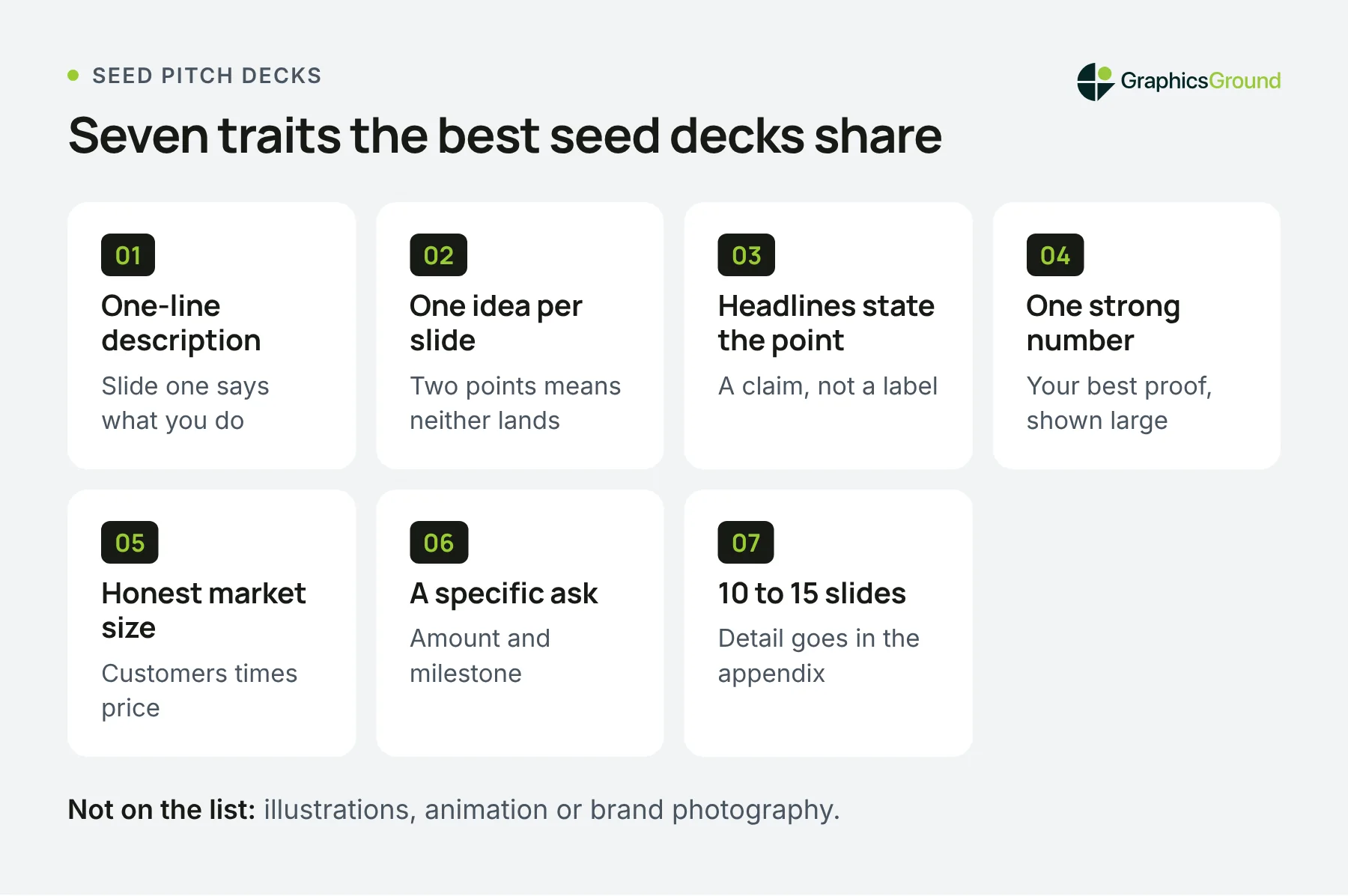
- A first slide that says what the company does. One sentence, plain words, no slogan.
- One idea per slide. If a slide makes two points, the reader keeps neither.
- Headlines that state the point. “Revenue grew 3x in six months” instead of “Traction”.
- One traction number, shown large. The strongest proof you have, over time if possible.
- A market size the reader can check. Built from customers and price, not a trillion-dollar headline.
- A specific ask. The amount, and what it gets you to.
- Short. Around 10 to 15 slides, with detail moved to an appendix.
Why does short matter so much? A DocSend study covered by TechCrunch found investors spent an average of 3 minutes 44 seconds on a deck. A seed deck is read fast, usually alone, and often on a phone.
Example 1: Airbnb, and the value of saying it in one line
The early Airbnb deck is the most shared seed deck on the internet, and it is visually plain. You can see a copy in Alexander Jarvis’s collection. What makes it worth studying is how little each slide tries to do.
- The opening line describes the product in a handful of words. A reader knows what the company is before the second slide.
- Problem and solution are three short points each. No paragraphs.
- The market slide narrows in steps, from the whole travel market down to the share the company could reach. The reader can follow the logic and argue with it.
What to copy: the discipline. Write your company in one sentence a stranger could repeat. If you cannot, the deck is not the problem yet.
What not to copy: the content. Investors have seen this deck hundreds of times, and a market slide built for 2009 travel tells them nothing about your business.
Example 2: Buffer, and leading with traction
Buffer published the deck behind its seed round, along with what happened when they used it. In co-founder Leo Widrich’s write-up, three details stand out:
- They built the pitch around the traction slide. As first-time founders they had no track record to lean on, so they led with the numbers the product was already producing.
- The competition question kept stalling conversations. Investors liked the traction, then got stuck on how Buffer differed from other tools. The team reworked the competition slide to answer that directly.
- It took volume. They contacted around 200 investors, had around 50 meetings, and closed the round with 18 investors.
What to copy: two habits. Lead with your strongest proof, and treat a question you hear repeatedly as a slide that needs fixing. That second habit is the one we build into our own work: when feedback repeats, the deck changes.
Example 3: The Y Combinator seed deck template
Y Combinator publishes its own seed deck template. It is useful because it is deliberately bare: a short run of slides covering the problem, the solution, traction, the market, the team and the ask, with almost nothing decorative on the page.
What to copy: the restraint. A template like this forces you to make each point in a sentence. If your point needs a paragraph and four screenshots to land, it is not sharp enough yet.
Where to go further: a bare template works well on stage, where you supply the detail out loud. A deck that is emailed and read alone needs slightly more on each slide: a full-sentence headline and the one number that proves it.
What the three examples have in common
| Trait | Airbnb | Buffer | YC template |
|---|---|---|---|
| Company explained in one line | Yes, on slide one | Yes | Yes, it is the first slide |
| One idea per slide | Yes | Yes | Yes |
| Leads with strongest proof | Market and model | Traction | Whatever is strongest |
| Heavy visual design | No | No | No |
| Readable without a presenter | Yes | Yes | Partly |
Notice what is missing from that table: illustrations, animations, brand photography. Design matters, but its job in a seed deck is to make the argument faster to read. In our own process we do not design a single slide until the founder has approved the story, for exactly this reason.
Weak and strong versions of the same seed slide
Here is how the same information reads when it follows those traits. The company is invented for illustration.
Weak opening slide: “Shiftwise: Reimagining the future of hospitality work.”
Strong opening slide: “Shiftwise fills last-minute restaurant shifts in under 2 hours.”
Weak traction slide: headline “Traction”, a chart with four lines and no labels.
Strong traction slide: headline “Revenue grew 3x in six months, and 9 in 10 customers renew”, one line on the chart, the latest figure set large.
Weak ask slide: “Raising $2M.”
Strong ask slide: “Raising $2M to reach 500 paying restaurants in 18 months.”
The strong versions are not longer. They are more specific. For the full slide-by-slide order, see the 10 slides every seed deck needs.
A checklist to test your seed deck against the examples
Run this before you send the deck to anyone.
- Can a stranger say what you do after reading only the first slide?
- Does every slide make exactly one point?
- Read the headlines alone. Do they form an argument?
- Is your best number the largest thing on its slide?
- Could an investor rebuild your market size with a calculator?
- Does the ask name an amount and a milestone?
- Is the main deck 15 slides or fewer?
- Does the competition slide answer “why you and not them” in one glance?
If you miss two or more, the fix is usually structural, not visual. Our guide to deciding between a redesign and a rebuild shows how to tell which.
Frequently asked questions
What should a strong seed pitch deck include to get investor attention?
A one-line description, the problem, your solution, the product, traction, market size, business model, competition, team and the ask. Lead with whichever of those is your strongest proof, and state each point in the slide headline.
How many slides should a seed pitch deck have?
Aim for 10 to 15 in the main deck. Keep financial detail, extra product screens and customer lists in an appendix you can send on request.
Should I copy a famous deck’s layout?
Copy the order and the discipline. Do not copy the look or the wording. Investors recognize the famous ones, and a deck that looks like 2009 suggests you have not thought about your own story.
Do seed investors care about design?
They care about how quickly they can understand you. Clean, consistent slides signal a careful team and make the argument easier to follow. Decoration that slows reading works against you.
Is a Demo Day deck the same as a seed deck?
No. A Demo Day deck is built to be presented in a few minutes. A seed deck is built to be read alone. See what to change after Demo Day.
Want to know how your deck compares? Send it to us and we will tell you which of the seven traits it is missing. Or start with the free 30-Day Fundraising Checklist.
What to prepare, send, and track in your first 30 days of raising. Free.
Series A Pitch Deck: What Changes From Your Seed Deck
A Series A pitch deck proves a business is working, where a seed deck proved it could. Here are the six slides that change, the metrics to show, and the order.
Read the article
Pre-Seed Pitch Deck: What Investors Look For
A pre-seed pitch deck has to earn belief before there is revenue. Here are the 12 sections, where investors spend their time, and what counts as proof this early.
Read the article