
How Many Slides Should a Pitch Deck Have?
A pitch deck should have 10 to 15 slides. Here is what the data says, how the number changes by stage, and how to cut a long deck without losing the argument.
 GraphicsGround teamInvestor decks, built with you, backed for the raise.
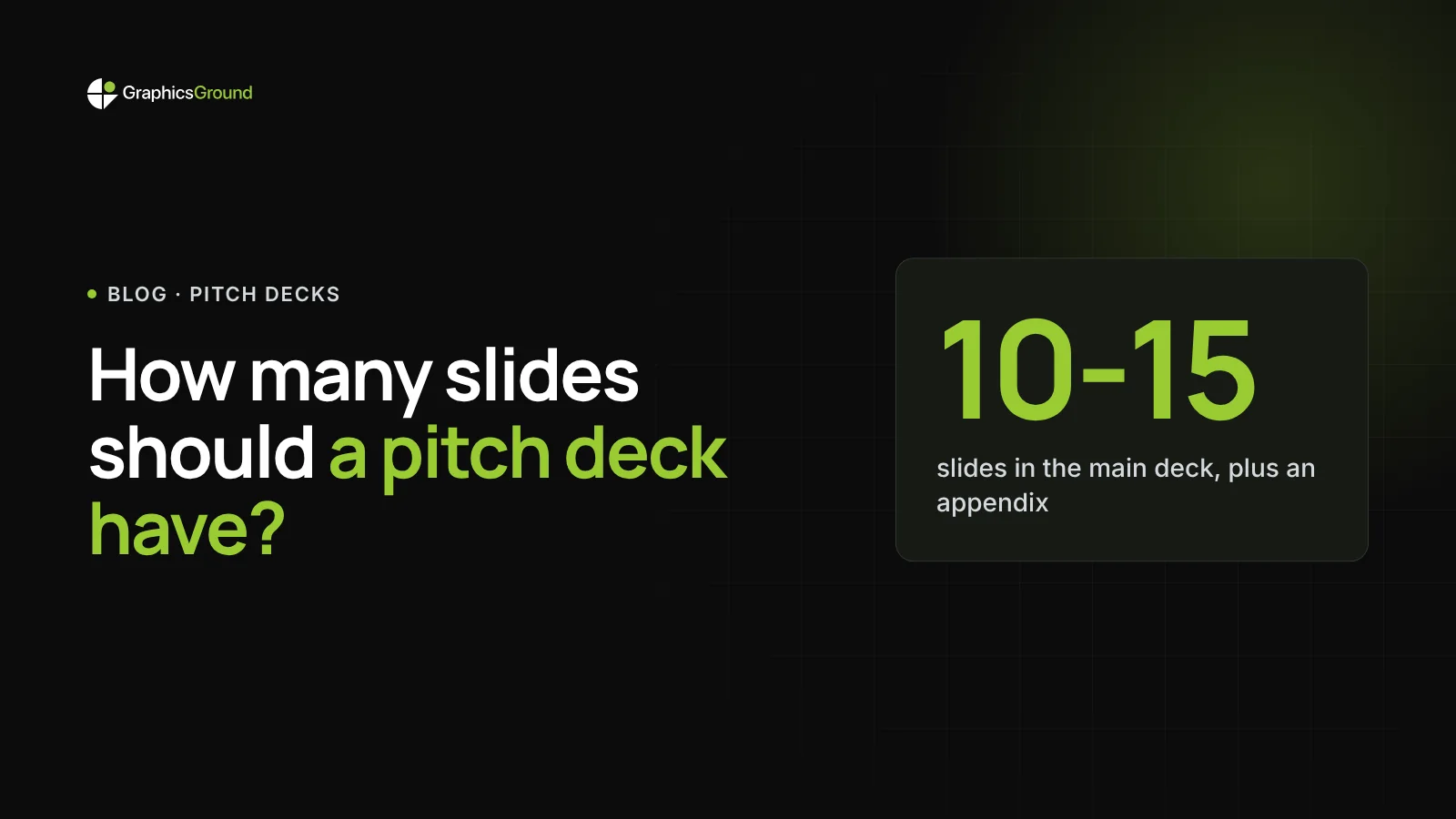
A pitch deck should have 10 to 15 slides. That is enough to cover the problem, solution, product, traction, market, business model, competition, team and ask, with one idea on each slide. Fewer than 10 usually means something an investor needs is missing. More than 15 usually means detail that belongs in an appendix.
The number matters less than the reason behind it, which is time. Investors spend two to four minutes on a deck. This guide shows the data, the right length for each stage, and how to shorten a deck that has grown too long.
Key takeaways
- Aim for 10 to 15 slides in the main deck, plus an appendix.
- Investors read a deck in two to four minutes, so each slide gets seconds.
- One idea per slide matters more than the total count.
- Decks have been getting shorter, and shorter decks have done better.
What the data says about pitch deck length
Two studies from DocSend, which tracks how investors open and read decks, are the most useful evidence we have.
- Investors read fast. A 2015 study of more than 200 decks, run with a Harvard Business School professor and reported by TechCrunch, found investors spent an average of 3 minutes 44 seconds on a deck.
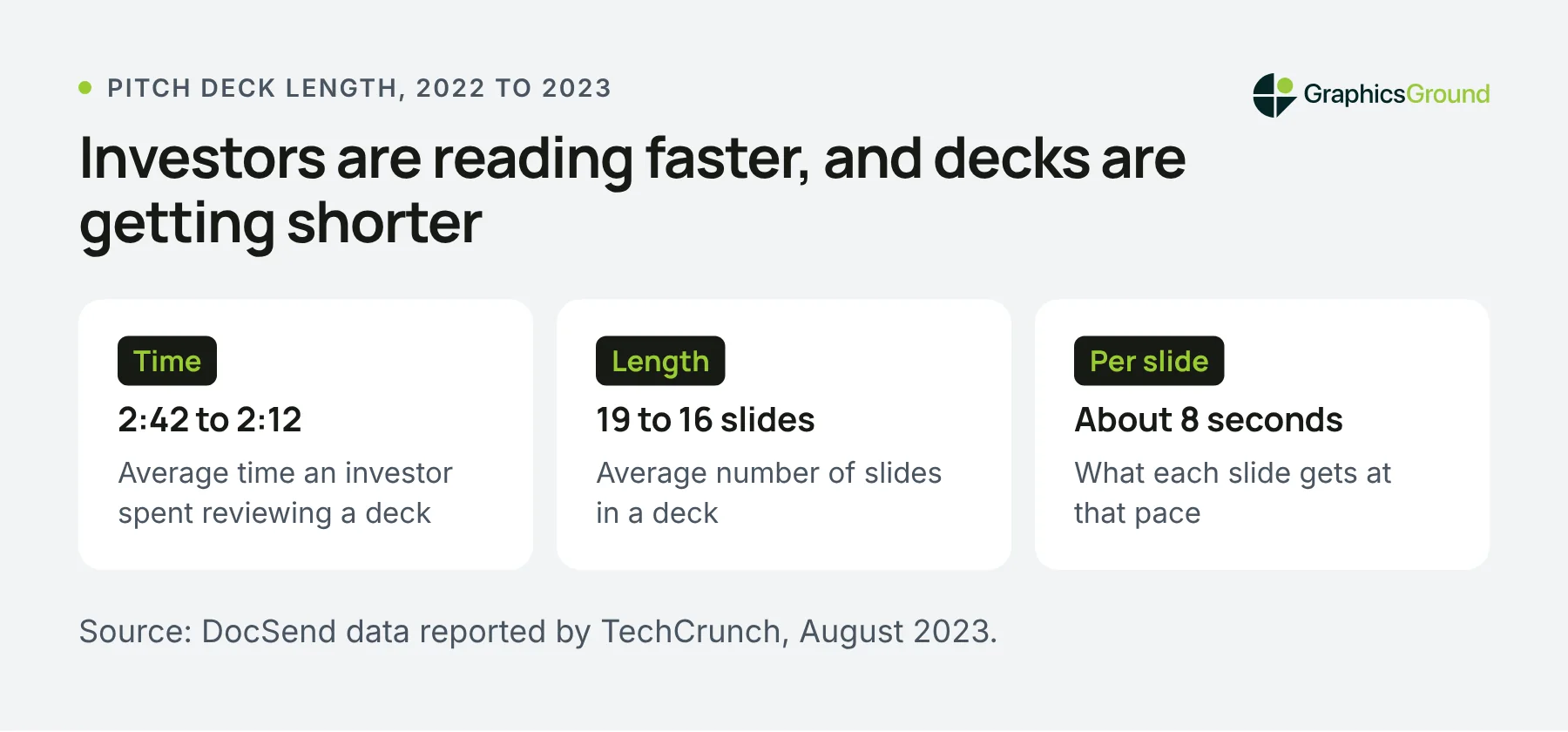
- They now read faster. By 2023, TechCrunch reported that review time had fallen from 2 minutes 42 seconds to 2 minutes 12 seconds in a year.
- Decks are getting shorter. The same report put the average deck at 16 slides, down from 19 the year before.
- Shorter decks did better. Among pre-seed teams, 40% of those that raised had shorter-than-average decks, and 65% of those that did not raise had longer-than-average decks.
Put those together. At a little over two minutes for 16 slides, an investor gives each slide about eight seconds. Every slide you add takes time from the others.
The right number of slides by stage
The 10 to 15 range fits most early raises. The target moves a little with the type of deck.
| Deck | Main slides | Why |
|---|---|---|
| Demo Day or stage pitch | 9 to 12 | Presented in about three minutes. You supply the detail out loud. |
| Pre-seed | 12 to 15 | Team, insight and early signals. Product and business model may need a second page each. |
| Seed | 10 to 15 | The standard deck, read alone before any meeting. |
| Series A | 15 to 20 | More to prove: unit economics, go-to-market, hiring plan. |
| Venture fund (LP deck) | 10 to 12 | Thesis, team, track record, portfolio math, terms. |
| Real estate fund | 15 to 20 | Sponsor, track record, example deals, returns, terms. |
Opinions differ at pre-seed. DocSend’s own pre-seed deck guide suggests around 18 pages across 12 sections. If you go that long, each page still has to carry a single idea. See what investors look for in a pre-seed deck.
We cover the slide-by-slide order for each in separate guides: the Demo Day deck, the 10 seed slides, the LP deck and the real estate fund deck.
Why one idea per slide beats a low slide count
Founders who hear “keep it short” often do the wrong thing. They keep all the content and squeeze it onto fewer slides. The count goes down and the deck gets harder to read.
A reader does not experience slide count. They experience effort. Twelve slides with one clear point each read faster than eight slides with three points each. When we design a deck, we would rather split a crowded slide into two clean ones than protect a round number.
So use this test instead of counting: for each slide, can you say its point in one sentence? If a slide needs “and” to describe, it is two slides, or one slide and an appendix page.
What goes in the main deck and what goes in the appendix
| Main deck | Appendix |
|---|---|
| What you do, in one line | Detailed product screens |
| The problem and who has it | Customer interviews and quotes |
| Your best traction number | Cohort tables and full metrics |
| Market size, with the logic | The market model behind it |
| Business model in one slide | Pricing tiers and unit economics detail |
| Why you beat the alternatives | The full competitor grid |
| The team | Advisors and extended biographies |
| The ask and use of funds | Financial projections by month |
The appendix is not a dumping ground. It is where you put the answer to a question you expect. When an investor asks about retention, you can say “slide 17” instead of promising to follow up.
How to cut a deck that is too long
These are the steps we take when a founder sends us a 30-slide deck.
- List the headlines. Copy every slide title into a document. Read only that list.
- Mark the argument. Which slides are needed for the story to make sense? Usually ten to twelve.
- Move the proof. Slides that support a point already made go to the appendix.
- Merge the duplicates. Three slides on the product often become one with the strongest screen.
- Delete the comfort slides. The agenda, the “thank you”, the vision quote, the second team slide.
- Rewrite the headlines as claims. A headline that states the point lets you remove body text.
- Test it cold. Give it to a stranger for three minutes and ask them to explain the company back.
If the cold test fails after cutting, the problem is the story and not the length. See pitch deck redesign: fix it or rebuild it.
Do not shrink the text to fit. Reducing font size to get from 16 slides to 12 keeps all the reading and removes the breathing room. Cut words, or add a slide.
When more slides are fine
- When you present live. A stage deck can use many simple slides, because each one is on screen for seconds while you talk.
- When the round is later. A Series A investor expects to see more of the machine.
- When the business is hard to explain. Deep tech, regulated markets and funds sometimes need one extra slide to define terms. Use it.
This is why our own service has no slide limit. A raise does not depend on slide count, so we do not price or plan by it. The decks we build vary in length. The rule is the same for all of them: every slide earns its place.
Frequently asked questions
Is 20 slides too many for a pitch deck?
For a seed deck that will be read alone, usually yes. Move five or more into an appendix. For a Series A deck, 20 can be right.
What is the 10/20/30 rule?
Guy Kawasaki’s rule for a live pitch: 10 slides, 20 minutes, and no font smaller than 30 points. It is a useful discipline for presenting. A deck that is emailed needs a little more text than that rule allows.
Do appendix slides count?
No. Investors judge the main deck. Put a clear divider slide before the appendix so the reader knows the argument has finished.
How many slides for a 5-minute pitch?
About 10 to 12, at roughly 25 to 30 seconds each. For a three-minute pitch, see how to build a Demo Day pitch deck.
Should I have two versions of my deck?
Yes: one to present and one to send. The sending version has fuller headlines and a little more text, because nobody is there to explain it. We explain the difference in what to change after Demo Day.
Have a deck that runs long? Send it to us and we will tell you which slides are carrying the argument and which can go. Or use the free 30-Day Fundraising Checklist to plan the rest of your raise.
What to prepare, send, and track in your first 30 days of raising. Free.

Series A Pitch Deck: What Changes From Your Seed Deck
A Series A pitch deck proves a business is working, where a seed deck proved it could. Here are the six slides that change, the metrics to show, and the order.
Read the article
Pre-Seed Pitch Deck: What Investors Look For
A pre-seed pitch deck has to earn belief before there is revenue. Here are the 12 sections, where investors spend their time, and what counts as proof this early.
Read the article