Your Demo Day pitch went well. Investors came up afterwards, cards were exchanged, and a few people asked you to “send the deck”.
This is where many founders make a quiet mistake. They send the same deck they just presented on stage. It was built to be seen once, for three minutes, with them talking over it. Read alone on a laptop, it falls flat.
Demo Day gets you attention. The meetings that follow get you funded. This guide covers why your stage deck fails in those meetings, how to use the two weeks after Demo Day, what investors will ask for, and which slides to add or cut.
Why your stage deck fails in an investor meeting
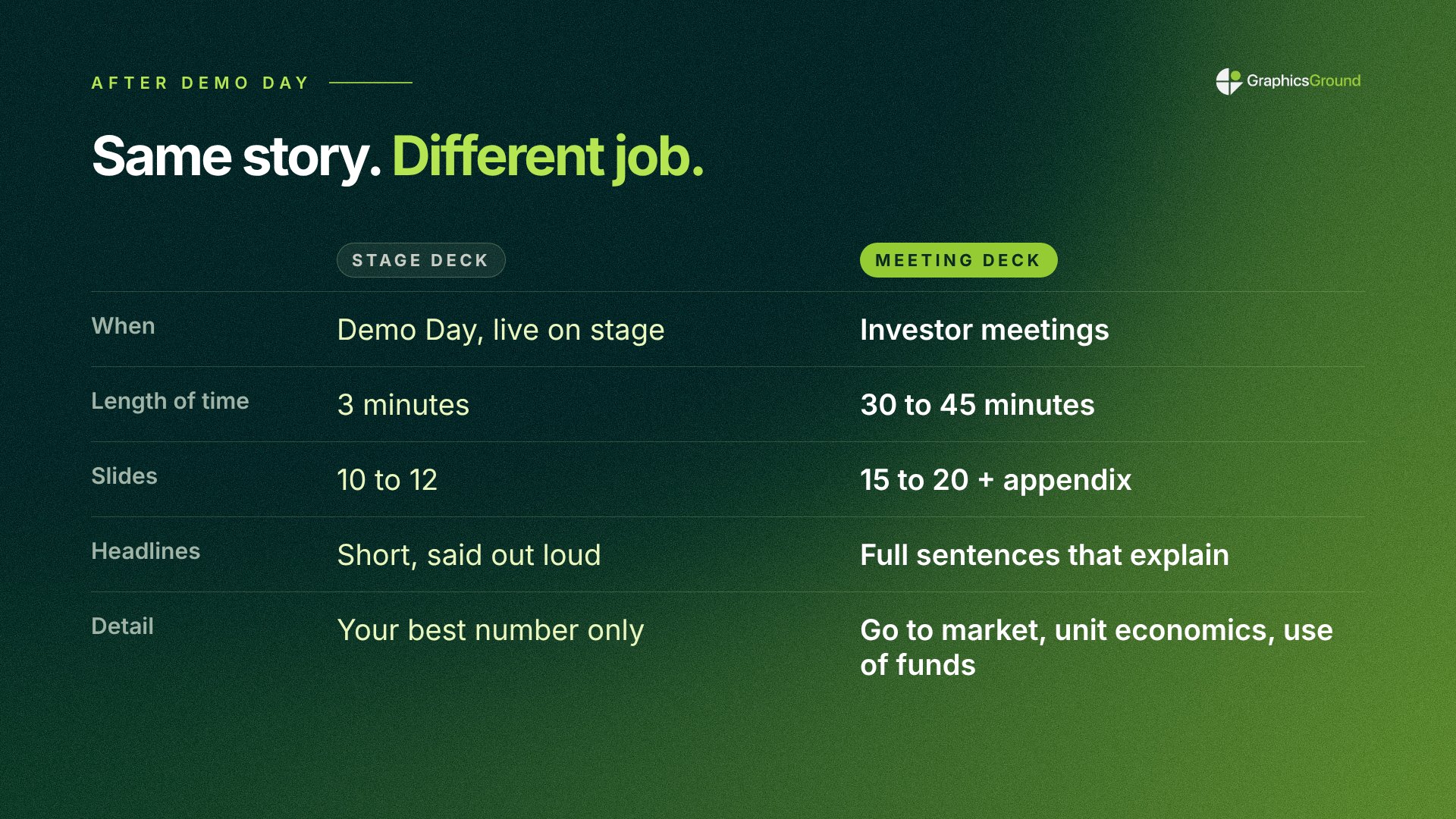
A Demo Day deck and an investor meeting deck tell the same story, but they do different jobs.
1. It needs you in the room
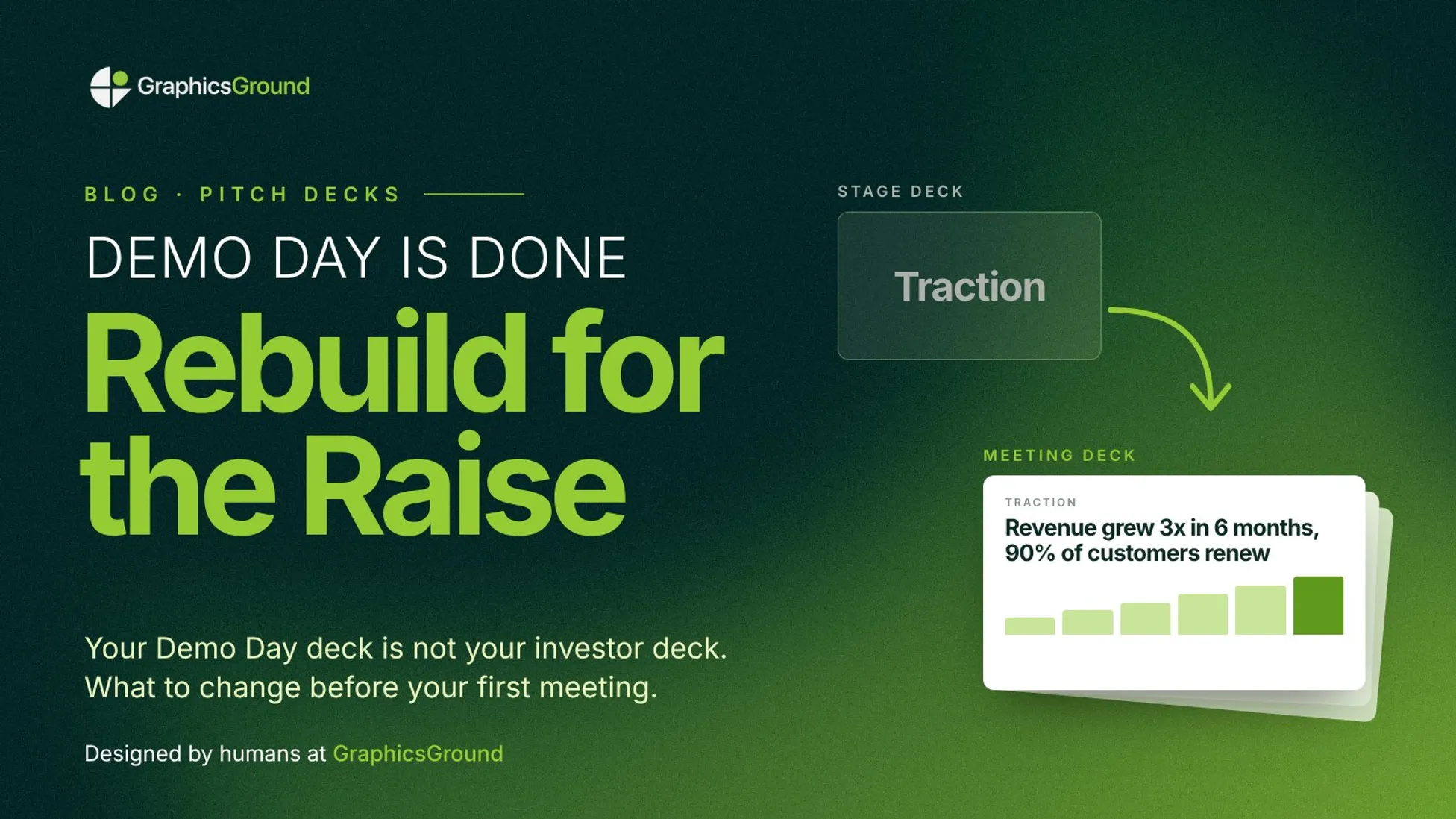
On stage, your slides were props. A slide that just says “Traction” with a chart worked because you were explaining it. Sent by email, that slide makes an investor guess, and guesses rarely go your way.
2. It skips the questions a meeting is about
Three minutes forced you to cut. That was the right call on stage. But a 30 to 45 minute meeting is exactly where investors dig into what you left out: how you will find customers, what each customer is worth, who else is chasing this, and how you will spend the money.
3. Its detail is too thin
Your stage traction slide showed one big number. In a meeting, an investor wants to know whether that number holds up: is it growing every month, do customers stay, and is it revenue or just signups?
4. It was designed for a projector
Huge type and one word per slide is perfect from 20 meters away. On a laptop screen, it can look empty and unfinished.
The 2-week window after Demo Day
Investor interest is highest in the days right after Demo Day, while your pitch is fresh and they are comparing the companies in your cohort. After that, it fades fast as their attention moves to the next batch of deals. Plan the two weeks before Demo Day, not after.
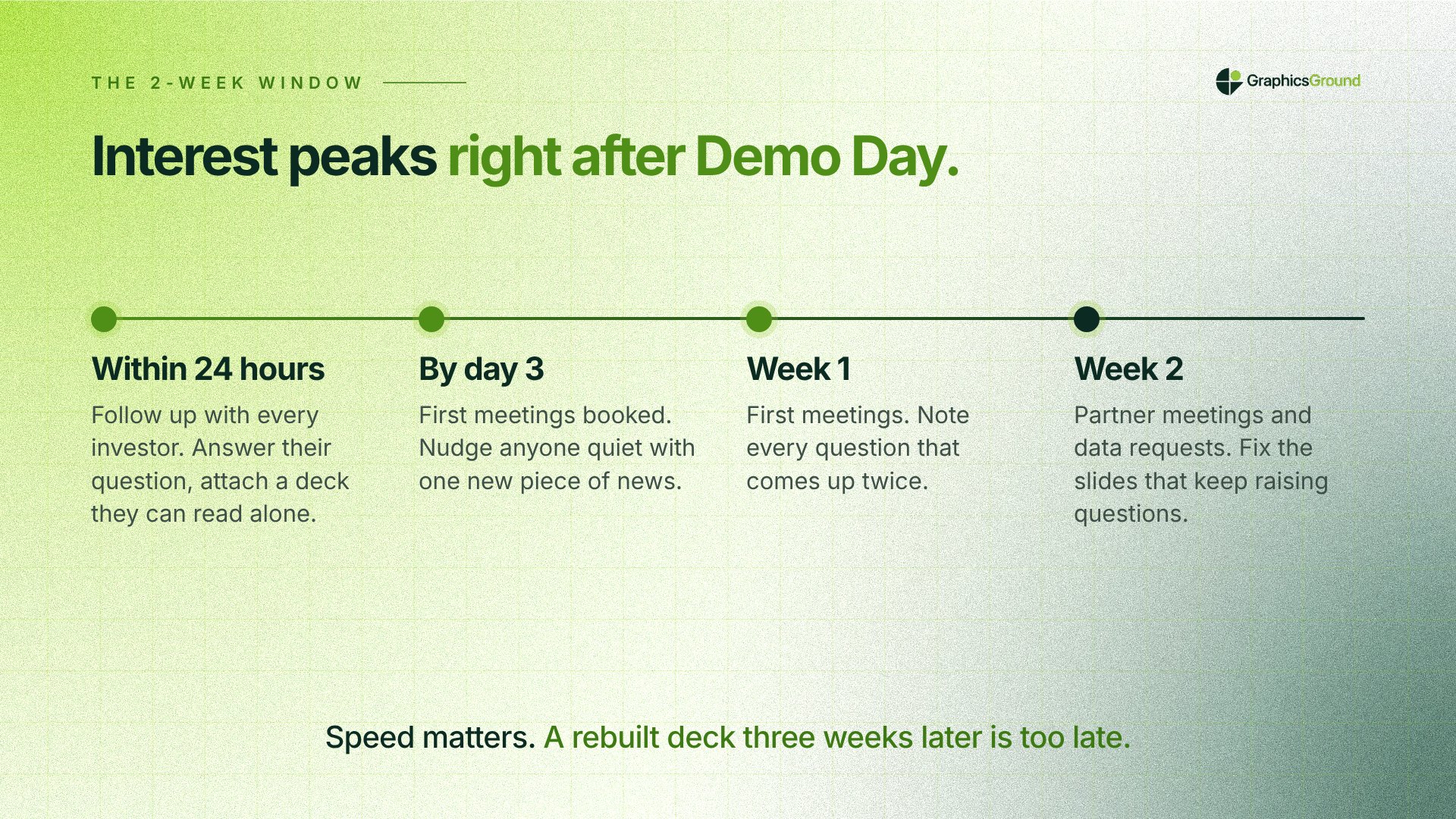
- Within 24 hours: Follow up with every investor you spoke to. Answer the question they asked you, attach a deck they can read alone, and propose a meeting.
- By day 3: Have your first meetings booked. Send a short update to anyone who hasn’t replied, ideally with one new piece of news.
- Week 1: First meetings. Present your meeting deck, listen for the questions that come up more than once, and note them.
- Week 2: Second meetings, partner meetings and data requests. Fix the slides that keep raising the same questions before your next meeting.
The point of the window is speed. A rebuilt deck that arrives three weeks later is answering investors who have already moved on.
What investors ask for after Demo Day
Expect follow-up requests to fall into a few groups. Have each one ready before Demo Day, so you can reply the same day.
- A deck they can read without you. Shorter than your meeting deck, with headlines that explain each slide on their own.
- Your key numbers. Monthly revenue or usage over time, growth rate, retention, and how you get customers.
- A financial summary. Not a full model in the first email, but a clear view of burn, runway, and the plan for this round.
- Round details. How much you are raising, who has committed, the terms if set, and the timeline to close.
- Customer proof. Some investors will ask to speak with one or two customers. Line them up early.
Every question an investor asks in a meeting is a sign that a slide didn’t do its job. Keep a list of what each investor asks, and you will see which slides need work first.
Get the rebuild kit. It includes a map of the three decks you need after Demo Day, a fill-in tracker that turns investor questions into slide fixes, and three follow-up email templates you can send within 72 hours.
Which slides to add, cut and rewrite
You don’t need to start from scratch. Your stage deck’s story already worked in front of a room. Keep its order, then rebuild around it.
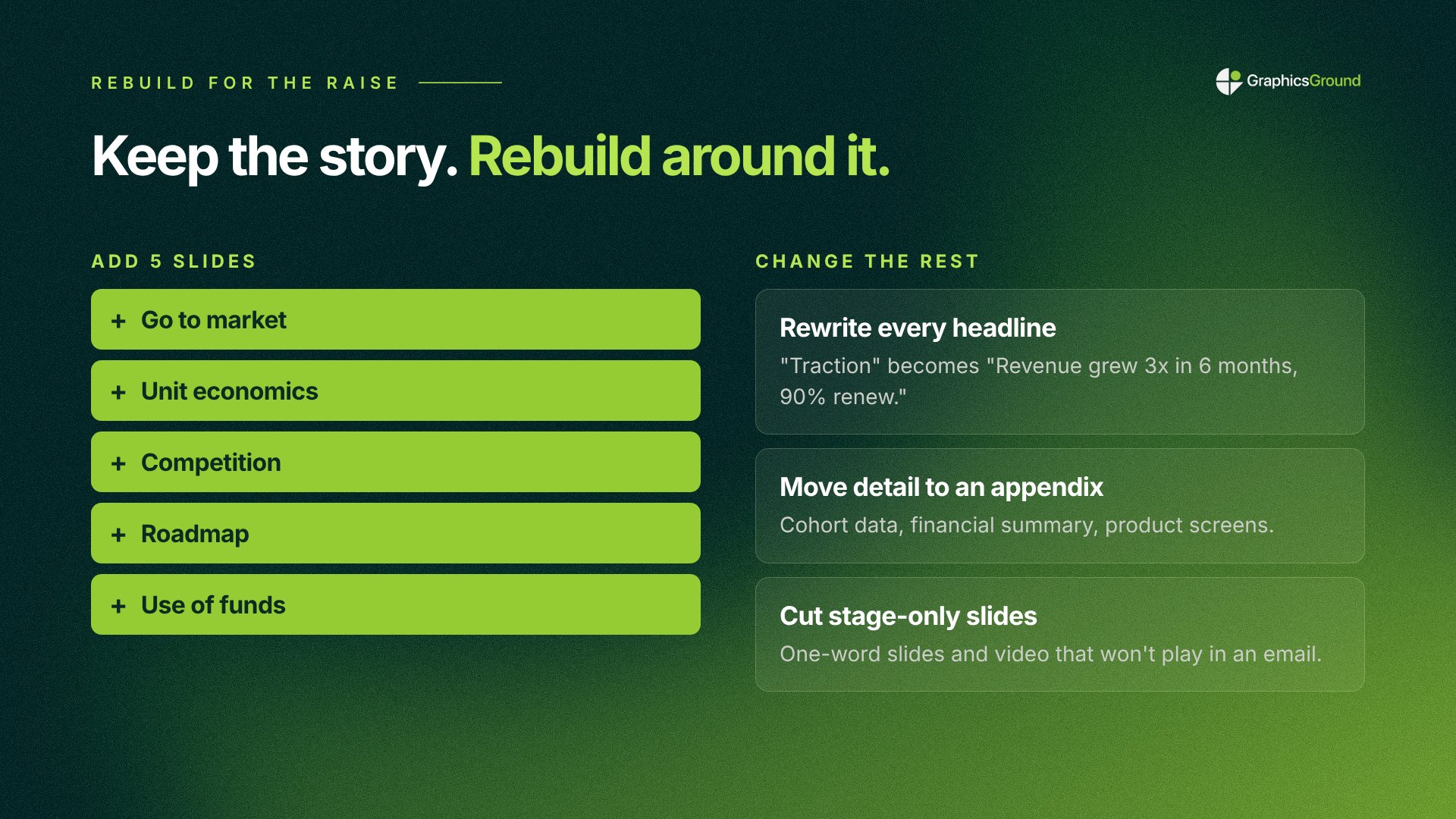
Add these 5 slides
- Go to market. How you find and win customers today, which channel works best, and what it costs.
- Unit economics. What a customer pays, what it costs to win them, and how long until they pay back. Even early numbers show you think like an operator.
- Competition. The real alternatives, including doing nothing or using spreadsheets, and the one thing you do that is hard to copy.
- Roadmap. What you will build next and why, tied to what customers are asking for.
- Use of funds. How the money splits across hiring, product and growth, and the milestone it gets you to.
Rewrite every headline
This is the single biggest change. On stage, “Traction” was fine. In a meeting deck, write the point: “Revenue grew 3x in 6 months, with 90% of customers renewing.” An investor flipping through should understand your story from the headlines alone.
Move detail to an appendix
Cohort tables, a financial summary, product screens and extra case studies belong after your main slides. You can jump to them when a question comes up, without slowing down the story.
Cut what only works on stage
Slides that relied on your voice, like a single word or a dramatic pause slide, either get a real headline or go. So does any video that won’t play inside an email attachment.
One story, more than one deck
After Demo Day, most founders need more than one version of the same story: a deck to present in meetings and a shorter one to send before them. Build the short one by cutting down your meeting deck, not from scratch, so your story and numbers always match.
The rebuild kit maps all three versions side by side (stage, meeting and teaser), with what to include and what to cut in each. It also has the follow-up emails ready to send.
Want help rebuilding your deck?
We turn Demo Day decks into meeting decks and teaser decks that hold up without you in the room. Start with a free 30 minute deck review. We will show you the slides to rebuild first.
Not sure how strong your current deck is? Read: How to Build a Demo Day Pitch Deck (3-Minute Format). Building your seed deck slide by slide? Read: The 10 Slides Every Seed Deck Needs.