Demo Day gives you about three minutes on stage in front of a room full of investors. Your Demo Day pitch deck has one job in that time: make enough people want a follow-up meeting. It is not the place to explain everything about your company. Think of it as a trailer, not the full film.
This guide shows you how to build a Demo Day pitch deck for the common 3-minute format: how to split your time, which 9 slides to use, how to design them for a big screen, and how to rehearse so you finish on time.
What makes a Demo Day deck different
Your regular investor deck is read on a laptop, often without you there, and it can hold detail. A Demo Day deck works under very different conditions:
- It is seen once. Nobody scrolls back. If a slide is unclear, the moment is gone.
- It is seen from far away. Investors in the back row sit 15 to 20 meters from the screen.
- You are talking over it. The audience splits attention between your voice and the slide. The slide should support what you say, not compete with it.
- It is one of many. Investors may watch dozens of pitches in a day. They remember companies they can describe in one sentence.
So the rules change. Fewer words, bigger type, one idea per slide, and a story simple enough to repeat at dinner.
How to split your 3 minutes
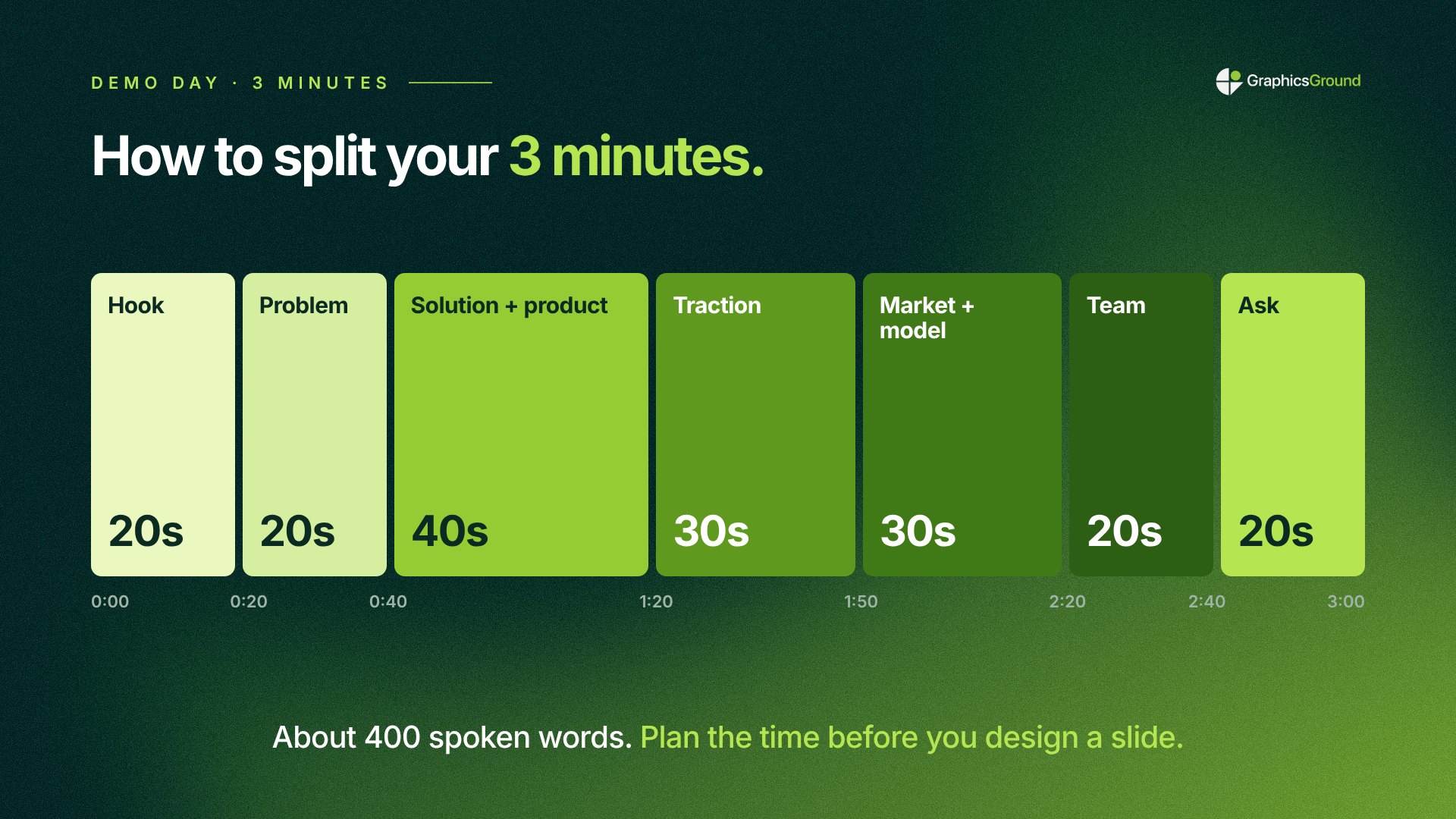
Three minutes is about 400 spoken words. That sounds like a lot until you try to fit your whole company into it. Plan your time before you design a single slide.
| Section | Time | What it must do |
|---|---|---|
| Hook | 0:00 to 0:20 | Say what you do in one sentence |
| Problem | 0:20 to 0:40 | Make the pain specific and real |
| Solution and product | 0:40 to 1:20 | Show how you remove the pain |
| Traction | 1:20 to 1:50 | Prove customers want it |
| Market and model | 1:50 to 2:20 | Show it can get big and make money |
| Team | 2:20 to 2:40 | Show why you will win |
| Ask and close | 2:40 to 3:00 | Say what you are raising and repeat your one-liner |
If your traction is your strongest point, move it earlier and give it more time. The order can flex. The total cannot.
The 9 slides of a 3-minute Demo Day deck
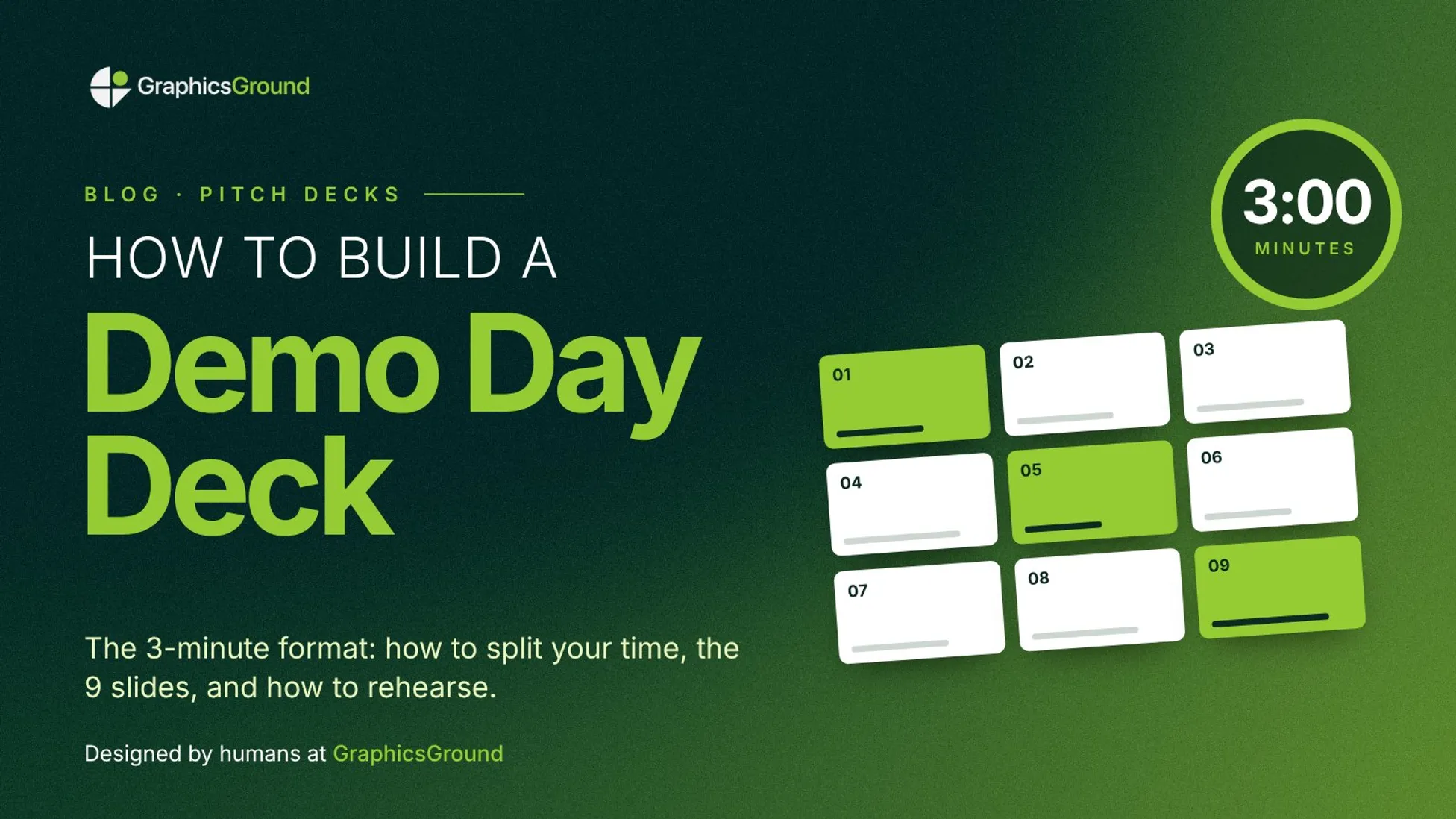
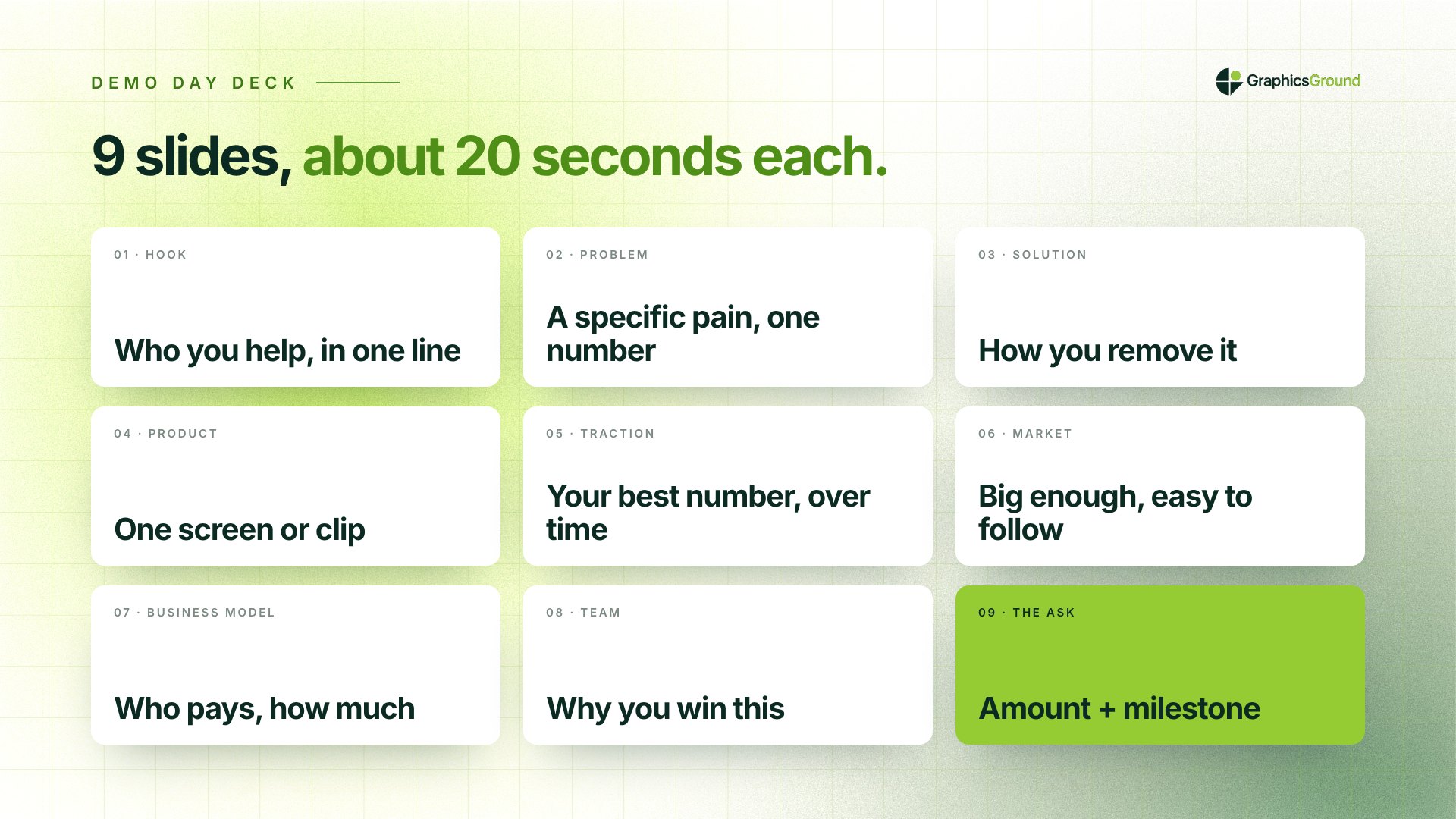
Nine slides at roughly 20 seconds each is a comfortable pace. More than 12 and you start rushing. Here is what each slide should carry.
1. The hook
Your company name and one sentence: who you help, what you do for them, and why it matters. Say it out loud the same way. If an investor remembers only this slide, they should still be able to describe your company.
2. The problem
Name a specific customer and a specific pain. One strong number beats three weak ones. “Warehouse teams lose 1 in 10 orders to picking errors” lands. “Logistics is inefficient” does not.
3. The solution
Show how you remove the pain from slide 2. Keep it to the one thing you do best, not your feature list.
4. The product
Make it real. One large screenshot or a 10-second clip of the key moment. If you use video, embed it in the file and keep a still image as backup in case it fails on the venue laptop.
5. Traction
Your most convincing number, as large as the slide allows, with a time frame. A rising line over six months tells investors where you are going, not only where you are.
6. The market
One clear figure that shows the opportunity is big enough. Build it from your customers and price if you can, so the logic is easy to follow.
7. The business model
Who pays, how much, and how often. One line is usually enough on stage.
8. The team
Photos, names, and one line each on why you are the right people for this problem. Skip long bios. Nobody can read them from the back row.
9. The ask and close
How much you are raising and what it gets you, then your one-liner again and how to reach you. Leave this slide up while you walk off stage. It is the slide investors photograph.
Already built your deck? Before you go on stage, check it against the 20 questions investors judge every deck on. The free scorecard takes 5 minutes and tells you which slides to fix first.
Design your slides for the big screen
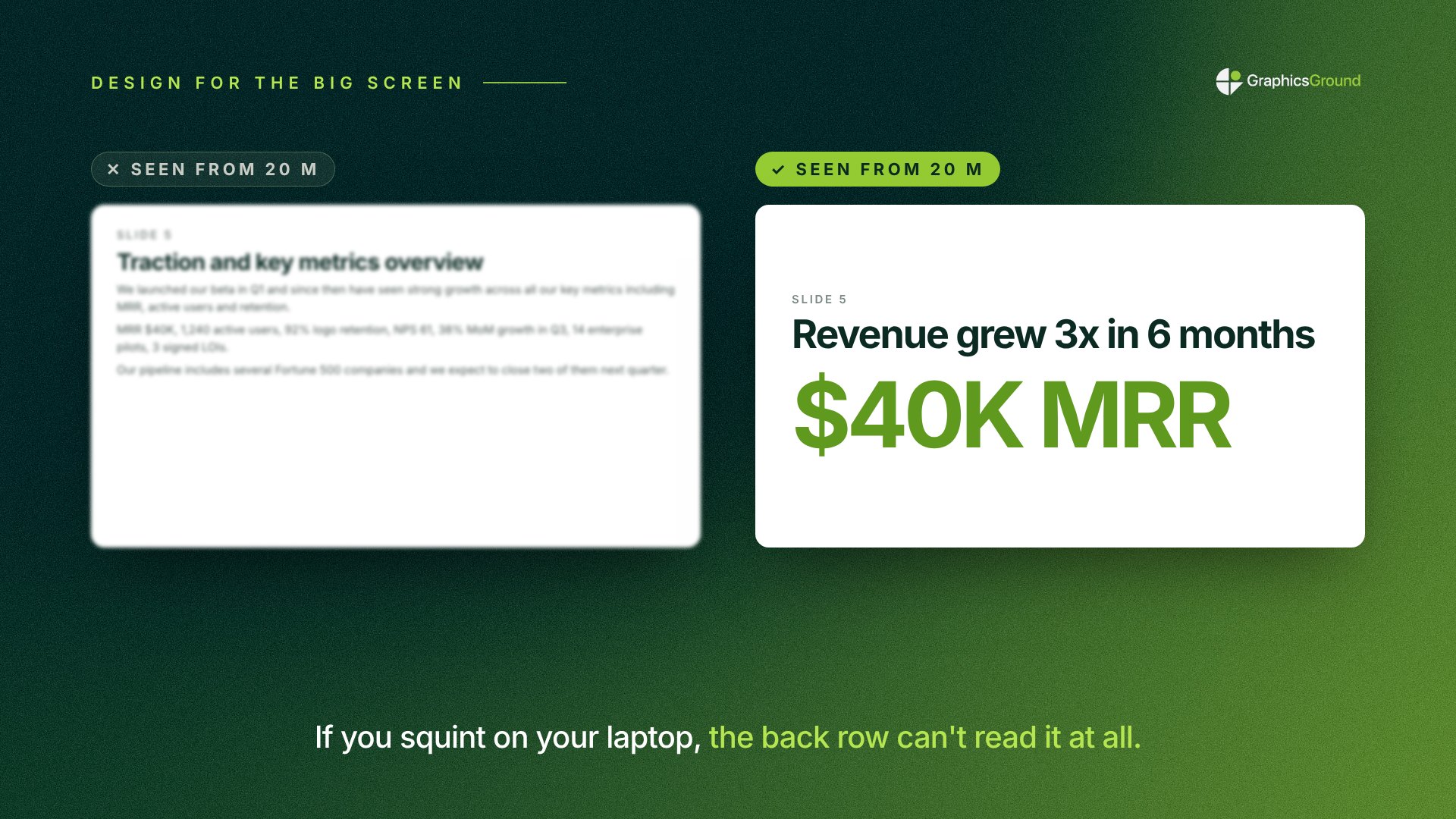
Most Demo Day decks fail on design, not content. The slide that looks fine on your laptop becomes unreadable on a venue projector. A few rules fix most of it.
- One idea per slide. If you need to say “and also”, that is a second slide.
- Big type. Keep body text at 24 pt or larger and headlines much bigger. If it looks too big on your laptop, it is probably right.
- Fewer than 20 words per slide. You are the narrator. The slide is the picture.
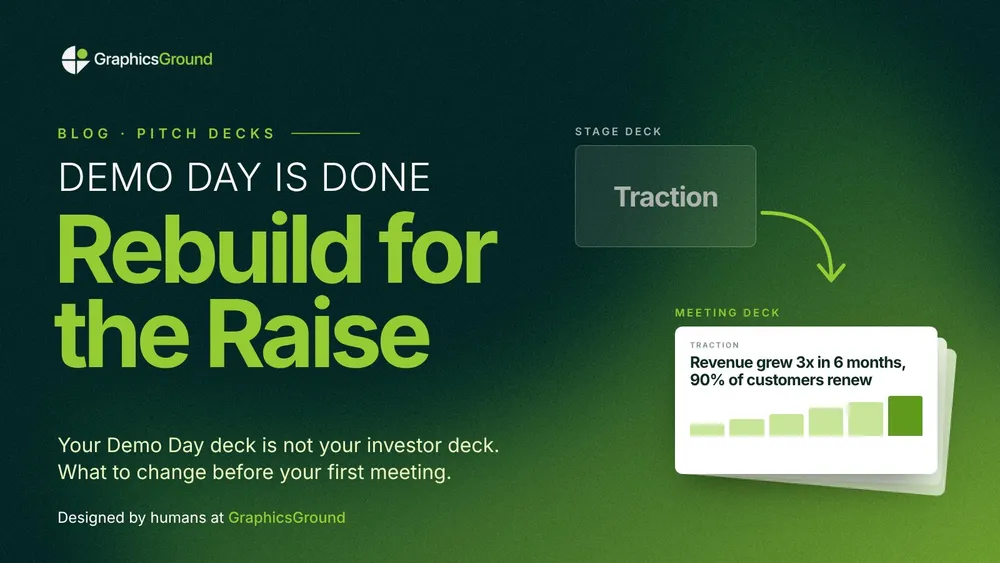
- Headlines that state the point. “Revenue grew 3x in 6 months” works from the back row. “Traction” makes people work it out.
- High contrast. Projectors wash out colors. Dark text on light, or light text on dark, never mid-grey on mid-grey.
- 16:9 format. Check the venue screen ratio with the organizers and build to it.
- Test on a real screen. Stand at the back of a room with a TV or projector and click through. Fix anything you have to squint at.
Write your script with the deck, not after it
Your words and your slides should be built together. Write the script first, roughly 40 to 50 words per slide, then design each slide to support that line.
- Open with the one-liner, not your name or a thank you. The first 10 seconds decide whether the room listens.
- Say every number the same way it appears on the slide.
- Use short sentences. Long sentences are where people stumble under pressure.
- End on the ask and the one-liner, then stop. Do not trail off with “so yeah, that’s us”.
Rehearse until it feels boring
The founders who look relaxed on stage are usually the ones who rehearsed the most. Aim for at least 10 full run-throughs.
- Time every run. Aim for 2 minutes 45 seconds, which leaves room for nerves and applause.
- Stand up and use a clicker. Rehearse the way you will present.
- Record yourself. Watch it once with the sound off. Can you follow the story from the slides alone?
- Practice in front of people. Ask them to repeat your one-liner afterwards. If they can’t, fix the hook.
- Plan for things going wrong. Know what you will say if the video fails or the clicker stops working.
Score your deck before you go on stage
A good Demo Day deck is clear from the back row, tells one story, and ends with an ask investors can act on. Once yours is built, run it through the scorecard. It covers the 20 checks investors use to judge a deck, with score bands and the 4 checks to fix first if you are short on time.
After Demo Day
The pitch gets you attention. The meetings that follow get you funded, and they need a different deck. Read next: Your Demo Day Deck Is Not Your Investor Deck: What to Change Before Your First Meeting. Building your seed deck slide by slide? Read: The 10 Slides Every Seed Deck Needs.
Want a second pair of eyes?
Book a free 30 minute deck review with our team. We will go through your Demo Day deck with you and show you the 3 slides to fix first. No cost, no obligation.