
Why Investors Are Not Responding to Your Pitch Deck
When investors are not responding to your pitch deck, the cause is one of four things: the list, the email, the deck, or the timing. Here is how to find which.
 GraphicsGround teamInvestor decks, built with you, backed for the raise.
If investors are not responding to your pitch deck, the cause is almost always one of four things. You are sending it to the wrong investors. The email around it gives them no reason to open it. The deck does not explain the business to someone reading alone. Or the timing is off and they are simply busy. Each cause leaves a different trace, so you can work out which one you have before you change anything.
Most founders skip that step. They assume the deck is the problem, redesign it, and get the same silence. This guide shows how to diagnose the real cause in four checks, and what to fix for each.
Key takeaways
- Silence has four possible causes: list, email, deck or timing. Check them in that order.
- No opens points to the list or the email. Opens with no reply points to the deck.
- Investors are busy and often never send a no. Some silence is normal.
- Fix one thing at a time, on a small batch, so you can see what changed.
First, how much silence is normal?
More than you would hope. In a TechCrunch report on why VCs ghost founders, investors were candid about it. Writing a pass takes effort and often gets pushed down the list. Follow-ups slip in busy weeks. One investor said he receives about 30 pitches a day.
The numbers from real raises say the same. Buffer’s founders wrote that they contacted around 200 investors to get roughly 50 meetings and 18 investors. Three out of four people they approached did not turn into a meeting.
So a few unanswered emails is not a signal. A pattern is. If you have sent the deck to 15 or 20 well-chosen investors and heard nothing, something is wrong, and the four checks below will find it.
The four causes, and the trace each one leaves
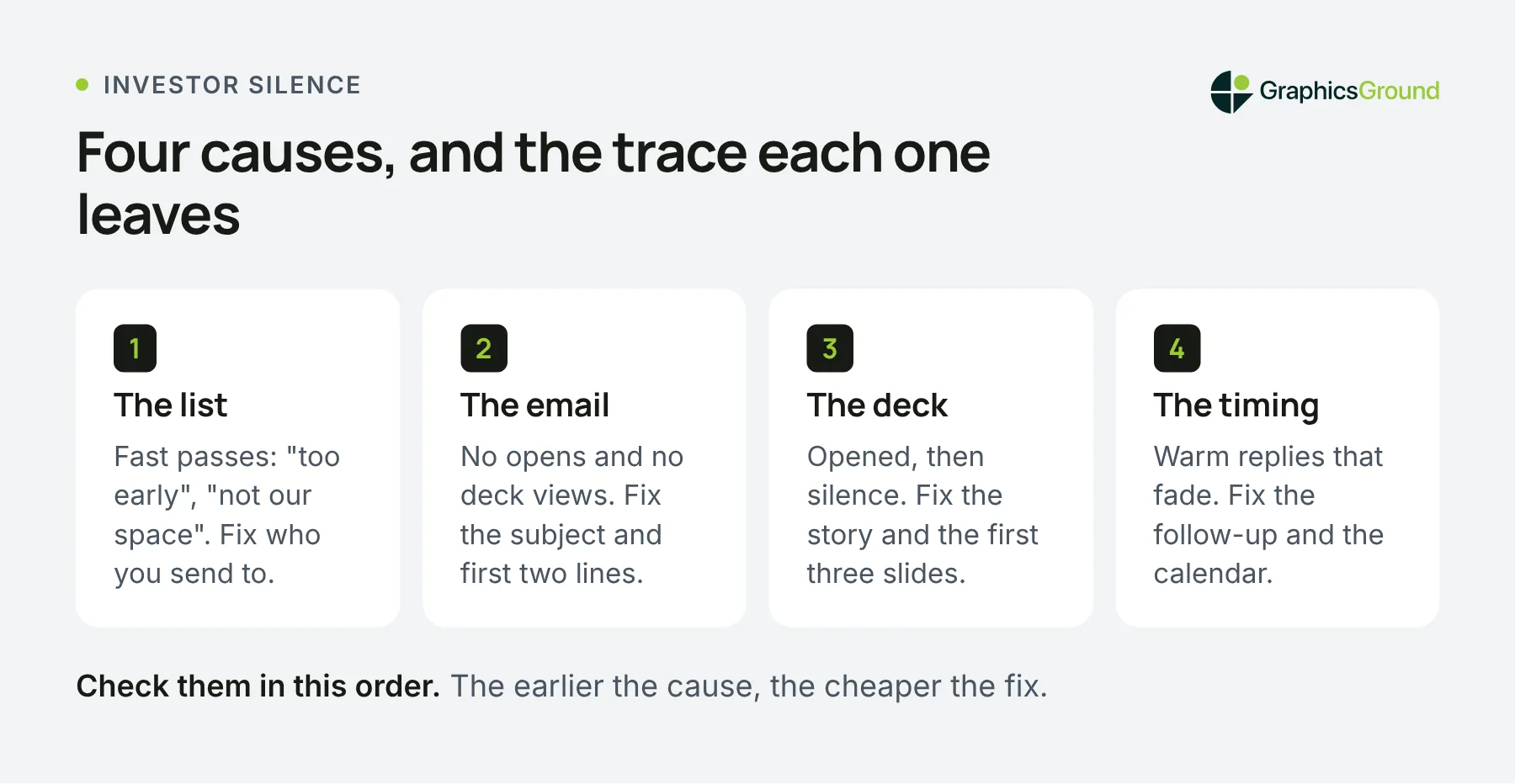
| Cause | What you see | What to fix |
|---|---|---|
| The list | Fast passes saying “too early” or “not our space”, or nothing at all | Who you are sending to |
| The email | No opens, no replies, no deck views | The subject line and first two lines |
| The deck | The deck is opened, sometimes more than once, and then silence | The story and the first three slides |
| The timing | Warm replies that trail off, “let’s talk after the holidays” | Your follow-up and your calendar |
Check 1: Are you sending it to the right investors?
This is the most common cause and the least examined. A strong deck sent to a Series B fund, a fintech specialist or an investor who has not written a check in a year will get no reply, and it tells you nothing about the deck.
Look at the last 20 investors you contacted and answer honestly for each:
- Do they invest at your stage, as a first check?
- Is their usual check size close to what you need?
- Have they backed a company like yours?
- Have they made a new investment in the last 12 months?
- Did you write to a named partner, or to an info@ address?
If fewer than half pass all five, stop and rebuild the list before touching anything else. Our guide on building an investor list for a seed round shows how to score and cut.
Check 2: Does the email earn an open?
The deck cannot work if nobody opens it. Read your last outreach email as the investor would: one of dozens that day, from a name they do not know.
- Subject line. Does it name the company and one concrete fact, or does it say “Investment opportunity”?
- First line. Could it only have been written to this investor?
- Second line. Does it say what the company does in plain words?
- Length. Does it fit on a phone screen?
- Ask. Is there one clear, small next step?
If you use a link that shows views and nobody is opening the deck, the problem is here, not in the slides. We give a five-line structure and templates in how to write a cold email to investors.
Check 3: Does the deck work without you?
If the deck is being opened and the replies still do not come, look at the deck. The usual cause is not ugly slides. It is a deck that was built to be presented and is now being read alone.
Run the cold read test. It is the first thing we do with any deck a founder sends us.
- Give the deck to someone smart who does not know your company.
- Let them read for three minutes with no explanation.
- Ask them: what does this company do, who is it for, what proof did you see, and what is being asked for?
Three minutes is generous. DocSend data reported by TechCrunch in 2023 put the average investor review at 2 minutes 12 seconds.
What the test usually finds:
- The first slide is a slogan. The reader still does not know what you do on slide three.
- Headlines are labels. “Traction” instead of “Revenue grew 3x in six months”.
- The best number is buried. It sits in a chart legend on slide nine.
- The ask is vague or missing. No amount, no milestone.
- It is long. Twenty-five slides, each needing your voice to make sense.
If the stranger explains your company correctly, the deck is not your problem. If they cannot, no change to the email or the list will rescue it. See whether your deck needs a redesign or a rebuild and how many slides a pitch deck should have.
Check 4: Is it timing?
Sometimes everything is right and the investor is on holiday, closing another deal, or between funds. Timing leaves a recognizable trace: warm early replies that fade, or a meeting that went well and then nothing.
- Follow up three times over three weeks, each time with something new. See what to send after a pitch.
- Avoid dead periods. Late December and much of August are slow in many markets.
- Bunch your meetings. Investors move faster when they know others are looking in the same weeks.
- Move quiet investors to a monthly update instead of chasing. See our investor update template.
Fix one thing, then measure
The mistake after a diagnosis is changing everything at once. New list, new email, new deck, all in the same week, and you will never know what helped.
- Pick the earliest check you failed.
- Fix only that.
- Send to a new batch of 10 investors.
- Compare opens, replies and meetings with the previous batch.
- Then move to the next check.
This is the routine we follow in the weekly calls of our raise support. Each week we look at who replied, what they asked, and where the conversations stopped, then decide on one change. One investor’s opinion does not change the deck. The same reaction from several does.
Do not resend a new deck to investors who passed. An investor who said no rarely reopens version two. Use what you learned on the investors you have not contacted yet.
Frequently asked questions
How long should I wait for an investor to respond?
About a week before the first follow-up. After three attempts over three weeks with no reply, treat it as a no for this round.
An investor keeps opening my deck but has not replied. What does that mean?
Usually that it is being shared internally or revisited. It is mild interest, not a decision. Send your next scheduled follow-up with a piece of news, and do not mention the opens.
Should I ask investors why they did not respond?
You can ask those who passed what they would need to see to look again. It is a fair question and some will answer. Do not ask people who never replied.
Could my deck design be the reason?
Sometimes. Messy, inconsistent slides make a team look careless. More often the cause is the story: the reader cannot tell what you do or why it matters. Test that first.
Is it normal to get no replies from cold emails?
A low reply rate is normal. Zero replies from 20 well-targeted, specific emails is not. That points to the list or the first two lines.
Not sure which of the four it is? Send us your deck and we will run the cold read for you and tell you what an investor will question first. If you want a week-by-week plan for the whole raise, the 30-Day Fundraising Checklist is free.
What to prepare, send, and track in your first 30 days of raising. Free.
Investor Feedback on Your Pitch Deck: When to Change It
One investor’s comment is an opinion. The same comment from three is a pattern. Here is how to log investor feedback, read it, and decide what to change.
Read the article
Investor Ready Checklist: 30 Days Before You Raise
Being investor ready means you can answer “send me more” within the hour. Use this four-week checklist to prepare, target, send and track before you raise.
Read the article