
How Long Does It Take to Raise a Seed Round?
Plan for about three months of active fundraising for a seed round, plus preparation before and legal work after. Here is the timeline, week by week.
 GraphicsGround teamInvestor decks, built with you, backed for the raise.
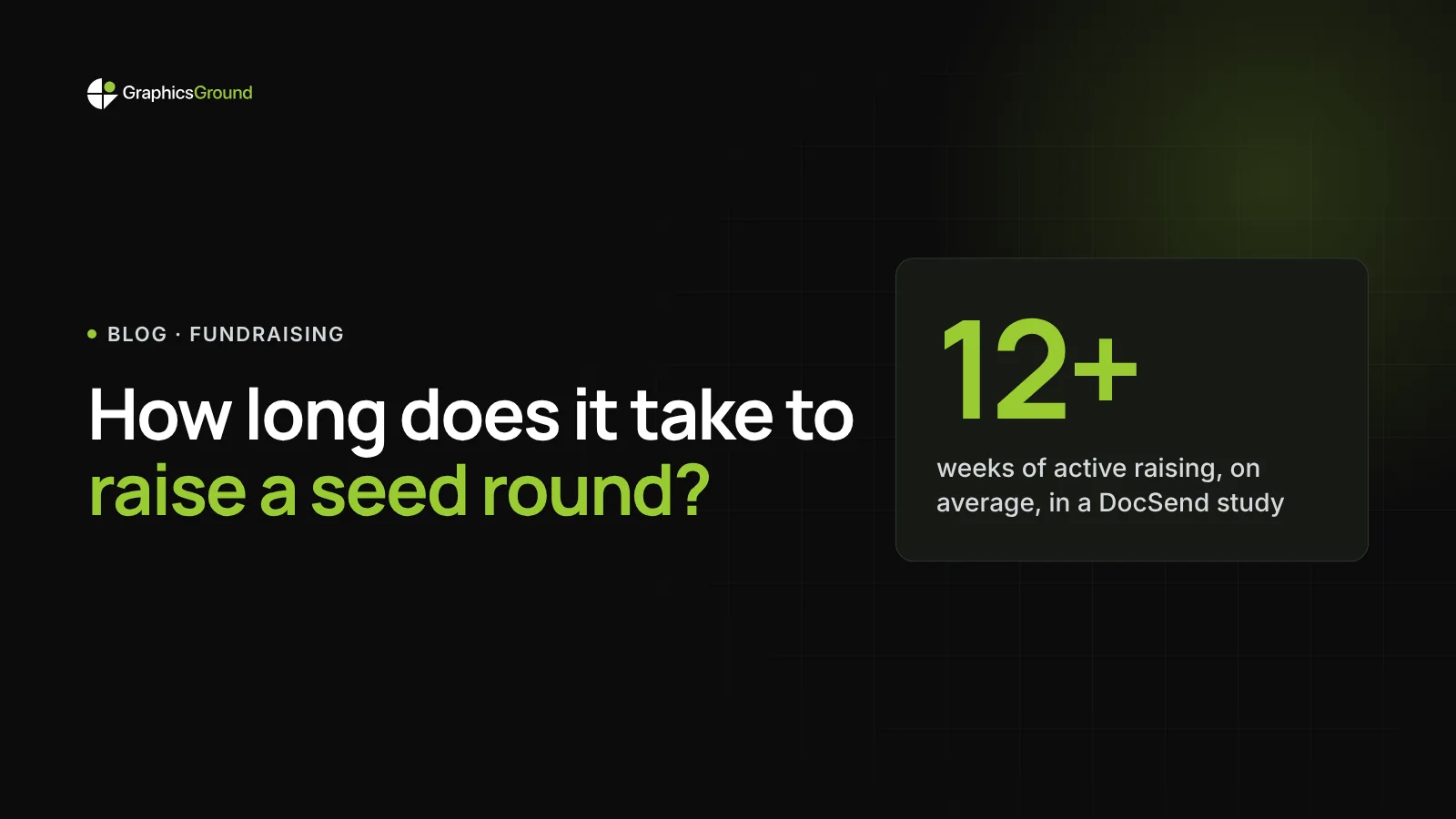
Raising a seed round takes about three months of active fundraising for most founders, and closer to four or five months once you count the preparation before and the legal work after. In a DocSend study of more than 200 raises, the average seed round took just over 12 weeks to close and involved about 40 investor meetings. Nearly half of the rounds took 11 to 15 weeks, and about one in six took 16 weeks or more.
Those numbers are the middle of a wide range. Some rounds close in a month and some take most of a year. This guide shows what the data says, what the weeks actually look like, and what makes a raise faster or slower.
Key takeaways
- Plan for 12 to 16 weeks of active raising, plus two to four weeks of preparation.
- Expect dozens of meetings. Volume is normal, not a sign of failure.
- Rounds with a lead investor tend to close faster.
- Have at least six months of runway when you start. A raise that runs long is common.
What the data says
The clearest public numbers come from a study DocSend ran with a Harvard Business School professor, reported by TechCrunch. It looked at more than 200 companies.
| Finding | Number |
|---|---|
| Average time to close a seed round | Just over 12 weeks |
| Rounds closed in 0 to 5 weeks | 15% |
| Rounds closed in 11 to 15 weeks | Nearly half |
| Rounds that took 16 weeks or more | 17% |
| Investor meetings before closing | About 40 |
| Rounds led by a firm, compared with angel rounds | Closed about four weeks faster |
Two cautions. The study is from 2015 and the sample was small, so treat the figures as a guide and not a promise. And it counted from the start of active fundraising, so the preparation weeks are on top.
One finding has aged well: more meetings did not mean more money. The founders who contacted the most investors did not raise larger rounds. A well-chosen list worked better than a long one.
The seed round timeline, week by week
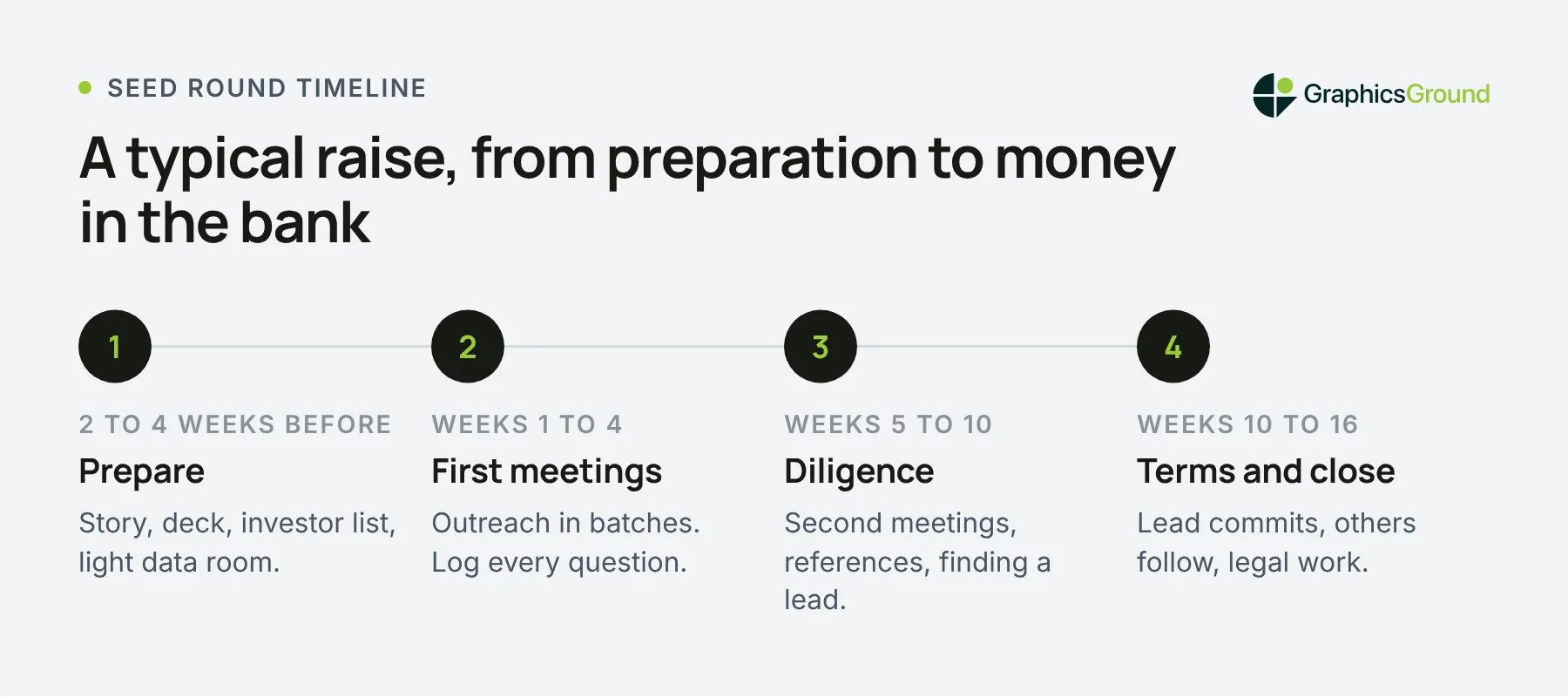
Before you start: two to four weeks of preparation
- Settle the story: what you do, the proof, the ask.
- Build the deck in the version that can be read alone, plus a one-page summary.
- Research 30 to 50 investors who fit your stage, sector and check size. See how to build an investor list.
- Prepare a light data room. See our data room checklist.
- Write your outreach emails.
Founders who skip this phase do not save time. They spend it later, answering the same question forty times and rebuilding the deck in the middle of the raise.
Weeks 1 to 4: outreach and first meetings
- Start with a few lower-priority investors to practice.
- Send to your best-fit investors close together, so meetings land in the same two or three weeks.
- Log every question. Fix the slide when the same one comes up three times.
- Follow up within 24 hours of each meeting. See what to send after a pitch.
Weeks 5 to 10: second meetings and diligence
- Interested investors ask for the data room, references and a meeting with more of their team.
- You are looking for a lead: someone who will set the terms.
- Keep new conversations going. Do not stop outreach because two investors seem keen.
- Send your first monthly update to everyone who said “keep me posted”.
Weeks 10 to 16: terms and closing
- A lead commits and proposes terms.
- Other investors fill the rest of the round, usually faster once a lead is in.
- Lawyers prepare documents, investors sign, money arrives. The legal step commonly takes two to four weeks.
What makes a seed round faster
- A lead investor. In the DocSend study, rounds led by a firm closed about four weeks sooner than rounds made up of angels. One decision maker moves faster than fifteen.
- A deck that works without you. Investors forward decks to partners. If the deck explains itself, you skip a meeting.
- Meetings bunched together. Investors act when they know others are looking in the same weeks.
- A ready data room. Same-day answers keep momentum.
- Warm introductions. They shorten the time from first contact to first meeting.
- Clear traction. One strong number, improving month over month, answers most questions before they are asked.
What makes it slower
- Starting without a list. Writing to whoever comes to mind, one at a time.
- A deck built for the stage. It worked when you presented it and fails when emailed.
- No lead. Many interested investors, each waiting for someone else to go first.
- Raising around holidays. Late December and much of August are slow in many markets.
- Changing the story mid-raise. A new pitch every week resets every conversation.
- Running the company and the raise with no plan for either. Fundraising takes a large share of a founder’s week for three months.
How to plan around a three-month raise
The practical consequence is about cash and attention.
- Start with runway. If the raise takes four or five months from first preparation to money in the bank, starting with three months of cash puts you in a weak position. Six months or more is a safer margin.
- Decide who runs the company. If you have a co-founder, split the work so one of you is mostly on the raise.
- Set a weekly review. Once a week, look at who replied, what they asked and what to change. Small corrections every week beat one big rethink in month three.
That weekly review is why our raise support runs for 90 days. Three months is the length of a typical active raise, so we built the support to cover it: 12 weekly calls, a researched investor list, outreach templates, and three rounds of deck revisions as real feedback comes in. The first 30 days are the most important, which is why we wrote the 30-Day Fundraising Checklist.
Nobody can promise a timeline. A raise depends on your traction, your market and the investors’ own calendars. What you can control is preparation, a well-chosen list, and how fast you respond.
Frequently asked questions
How long does a pre-seed round take?
Often a little less than a seed round, because checks are smaller and many come from angels who decide alone. It varies widely. Plan for two to three months of active raising.
How many investors do I need to meet?
The DocSend study found about 40 meetings for an average seed round. Buffer’s founders reported around 50 meetings to close with 18 investors.
When should I start fundraising?
When you have at least six months of runway and a clear milestone to point to. Starting from a position of urgency makes every conversation harder.
Can a seed round close in a month?
Yes. In the study, 15% closed within five weeks. Those tend to be founders with strong traction, an existing relationship with a lead, or both.
What if my raise is taking longer than four months?
Stop and diagnose before sending more emails. The cause is usually the list, the email, the deck or timing. See why investors are not responding to your pitch deck.
Planning a raise? The 30-Day Fundraising Checklist is a free week-by-week plan for the first month. If you want someone alongside you for the full three months, see Investor Deck + 90 Days of Raise Support.
What to prepare, send, and track in your first 30 days of raising. Free.
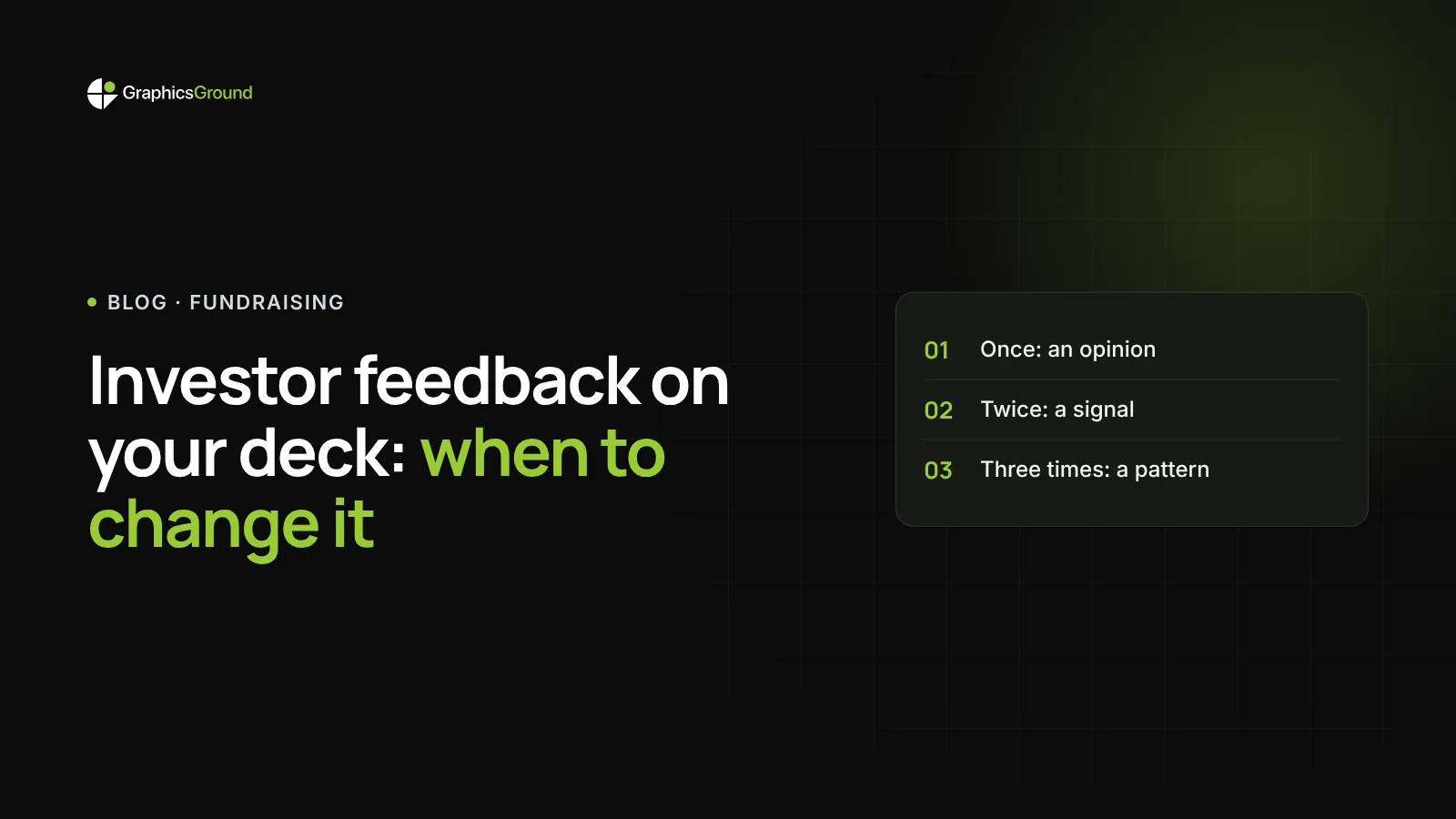
Investor Feedback on Your Pitch Deck: When to Change It
One investor’s comment is an opinion. The same comment from three is a pattern. Here is how to log investor feedback, read it, and decide what to change.
Read the article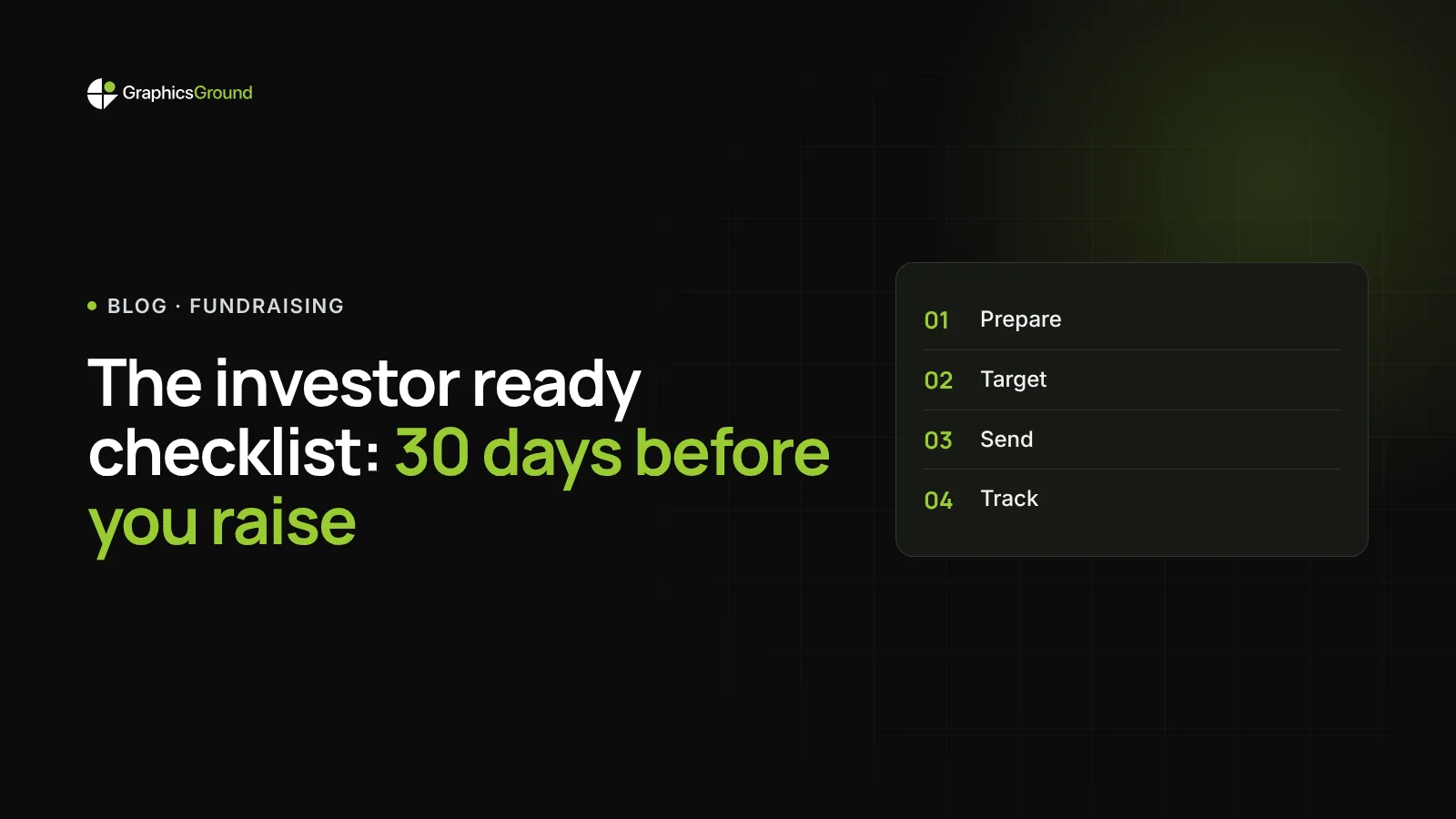
Investor Ready Checklist: 30 Days Before You Raise
Being investor ready means you can answer “send me more” within the hour. Use this four-week checklist to prepare, target, send and track before you raise.
Read the article